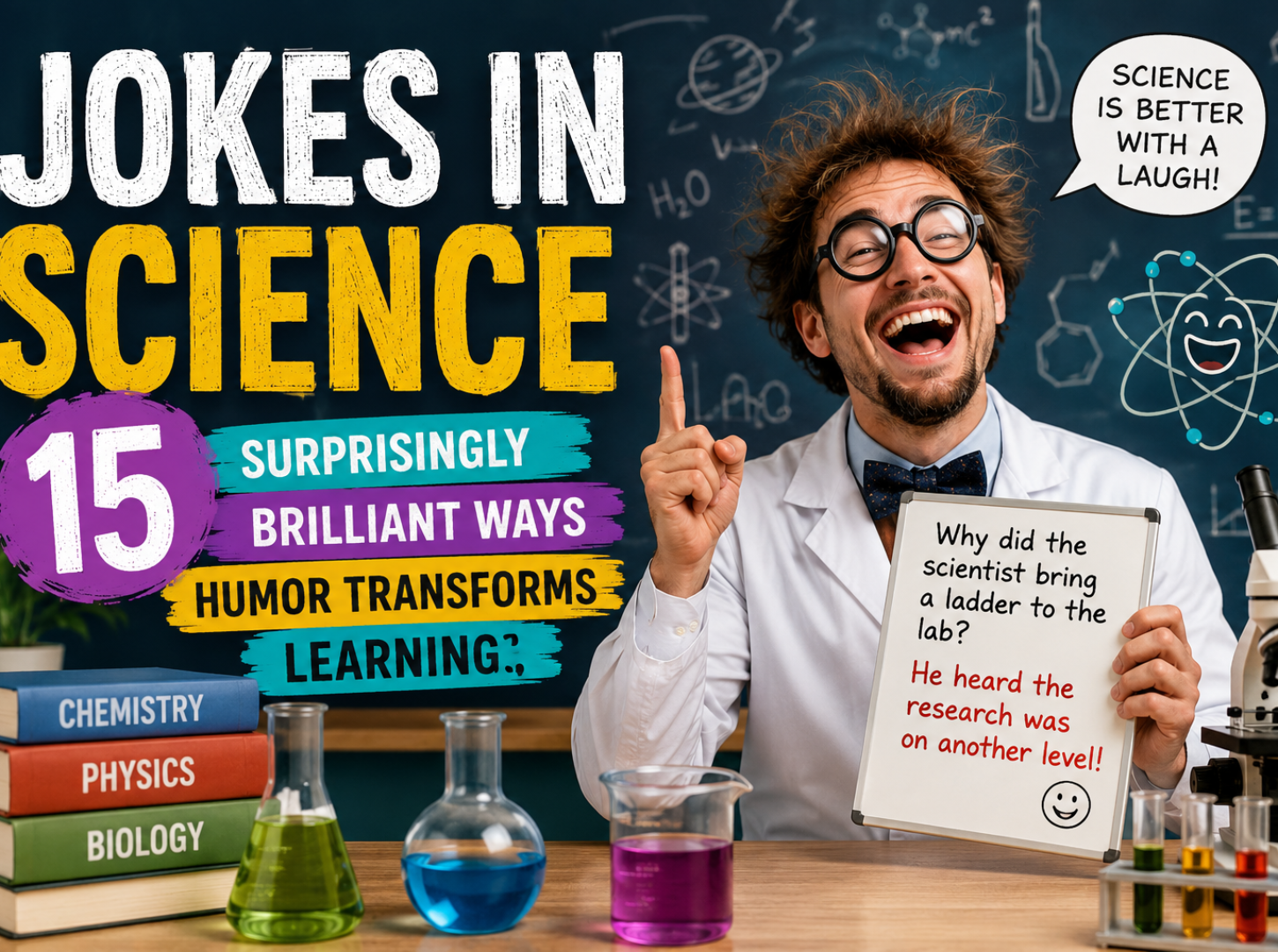
Why Laughter Matters Scientifically
Jokes in science might seem like an unlikely pairing at first glance, but the relationship between humor and scientific learning runs surprisingly deep. When a teacher cracks a well-timed joke about Newton’s apple or throws in a pun about mitochondria, something interesting happens in the brain. Students lean forward instead of zoning out. The information suddenly feels less intimidating, more human, and far more memorable than it did three seconds before the punchline landed.
Research consistently shows that laughter triggers dopamine release, which directly supports memory consolidation and motivation. This is not just a feel-good observation. It is a neurological reality. Scientists who study learning environments have found that classrooms where humor is used strategically produce students who retain information longer and engage with material more willingly. That alone should make every educator take jokes in science far more seriously than most currently do.
Humor Builds Genuine Classroom Connection
One of the most underappreciated benefits of jokes in science is what they do to the relationship between teacher and student. A professor who never smiles, never laughs, and treats every lecture like a funeral creates distance. Students feel like outsiders peering into a world that was not built for them. But a single well-placed joke changes the atmosphere completely. It signals that this person is human, approachable, and genuinely enjoys what they are teaching.
That sense of connection matters enormously in science education specifically. Many students walk into chemistry or physics with a deeply held belief that they are simply not science people. They have already decided the subject is too hard, too dry, or too abstract for someone like them. Jokes in science gently dismantle that wall. When the material becomes something to laugh about, it also becomes something to engage with rather than something to survive.
Comic Relief Reduces Learning Anxiety
Science anxiety is a well-documented phenomenon that affects millions of students worldwide. The pressure of understanding complex equations, memorizing the periodic table, or grasping quantum mechanics creates genuine stress that interferes with learning. Jokes in science act as a pressure valve. They momentarily release tension and remind students that confusion is normal, mistakes are human, and even experts get things wrong sometimes.
If you are looking for more ways educators manage complex academic environments with creativity and structure, this guide on Innova School’s innovative education system offers fascinating insight into how forward-thinking institutions approach student engagement at scale.
There is also something psychologically grounding about laughing at the subject you fear. When a biology teacher jokes that the endoplasmic reticulum sounds like a villain in a low-budget film, students laugh, repeat the name, and suddenly it sticks. The fear does not disappear entirely, but it shrinks enough to let curiosity take the driver’s seat. That shift in emotional state is precisely where real learning begins.
Famous Scientists Who Loved Humor
The popular image of scientists as humorless, socially awkward geniuses locked in sterile laboratories has always been more myth than reality. History is packed with brilliant minds who understood that jokes in science are not distractions from serious thinking but expressions of it. Richard Feynman, one of the greatest physicists of the twentieth century, was famously known for his irreverent wit, his love of pranks, and his ability to explain impossibly complex ideas through playful storytelling.
Albert Einstein, whose name has become almost synonymous with serious intellectual labor, was also a deeply funny man. He made jokes about relativity that turned abstract physics into something dinner-party guests could laugh about without fully understanding. Carl Sagan used gentle humor throughout his writing and television work to make the vastness of the cosmos feel like an invitation rather than an existential threat. These figures understood instinctively what modern neuroscience now confirms about jokes in science.
Puns And Wordplay Teach Terminology
Scientific vocabulary is one of the biggest barriers students face when trying to understand new material. Words like photosynthesis, nucleotide, thermodynamics, and electromagnetic radiation can feel like a foreign language that no one bothered to translate. This is where jokes in science, particularly puns and wordplay, become genuinely useful teaching tools rather than mere entertainment.
A chemistry teacher who says “I told a joke about noble gases once, but there was no reaction” is doing something clever. The student laughs, remembers the term noble gases, and associates it with the property of being unreactive. The joke has encoded information in a format the brain finds easy to retrieve. Word association and emotional response are two of the most powerful memory tools available to any learner, and a good pun delivers both simultaneously.
Science puns work because they demand that students understand the double meaning. You cannot laugh at the joke unless you get the reference. This means every successful science pun is also a tiny comprehension check. When the class laughs, the teacher knows the concept landed. When someone looks confused, that is equally useful information. Jokes in science, used this way, transform passive listening into active cognitive processing.
Humor Works Across Scientific Disciplines
Some educators worry that humor is easier to incorporate in some sciences than others. Biology gets the animal jokes, chemistry gets the element puns, but what about geology or astrophysics? The truth is that jokes in science work beautifully across every discipline when the person using them understands the material well enough to find its comic potential. Geology has an entire culture of rock-related puns that geologists trade at conferences with obvious delight. Astrophysics offers endless material about black holes, dark matter, and the sheer indifference of the universe.
Physics teachers have been making jokes about Schrödinger’s cat for decades because the thought experiment is genuinely absurd and invites playful interpretation. Mathematics, often considered the most humorless of disciplines, has a rich tradition of jokes that hinge on logical paradoxes and infinite series. The fact that a joke can be told at all about a topic means the topic has been understood well enough to be played with. Jokes in science therefore signal mastery as much as they signal personality.
Even the most abstract fields find their comic footing when given enough time and the right voice. Neuroscientists joke about forgetting things. Evolutionary biologists joke about natural selection in traffic. Climate scientists, facing perhaps the most serious subject imaginable, still find moments of dark humor that help them process the emotional weight of their work. Humor is not a retreat from seriousness. It is a different way of being serious, and jokes in science prove that point repeatedly.
The Neuroscience Behind Funny Learning
Understanding why jokes in science work so well requires a brief detour into the brain itself. According to research published through institutions like the Association for Psychological Science, humor activates the brain’s reward circuitry in ways that overlap significantly with learning and memory systems. When something is funny, the prefrontal cortex, the limbic system, and the nucleus accumbens all light up together. That simultaneous activation creates a richer, more interconnected memory trace than standard instruction alone.
According to research supported by the American Psychological Association, humor in educational settings has been linked to improved student performance, higher engagement levels, and stronger teacher-student relationships across multiple age groups and academic disciplines. This is not anecdotal. These findings come from controlled studies with measurable outcomes. The science of why jokes in science work is itself a legitimate area of academic inquiry.
What makes this particularly interesting is that the effect is not limited to funny teachers or naturally charismatic communicators. Even simple, slightly cheesy jokes produce measurable spikes in attention and retention when used at the right moment. The bar for humor in a classroom is not stand-up comedy. It is relevance, timing, and a willingness to not take yourself too seriously. Any educator with those three qualities can harness the neuroscience behind jokes in science without needing to be naturally funny.
Writing Humor Into Science Communication
Science communication beyond the classroom has also discovered the power of jokes in science. Podcasts, YouTube channels, science blogs, and social media accounts built around scientific content have found that mixing genuine information with humor dramatically increases reach and audience retention. Shows like Mythbusters and channels like Kurzgesagt built massive audiences partly by treating science as something worth laughing about and being amazed by in equal measure.
Science writers who can be funny while remaining accurate occupy a rare and valuable niche. They translate dense research into language that does not condescend but also does not bore. The joke becomes a doorway. The reader enters laughing and exits having learned something they did not know before. This is exactly what the best science communicators have always done, from Isaac Asimov to Mary Roach, whose books about the human body and death combine rigorous research with genuine comedy that makes the material completely irresistible.
The challenge for science writers is ensuring that the humor never undermines the accuracy. A joke that distorts a scientific concept for the sake of a better punchline does more harm than good. The best jokes in science are accurate first and funny second. They find the comedy that already exists within the true version of the story rather than inventing a funnier but less truthful alternative. That discipline is what separates good science communication from viral misinformation dressed up in wit.
Inclusive Humor In Diverse Classrooms
Not all humor lands the same way in every room, and science educators need to think carefully about what kinds of jokes in science actually serve their students well. Humor that excludes, demeans, or makes certain students feel like the butt of the joke is not just unfunny. It is actively harmful and contradicts the entire purpose of using humor to lower barriers. Inclusive humor punches at ideas and situations, never at people or identities.
The best jokes in science are ones that virtually anyone in the room can access regardless of cultural background, language proficiency, or prior knowledge of the subject. Self-deprecating humor from the teacher works particularly well because it levels the hierarchy without targeting anyone in the class. A professor who laughs at their own past mistakes or admits that they still find certain concepts genuinely confusing creates a permission structure that helps students feel safe enough to ask questions and make mistakes of their own.
Diversity in science classrooms also means thinking about which scientists are referenced in the jokes and examples used. Humor built exclusively around European male scientists reinforces the idea that science belongs to a particular type of person. Jokes in science can actively work against this by celebrating a broader range of scientific figures and drawing examples from a wider geography of discovery. Inclusive humor is not just morally better. It is also more interesting, more surprising, and ultimately funnier.
Jokes Help Explain Abstract Concepts
Some scientific concepts are so abstract that even the most precise technical explanation leaves students more confused than enlightened. Dark energy, quantum entanglement, the concept of infinity, and the behavior of subatomic particles all challenge human intuition in ways that straightforward description cannot always resolve. This is precisely where jokes in science find their most powerful application. A joke that makes an abstract concept feel tangible, even momentarily, can unlock understanding in a way that ten minutes of earnest explanation cannot.
The classic joke about Schrödinger’s cat works not just because it is funny but because it illustrates a genuinely strange quantum phenomenon through a relatable, slightly absurd scenario. Students who cannot explain wave function collapse can often explain why the cat is both alive and dead, and that partial understanding is a legitimate starting point for deeper learning. Jokes in science serve as conceptual scaffolding that students can cling to while they build more sophisticated understanding.
Analogies and jokes share this function. Both take something unfamiliar and map it onto something already known. The difference is that a joke adds an emotional charge that makes the mapping more durable. When a student laughs at the explanation, they are not just acknowledging the comparison. They are experiencing the surprise of recognition, which is one of the most reliable triggers for lasting memory formation. Used this way, jokes in science are genuine pedagogical tools with measurable cognitive value.
Humor In Science Exams And Assessment
The relationship between jokes in science and formal assessment is more nuanced than it might appear. Some educators worry that using humor in teaching creates a casual atmosphere that students cannot shift out of when serious evaluation arrives. The evidence suggests the opposite is closer to the truth. Students who have learned material through engaging, humor-rich instruction tend to perform better on assessments because the material is more deeply encoded and easier to retrieve under pressure.
Some educators have even experimented with including light humor in exam questions themselves, not to confuse students but to reduce the anxiety that often impairs performance. A test question that includes a gentle joke or a playful scenario creates a momentary emotional release that can help students access their knowledge more freely. This does not mean turning exams into comedy shows. It means recognizing that jokes in science can serve students even in high-stakes moments when anxiety is most likely to interfere with performance.
The key distinction is between humor that distracts and humor that grounds. A confusing pun in an exam question wastes precious time and creates frustration rather than relief. But a familiar reference, a mildly amusing scenario, or a question framed with a light touch signals to the student that the person who wrote this exam also understands that learning is a human activity. That small signal of humanity can make a meaningful difference in how students approach the work in front of them.
Student Created Jokes Deepen Understanding
There is a significant difference between receiving a joke and creating one, and that difference matters enormously in educational contexts. When students are asked to write their own jokes in science, they must understand the material well enough to find its comic potential. This is a genuinely high-order cognitive task that requires comprehension, analysis, and creative synthesis working simultaneously. It is also far more enjoyable than writing a standard summary.
Having students create science jokes as a review activity produces surprisingly strong results. Students who must explain why their joke is funny are demonstrating their understanding of the underlying concept in a way that a multiple-choice answer cannot capture. A student who writes a decent pun about osmosis clearly understands osmosis. The joke is the evidence. Jokes in science created by students also tend to be shared, which means the learning spreads beyond the individual who did the creating.
This approach works particularly well at the end of a unit when students have enough foundational knowledge to play with it creatively. It can also serve as a powerful diagnostic tool for teachers who want to understand which concepts students have genuinely internalized versus which ones they have merely memorized. A student who can make a joke about something understands it at a different level than a student who can only recite a definition. Jokes in science, when generated by learners themselves, reveal the depth of comprehension in a way few other tasks can match.
Science Stand Up Comedy Movement
A genuinely surprising cultural development of the past two decades is the emergence of science stand-up comedy as a legitimate performance genre with dedicated audiences. Events like Bright Club, which originated in the United Kingdom, invite researchers and academics to perform stand-up comedy based on their actual work. The results are often remarkable. Scientists who have spent years communicating in the restricted language of academic journals discover that jokes in science can reach audiences that peer-reviewed papers never will.
These events serve a dual purpose. For scientists, performing comedy about their work forces a kind of clarity and distillation that academic writing rarely demands. If the audience does not understand the setup, the punchline falls flat, which means the comedian has failed to communicate. For audiences, science stand-up offers a way into complex research that does not require a graduate degree. A ten-minute comedy set about the mating habits of deep-sea creatures is more likely to inspire genuine curiosity than the same information presented as a literature review.
The growth of science comedy also reflects a broader cultural shift in how expertise is communicated and received. Audiences increasingly distrust institutions and formal authority while remaining deeply curious about how the world works. Jokes in science meet that curiosity where it lives, in informal spaces, social media, live performance venues, and casual conversation. Scientists who can be funny without being inaccurate become ambassadors for their fields in ways that no press release or journal abstract can replicate.
Humor As A Teaching Philosophy
Some of the most effective science educators treat humor not as an occasional tool but as a foundational teaching philosophy. For these teachers, jokes in science are not interruptions to the serious business of instruction. They are expressions of what good instruction looks like. Learning is a fundamentally human activity, and humans communicate through stories, metaphors, laughter, and play as much as they communicate through facts and logical argument. A teaching philosophy that excludes humor is a philosophy that excludes part of what makes us human.
This does not mean every lesson needs to be a comedy performance. It means approaching material with the kind of intellectual playfulness that good scientists actually demonstrate in their work. The best researchers are often deeply curious, frequently surprised by their own findings, and willing to follow an idea wherever it leads even if it leads somewhere unexpected and a little absurd. Modeling that attitude in a classroom is itself a form of humor, even when no explicit joke is being told.
Teachers who embrace jokes in science as a philosophy rather than a technique tend to create classroom cultures that are more psychologically safe, more intellectually adventurous, and more genuinely enjoyable. Students in these environments learn that it is acceptable to be wrong, acceptable to be confused, and acceptable to find the whole enterprise of understanding the universe both deeply serious and occasionally hilarious. That balance is not just good for learning. It is good for producing the kind of curious, resilient thinkers that science actually needs.
Cultural Differences Shape Science Humor
Humor is culturally embedded in ways that science educators working in diverse environments need to understand. What counts as funny varies significantly across cultures, and jokes in science are not exempt from this variation. A pun that works beautifully in English may be completely opaque when translated into another language. A joke that plays on one cultural assumption about scientists may reinforce a stereotype that feels exclusionary to students from a different background.
This does not mean abandoning humor in multicultural classrooms. It means being thoughtful about which jokes land universally and which depend on specific cultural references. Physical comedy, timing, absurdist scenarios, and universal human experiences like confusion, surprise, and the satisfaction of sudden understanding tend to work across cultural boundaries more reliably than verbal puns or references to specific cultural figures. Jokes in science built around the strangeness of the universe itself, rather than the quirks of any particular culture, have the widest possible reach.
Cultural differences also offer opportunities rather than just obstacles. A classroom with students from multiple countries and backgrounds has access to a much wider range of scientific traditions, folk knowledge, and ways of thinking about the natural world. Drawing humor from that diversity, celebrating the different ways various cultures have engaged with scientific questions, creates jokes in science that enrich rather than exclude. The best humor in these environments is curious about difference rather than anxious about it.
Long Term Benefits Of Science Humor
The long-term benefits of incorporating jokes in science extend well beyond individual lessons or units. Students who associate science with positive emotional experiences are significantly more likely to pursue scientific subjects voluntarily, to read science for pleasure, to trust scientific institutions, and to apply scientific thinking to everyday decisions. Given that scientific literacy is one of the most important outcomes any education system can produce, the emotional associations formed during science education matter enormously.
Humor creates positive associations. When a student remembers a biology class because of the genuinely funny story their teacher told about fruit flies and genetics, that memory carries an emotional valence that makes the subject feel welcoming rather than forbidding. Every future encounter with genetics benefits from that foundation. Jokes in science, accumulated over a full educational career, contribute to a durable positive relationship with scientific thinking that no single lesson could establish on its own.
There is also something important about what humor communicates about the nature of science itself. Science is often presented as a collection of established facts waiting to be memorized and regurgitated. Humor reveals it as something messier, more human, more surprising, and more alive than that image suggests. A student who has laughed at the failures, the unexpected discoveries, and the genuine weirdness of scientific history understands science as a process rather than a product. That understanding is the deepest gift that jokes in science can give.
FAQs About Science Humor
What are jokes in science and why do they matter in education?
Jokes in science are humorous observations, puns, or stories connected to scientific concepts or the culture of science. They matter because they reduce anxiety, improve memory retention, and make complex material more accessible to a wider range of learners.
Can jokes in science actually improve student performance on tests?
Yes. Research in educational psychology supports the idea that humor-rich learning environments produce better retention and recall. Students who learn through engaging, emotionally resonant instruction access their knowledge more easily under pressure.
How can teachers use jokes in science without losing credibility?
By ensuring the humor is accurate, inclusive, and clearly connected to the material. Self-deprecating humor and jokes that celebrate the strangeness of scientific discovery tend to build credibility rather than undermine it.
Are jokes in science appropriate for all age groups?
Absolutely, though the style and complexity of humor should match the developmental stage of the audience. Young children respond to physical humor and simple wordplay, while older students appreciate more conceptually sophisticated jokes that require genuine understanding of the material.
Where can I find good jokes in science to use in my classroom?
Science joke collections exist across books, websites, and academic publications focused on science communication. The best approach is to develop your own based on your specific material, as original, context-specific humor almost always lands better than borrowed jokes.
Conclusion
Jokes in science represent far more than a lighthearted distraction from serious learning. They are a neurologically grounded, pedagogically valid, and culturally significant way of making science accessible, memorable, and genuinely enjoyable. From reducing anxiety to encoding vocabulary, from building teacher-student relationships to communicating research to public audiences, humor serves science education at every level and in every context. The evidence is clear, the practice is ancient, and the benefits are measurable. Every educator who dismisses jokes in science as frivolous is leaving one of their most powerful teaching tools unused. Laughter and learning have always belonged together, and in science classrooms around the world, the best teachers have always known it. Embrace the pun, welcome the absurdity, and trust that when students laugh, they are also learning something they will carry with them long after the lesson ends.