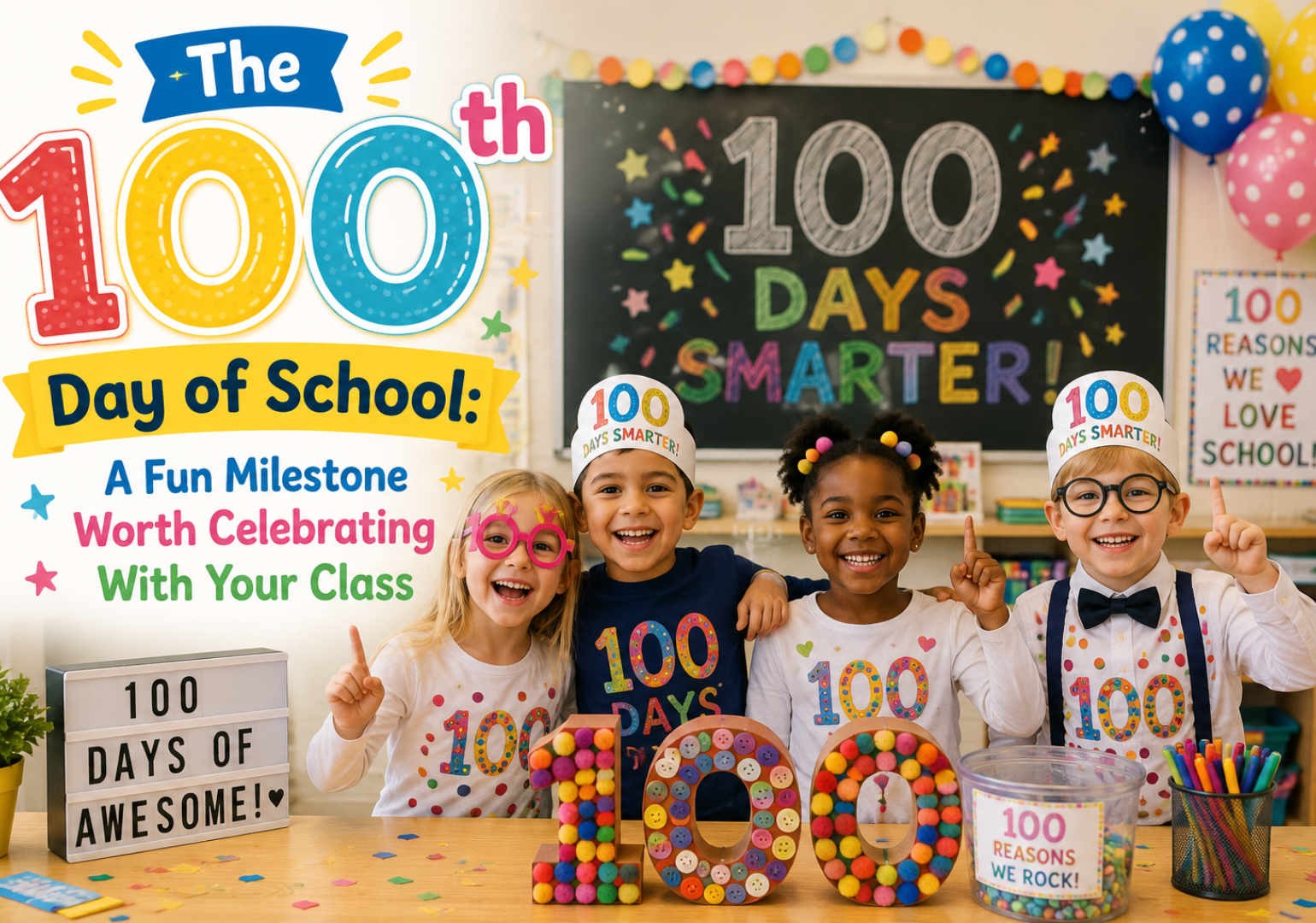
Wondering how to make the 100th day of school memorable for your students or your own kids? Here’s a complete guide with history, activities, and ideas teachers genuinely love using.
There’s something about hitting a round number that just feels good. Birthdays, anniversaries, even fitness goals — once you cross into the hundreds, it feels like an accomplishment worth marking. For young students, the 100th day of school is exactly that kind of moment. It sneaks up every January or February, and suddenly hallways are filled with paper hats, counting jars, and kids buzzing with excitement over a number they’re only just learning to grasp.
This guide covers everything worth knowing about the 100th day of school — where it came from, why it matters, and the best activities teachers and parents can pull off without weeks of prep. Pour yourself a cup of chai, and let’s get into it.
Why 100th Day Of School Matters
For kindergartners and first graders, the number 100 feels enormous. Most of these kids are still getting comfortable counting to twenty or thirty, so reaching one hundred days of school feels like a genuine milestone worth celebrating. The 100th day of school gives teachers a built-in reason to pause and reflect on how far the class has come since day one.
There’s also a psychological piece here. Kids respond well to milestones because they make abstract time feel real. A child can’t really picture what “one hundred days” means in theory, but when they count out one hundred items on a table, or clap one hundred times out loud, the number suddenly clicks. That’s the quiet power behind the 100th day of school as a teaching tool.
Teachers often mention a noticeable energy shift on this day. Students who normally drag their feet show up early, sometimes even before the morning bell. That kind of enthusiasm is hard to fake on a regular Tuesday, so smart educators lean into it fully.
History Of This School Tradition
The 100th day of school as a formal classroom celebration started gaining popularity in American schools back in the early 1990s, pushed mostly by early childhood education advocates looking for fun ways to reinforce number sense. Before that, counting school days was a quiet ritual — maybe a number written on a calendar corner or a tally chart near the door.
Once teachers began experimenting with themed activities around this day, the idea spread fast through teacher networks and shared resources. Schools that focus on hands-on, milestone-based learning often build entire units around moments like this. If you’re curious how progressive learning systems structure their year, this innovative education systems guide breaks down how creative schools turn ordinary calendar dates into teaching opportunities.
By the early 2000s, the 100th day of school had become a near-universal tradition in elementary schools across the United States, and it slowly spread to international schools as well. What started as a small classroom experiment turned into one of the most anticipated days of the school year for many young students.
100th Day Of School Decorations
Walk into any kindergarten classroom on this day and you’ll likely see balloons, banners, and paper chains made of exactly one hundred links. Decorations don’t need to be expensive or elaborate — the goal is simply to make the number 100 visible everywhere a child looks. Some teachers cover bulletin boards with one hundred stickers, while others create a “100 Days Smarter” banner using student handprints.
Door decorations are another classroom favorite. A simple poster with the number 100 surrounded by drawings, photos, or fingerprints gives kids a sense of ownership over the celebration. Many teachers also set up a “100 Wall” where students contribute one item each, building toward the total as a group project over several weeks.
What makes these decorations effective isn’t how fancy they look. It’s that kids participate in making them. When a child glues their own sticker onto a poster that says “100,” they internalize the number in a way that worksheets simply can’t replicate.
Fun Counting Activities For Kids
Counting activities are the heart of any 100th day of school celebration. The most popular one is probably the “100 objects” challenge, where students bring in a bag containing exactly one hundred small items — buttons, cereal pieces, beads, or even pasta shapes. Kids then sort, group, and count their items in different ways, which quietly reinforces skip counting by twos, fives, and tens.
Another classic activity involves building structures using one hundred blocks or cups. Students work in pairs or small groups to stack, arrange, or design something creative, all while keeping track of the count. This combines fine motor skills with math practice, and honestly, kids rarely realize they’re “doing math” at all.
Some teachers also organize a “100-second challenge,” where students guess how many times they can do something — jumping jacks, claps, or even blinks — within one hundred seconds. The anticipation alone gets the whole class engaged, and the results often surprise everyone, including the teacher.
100th Day Of School Costumes
Dressing up is one of the most fun parts of the 100th day of school, especially for younger students. A popular idea is dressing as a “100-year-old,” where kids wear glasses without lenses, use canes, and style their hair with white powder or hairspray to look gray. It’s silly, harmless fun, and the photos usually end up being classroom favorites for years.
Another costume idea involves wearing shirts covered in exactly one hundred stickers, stamps, or small drawings. This requires a bit of prep at home, but it doubles as a counting activity since kids often count their stickers out loud while attaching them. Parents tend to enjoy this one too, since it becomes a small bonding activity the night before.
Some classrooms skip costumes altogether and instead focus on themed clothing, like wearing something with the number 100 printed somewhere, or wearing a specific color tied to the celebration. Either way, the goal stays the same — making the day visually memorable for kids who might not remember much else from that week.
Tasty Snack Ideas For Celebration
Food-based activities are always a hit, and the 100th day of school is no exception. A common favorite is the “100-snack mix,” where each student contributes a handful of a specific snack — pretzels, cereal, crackers, or dried fruit — and the class combines everything into one giant bowl containing roughly one hundred pieces per serving.
Counting snacks before eating them adds an extra layer of fun. Kids might count out ten groups of ten crackers, reinforcing place value in a way that feels more like a game than a lesson. Some teachers even turn this into a graphing activity, asking students to predict which snack will be most popular before counting the final tally.
For classrooms with food allergies or dietary restrictions, non-food alternatives work just as well. Counting out one hundred cotton balls, buttons, or beads achieves the same educational goal without any safety concerns, and kids still enjoy the hands-on sorting and counting process.
100th Day Of School Math
Math is naturally at the center of the 100th day of school, and teachers use this day to introduce or reinforce several key concepts. According to data from the National Center for Education Statistics, strong early number sense in kindergarten and first grade is closely linked to later math achievement, which makes activities tied to milestones like this genuinely valuable beyond just being fun.
One popular activity involves a “100 chart,” where students fill in missing numbers, color specific patterns, or identify multiples. This simple grid becomes a tool for teaching skip counting, odd and even numbers, and even basic addition and subtraction within one hundred.
Word problems themed around the number 100 also show up frequently. Questions like “If you have 100 candies and share them equally among 4 friends, how many does each person get?” feel more exciting when tied to a special day, and students often engage with these problems more willingly than they would on a regular worksheet.
Creative Writing Prompts For Day
Writing activities tied to the 100th day of school give students a chance to reflect and express themselves. A common prompt asks kids to write about what they would do with one hundred dollars, one hundred wishes, or one hundred of their favorite item. These prompts spark surprisingly creative and sometimes hilarious responses.
Another favorite is the “100 words about me” activity, where older students write a short paragraph using exactly one hundred words to describe themselves, their goals, or their favorite memories from the school year so far. This combines writing practice with self-reflection, and many teachers keep these写 — sorry, keep these written pieces as keepsakes for end-of-year portfolios.
For younger students who aren’t writing full sentences yet, simple fill-in-the-blank prompts work well. Sentences like “If I had 100 ___, I would ___” let kids practice vocabulary while still participating in the celebration alongside older classmates.
Science Experiments Using Number 100
Science teachers often find creative ways to weave the number 100 into experiments around this time of year. One popular activity involves measuring how far an object travels after one hundred seconds, or observing changes after one hundred minutes — turning the celebration into a lesson on time and measurement.
Plant growth experiments also work well here. Some classrooms plant seeds at the start of the school year and track growth over one hundred days, measuring height, counting leaves, or recording observations in a simple journal. By the time the 100th day of school arrives, students have real data to analyze and discuss.
Simple chemistry-adjacent activities, like mixing exactly one hundred drops of water with food coloring to observe dilution, also tie nicely into the theme. These experiments don’t need expensive equipment — just a bit of planning and a willingness to let kids get a little messy in the name of learning.
100th Day Of School Online
Remote and hybrid classrooms don’t have to skip out on celebrating the 100th day of school. Virtual counting activities work surprisingly well over video calls, where students hold up items to the camera and the class counts together as a group. It’s a small thing, but it brings back some of the shared excitement that’s often missing from online learning.
Digital tools also open up new possibilities. Interactive number charts, virtual stickers, and online counting games let students participate from home while still engaging with the same concepts as their in-person peers. Some teachers create digital slideshows where each student contributes one slide, building toward a class total of one hundred contributions.
Parent involvement becomes especially important in virtual settings. A quick message home asking families to help their child count one hundred household items can turn into a fun shared activity, and many parents appreciate having a simple, low-pressure way to support classroom learning from home.
Parents And Home Celebration Ideas
Families don’t need a classroom to join in on the 100th day of school fun. At home, parents can set up simple counting challenges, like counting one hundred steps during a walk, or counting one hundred seconds of a favorite song. These small activities reinforce what’s happening at school without feeling like extra homework.
Cooking together offers another opportunity. Counting out one hundred chocolate chips for cookies, or one hundred grapes for a snack plate, turns a regular kitchen task into a math lesson. Kids tend to remember these moments far better than anything written on a worksheet, mostly because they’re having fun without realizing they’re learning.
For families who want to go a step further, keeping a simple journal of “100 things I’m grateful for” or “100 things I want to learn” can become a meaningful keepsake. It doesn’t have to be completed in one sitting — spreading it across a week makes it manageable for younger kids while still tying back to the milestone.
Best Books For This Milestone
Reading books themed around the number 100 adds a nice literacy component to the celebration. Picture books that focus on counting, patterns, or milestones help younger students connect language skills with the math concepts they’re practicing throughout the day.
Many school libraries set up special displays during this time, making it easy for students to pick out books that fit the theme. Teachers sometimes read one book aloud as a class activity, then follow up with a related counting or writing exercise tied to the story.
For older students, books about historical events that happened around one hundred years ago can spark interesting discussions. Comparing life “100 years ago” to life today gives students a chance to think critically while still connecting back to the day’s central theme.
Mistakes Teachers Often Make
One common mistake is overplanning. Teachers sometimes try to cram too many activities into a single day, leaving both students and staff exhausted by the afternoon. The 100th day of school works best when a handful of activities are done well, rather than rushing through ten different stations.
Another mistake involves forgetting accessibility. Activities that require students to bring items from home can unintentionally leave out kids whose families can’t easily provide one hundred small objects. Having classroom supplies ready as a backup ensures every student feels included, regardless of their situation at home.
Lastly, some teachers treat this day purely as “fun” without tying it back to learning goals. While celebration matters, the most effective classrooms use this day as a checkpoint — a chance to review concepts taught so far and set goals for the second half of the school year.
Long Term Benefits For Students
Beyond the immediate fun, the 100th day of school offers long-term benefits that often go unnoticed. Students who engage with number-based celebrations early on tend to develop a more positive relationship with math overall. They associate numbers with creativity and play, rather than just tests and pressure.
This day also builds classroom community. Group activities, shared snacks, and collaborative projects give students a chance to work together outside their usual routines. For many kids, this is one of the few days where the entire class works toward a single shared goal, and that sense of teamwork carries forward in subtle ways.
There’s also a confidence boost worth mentioning. Kids who participate in counting, sorting, and presenting their “100” projects often feel a sense of pride that extends beyond the classroom. Parents frequently report that children talk about this day for weeks afterward, which says something about how impactful it really is.
100th Day Of School Grades
While the 100th day of school is most commonly celebrated in kindergarten through second grade, older students can benefit too. Upper elementary classrooms sometimes use this milestone to introduce more advanced concepts, like percentages, ratios, or basic statistics, all framed around the number 100.
Middle school teachers occasionally use the day for reflection activities instead of pure celebration. Students might write about their academic goals for the remaining school year, or analyze their own progress using simple charts and graphs. This keeps the spirit of the milestone alive without feeling too “babyish” for older kids.
Even high school classrooms can find value here, particularly in subjects like statistics or economics, where the number 100 naturally ties into percentages and proportions. A teacher might use the day to introduce a unit on data analysis, framing it around the same milestone younger students are celebrating down the hall.
Common Questions About 100th Day
What is the purpose of the 100th day of school?
The main purpose is to celebrate a learning milestone while reinforcing number sense, counting skills, and classroom community in a fun, low-pressure way.
When does the 100th day of school usually fall?
It depends on the school calendar, but most schools reach this milestone sometime between late January and mid-February, depending on holidays and weather closures.
Do all grade levels celebrate this day?
Not always. It’s most common in kindergarten through second grade, though some upper elementary and middle school teachers adapt the concept for older students.
Can homeschool families celebrate the 100th day of school too?
Definitely. Many homeschool families track their own school days and celebrate this milestone with similar counting, snack, and writing activities at home.
Final Thoughts On This Milestone
At the end of the day, the 100th day of school isn’t really about the number itself. It’s about giving kids a reason to feel proud of how far they’ve come, and giving teachers a natural pause point in a long school year. Whether it’s through counting activities, costumes, snacks, or simple reflection writing, this day brings a little extra energy into classrooms that’s hard to replicate any other way.
What makes it work so well is how flexible it is. A kindergarten teacher with limited time can do something as simple as a counting jar, while a more ambitious classroom can turn it into a week-long theme involving math, science, writing, and art. There’s no single “right” way to celebrate, which honestly makes it more approachable for teachers who already feel stretched thin.
If there’s one takeaway here, it’s that small milestones matter more than we often give them credit for. The 100th day of school is proof that learning doesn’t always have to feel like work — sometimes it just needs a number, a little creativity, and a classroom full of excited kids ready to count their way to one hundred.