Why Reading Matters Now
Middle school is a transformative period in every young person’s life. Students are figuring out who they are, navigating friendships, and asking bigger questions about the world around them. Middle school books play a powerful role during this stage because they give students language for emotions they cannot yet articulate and perspectives far beyond their own neighborhoods. The right book at the right moment can shift a student’s entire relationship with learning.
Reading at this age is not just about vocabulary or comprehension scores. It is about connection. When a twelve-year-old opens a novel and sees a character wrestling with the same fears they carry into the cafeteria every morning, something clicks. That moment of recognition is what makes middle school books so uniquely important in a child’s development. Parents, teachers, and librarians all have a role in making sure young readers find those moments regularly.
Books Build Real Confidence
There is a reason educators consistently return to literature as one of their most reliable tools. Middle school books do something worksheets and textbooks simply cannot — they pull students into a story and keep them there. Sustained reading builds focus, patience, and the ability to sit with complexity, all skills that transfer directly into academic performance and personal maturity.
Students who read regularly in middle school tend to develop stronger writing instincts, larger vocabularies, and more nuanced critical thinking. But the benefits go well beyond academics. Reading fiction specifically has been shown to increase empathy because it requires readers to inhabit other minds. That is a life skill with no expiration date. Choosing the right middle school books for a student is genuinely one of the most impactful educational decisions a parent or teacher can make.
Classics Still Hold Ground
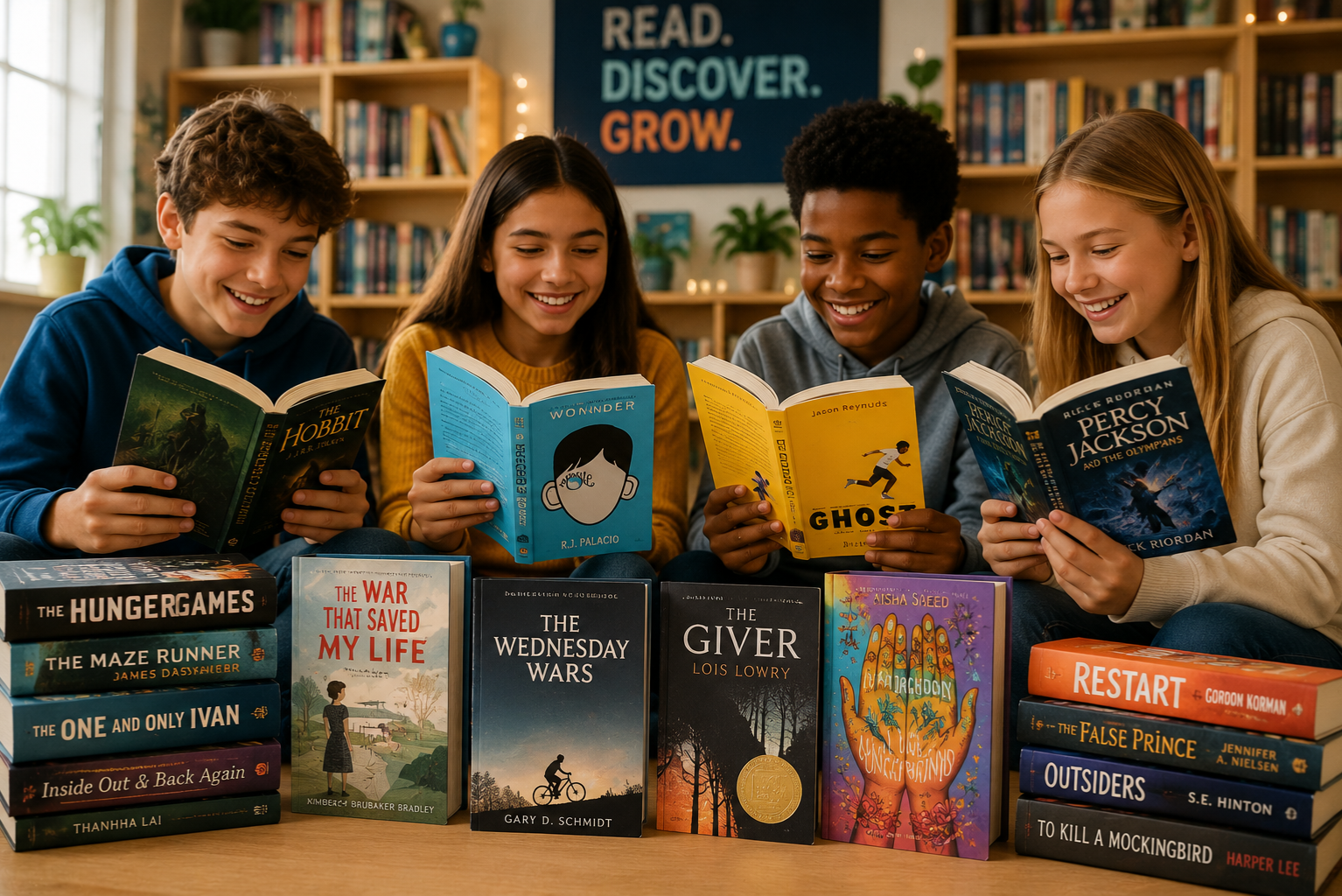
Some titles have survived decades of curriculum changes and generational shifts because they speak to something permanent in the human experience. Middle school books like The Giver by Lois Lowry and A Wrinkle in Time by Madeleine L’Engle continue to appear in classrooms not out of tradition alone, but because they work. They challenge students to think about justice, freedom, and the cost of conformity in ways that feel urgent rather than historical.
The Giver in particular remains one of the most taught middle school books in North America. It introduces concepts like dystopia, memory, and moral responsibility through a narrative that is both accessible and deeply unsettling in the best possible way. Students who read it rarely forget it. That staying power is the mark of a book genuinely worth the time. You can explore more about structured learning environments at Innova School complete guide.
Adventure Titles Ignite Passion
Not every student arrives at middle school already loving books. For reluctant readers, the entry point is almost always story momentum — a plot that does not wait around. Adventure-driven middle school books are often the gateway for students who have spent years believing reading is not for them. Once a reluctant reader finishes a book they genuinely could not put down, the entire category opens up.
Rick Riordan’s Percy Jackson and the Olympians series is the most obvious example, but it earns that reputation. The blend of Greek mythology with contemporary American life gives students both entertainment and a surprisingly rich cultural education. The protagonist’s dyslexia and ADHD are also handled in a way that reframes those traits as strengths rather than deficits, which resonates deeply with students who share similar experiences. Adventure titles like these consistently serve as the bridge between non-readers and lifelong readers.
Realistic Fiction Hits Differently
There is something uniquely powerful about realistic fiction for students in this age group. Unlike fantasy or science fiction, realistic middle school books hold up a mirror. The characters attend schools that look familiar, argue with parents in recognizable ways, and face social dynamics that students are actively living through. That proximity to real life is what makes the emotional impact so immediate.
R.J. Palacio’s Wonder is perhaps the most celebrated realistic fiction title of the past decade for this age group. It follows a boy with a facial difference entering school for the first time, and it handles themes of kindness, courage, and belonging with remarkable emotional intelligence. Teachers frequently report that Wonder changes classroom culture when read together. Few middle school books generate that kind of community effect, and that alone makes it essential reading.
Historical Stories Expand Worldviews
History taught through narrative lands differently than history taught through textbooks. When students encounter the past through a character they care about, dates and events stop feeling abstract. Historical middle school books build empathy across time in a way that lectures rarely achieve. They also raise questions about justice and human behavior that students carry well beyond the final page.
Roll of Thunder, Hear My Cry by Mildred D. Taylor is one of the most important historical novels ever written for young readers. Set in 1930s Mississippi, it follows the Logan family navigating racism, economic hardship, and the fight for dignity with extraordinary clarity and emotional power. According to the American Library Association, books that engage students with social history are among the most effective tools for developing civic awareness in young people. For students ready to engage seriously with the world, historical middle school books like this one are indispensable.
Fantasy Worlds Spark Creativity
Fantasy is one of the most popular genres among middle school readers, and for good reason. It offers complete imaginative immersion while still exploring deeply human themes. The best fantasy middle school books use invented worlds to ask real questions about power, identity, loyalty, and sacrifice. Students often find it easier to engage with difficult ideas when they arrive wrapped in dragons and magic rather than direct confrontation.
Ursula K. Le Guin’s A Wizard of Earthsea is a fantasy novel that has stood the test of time precisely because its themes are so honest. The protagonist Ged’s greatest enemy turns out to be a shadow of himself — a metaphor for confronting your own darkness that works on every reading level. More recent series like The Inheritance Games by Jennifer Lynn Barnes bring puzzle-solving and family mystery into the mix, keeping contemporary readers completely hooked. Fantasy remains one of the most reliable paths into deep, sustained reading for this age group.
Graphic Novels Count Too
There is still a persistent misconception among some parents and educators that graphic novels are somehow lesser reading. That view is outdated and counterproductive. Graphic novels require a specific kind of visual and textual literacy that is genuinely sophisticated. For many students, graphic novels serve as the most comfortable and engaging entry point into independent reading, and the stories themselves are often just as rich as traditional prose.
Raina Telgemeier’s Smile and Drama are two of the most widely read middle school books in the graphic novel format. Both deal with relatable social and emotional experiences — dental trauma, theater friendships, crushes, and identity — with warmth and humor that students respond to immediately. Smile in particular has introduced thousands of reluctant readers to the habit of finishing a book in one sitting. That experience alone builds reading confidence in ways that are difficult to manufacture through any other format.
Science Fiction Opens Minds
Science fiction for middle schoolers is having a genuine moment. Publishers have recognized that this age group is hungry for stories that wrestle with technology, climate, artificial intelligence, and the future in honest ways. Middle school books in the science fiction genre give students frameworks for thinking about the world they are actually going to inherit, which makes the genre both entertaining and genuinely educational.
The City of Ember by Jeanne DuPrau is a standout in this space. Set in an underground city running out of resources, it follows two young protagonists trying to decode instructions left by the city’s original builders. The themes of resource scarcity, civic responsibility, and the courage required to question authority are handled in a way that never feels preachy. Students who engage with science fiction middle school books often develop a stronger interest in STEM subjects alongside their reading habit, which makes the genre doubly valuable.
Diverse Voices Matter Most
Representation in literature is not a trend. It is a basic requirement for any reading program that takes its students seriously. Middle school books that feature protagonists from a wide range of cultural, racial, and socioeconomic backgrounds give every student a chance to see themselves reflected in story. They also give students from majority backgrounds essential exposure to experiences different from their own, which is foundational to genuine empathy.
Jacqueline Woodson’s Brown Girl Dreaming is one of the most beautifully written middle school books of the modern era. Written entirely in verse, it tells the story of Woodson’s own childhood moving between South Carolina and New York during the Civil Rights era. The language is stunning, the emotional clarity is rare, and the story is specific enough to feel deeply personal while being universal enough to reach any reader. Books like this one do not just entertain — they expand what students understand about American life and human experience
Series Books Keep Reading
One of the most effective strategies for building a consistent reading habit is finding a series a student loves. Series middle school books remove the friction of starting over with new characters and a new world every time. Students who find a series they connect with often read five or six books in rapid succession, building stamina and enthusiasm simultaneously.
The Harry Potter series remains the most globally recognized example, but the landscape for series books has expanded dramatically. The Mysterious Benedict Society, Ranger’s Apprentice, and The Lunar Chronicles all offer sustained narrative worlds with strong character development and escalating stakes. The key is matching the student to the right series early. A teacher or librarian who knows both the books and the reader can make that match in a single conversation, and the results can reshape a student’s relationship with reading entirely.
Nonfiction Builds Critical Thinkers
Nonfiction is often underrepresented in middle school reading lists, but it deserves equal attention. Strong nonfiction middle school books teach students how arguments are constructed, how evidence is used, and how to evaluate sources — skills that matter enormously in an era of information overload. Students who read nonfiction regularly develop a different kind of intellectual confidence, one rooted in facts and analysis rather than narrative alone.
Bomb by Steve Sheinkin is one of the most gripping nonfiction middle school books ever published. It tells the story of the race to build the atomic bomb during World War II with the pacing and tension of a thriller. Sheinkin’s ability to make historical complexity feel urgent and personal is extraordinary. Students who claim they do not enjoy reading frequently change their minds after encountering nonfiction written at this level. It proves that truth, told well, is as compelling as any invented story.
Poetry Collections Often Overlooked
Poetry is the most underutilized genre in middle school reading, and that is a genuine loss. Middle school books in verse form offer something prose cannot — compression. Every word carries maximum weight, and students who learn to read poetry carefully develop an appreciation for language that makes everything else they write and read sharper and more deliberate.
Inside Out and Back Again by Thanhha Lai tells the story of a Vietnamese refugee girl adjusting to life in Alabama, written entirely in verse. It won the National Book Award for Young People’s Literature and has been embraced by teachers across the country. The novel-in-verse format is also more approachable for students who feel intimidated by traditional poetry collections. Once students discover that poetry can tell a full story with this much emotional power, their resistance to the genre tends to dissolve quickly.
Teacher Recommendations Always Help
No algorithm, bestseller list, or online review replaces the judgment of a teacher who actually knows a student. Middle school books recommended by a trusted educator carry a different kind of weight because they come with context. A teacher who says “I think you specifically would love this one” is making a relational investment, and students respond to that.
Building strong communication between parents and teachers around reading choices is one of the most effective ways to support a middle schooler’s literary development. If a student is struggling to find books that hold their interest, that conversation is worth having directly with their English teacher. Most teachers have an informal mental library of titles matched to specific student personalities and reading levels. Tapping into that knowledge is free, immediate, and far more reliable than browsing alone
Library Access Changes Everything
Access to books matters as much as the books themselves. Students who have regular, low-barrier access to well-stocked libraries read more, read more widely, and develop stronger lifelong reading habits. School and public libraries remain the single most democratic institution in a young person’s educational life, and their role in connecting students to middle school books cannot be overstated.
Research consistently shows that the number of books available in a child’s home and school environment is one of the strongest predictors of reading achievement. For families with limited budgets, public libraries and school library programs are essential equalizers. Organizations like the American Library Association actively advocate for funding and access, recognizing that a student who cannot get to books is a student who cannot build a reading habit regardless of motivation or ability.
Building Personal Reading Lists
Every middle schooler should have a personal reading list — not assigned by a teacher, but built by the student themselves based on genuine curiosity. This practice develops agency and teaches students to think of themselves as readers with preferences, not just as consumers of assigned content. Middle school books chosen by the student tend to get finished, while assigned books with no personal connection often do not.
The process of building a list is also educational in itself. Students who browse library catalogs, read back-cover descriptions, sample first pages, and talk to peers about what they are reading are practicing a form of literary self-awareness that pays dividends for years. Encouraging this habit early — ideally in sixth or seventh grade — gives students a foundation that carries them through high school, college, and beyond. A reading life built on personal choice is a reading life that lasts.
Conclusion
Middle school books are not a luxury or a supplement to real education — they are central to it. The titles discussed throughout this guide represent a range of genres, styles, voices, and reading levels, but they share one quality: they are genuinely worth a young person’s time and attention. Whether a student gravitates toward fantasy, realistic fiction, nonfiction, graphic novels, or historical stories, there is a book in this space capable of changing how they see themselves and the world.
The best thing any parent, teacher, or librarian can do is make middle school books available, visible, and celebrated. Talk about what you are reading. Share recommendations. Ask students what they loved and what they did not. Build a culture around books rather than just a requirement. When reading feels like discovery rather than obligation, students engage with it differently — and that difference follows them for the rest of their lives.
FAQs
What are the best middle school books for reluctant readers?
Adventure series like Percy Jackson and graphic novels like Smile by Raina Telgemeier are consistently effective starting points for students who do not yet consider themselves readers.
How many middle school books should a student read per year
Most reading educators suggest a minimum of fifteen to twenty books annually for middle schoolers, combining assigned classroom reading with independent choice.
Are middle school books different from young adult books?
Yes. Middle school books typically target readers aged ten to fourteen and tend to have younger protagonists and slightly less mature themes than young adult titles aimed at high schoolers.
Can middle school books be used to support emotional development?
Absolutely. Bibliotherapy — the use of books to help young people process emotions and challenges — is a recognized practice. Titles like Wonder and Inside Out and Back Again are frequently used in this context.
Where can I find reliable recommendations for middle school books?
School librarians, the American Library Association’s youth reading lists, and award lists like the Newbery Medal are all excellent starting points for finding quality, age-appropriate titles.