HSE and Schools Explained
Health and safety executive schools guidance is not optional paperwork. It is the legal and regulatory framework that governs how every school in Great Britain manages risk, protects its workforce, and keeps the people in its care safe. The Health and Safety Executive is the national body responsible for enforcing workplace health and safety law, and schools fall within its remit just as factories, construction sites, and hospitals do. That fact alone changes how school leaders should think about compliance.
The primary legislation underpinning all of this is the Health and Safety at Work Act 1974. It places a duty of care on employers — which in school settings means the local authority, multi-academy trust, or governing body depending on the school type — to ensure the health, safety, and welfare of employees and anyone else affected by the work carried out on the premises. Pupils, visitors, contractors, and volunteers all fall within that scope. The HSE doesn’t station inspectors in schools permanently, but it has full authority to investigate, issue notices, and prosecute when things go wrong.
Health and Safety Executive Schools Legal Duties
The legal duties that health and safety executive schools guidance creates are not vague aspirations. They are specific, enforceable obligations that school employers must meet, and ignorance of them is not a defence in law. The Management of Health and Safety at Work Regulations 1999 require employers to carry out suitable and sufficient risk assessments, implement preventive measures, and review those assessments regularly — not once at the start of the school year and then forgotten in a filing cabinet.
Schools that prioritise strong institutional frameworks tend to handle compliance better than those that treat safety as an administrative tick-box exercise. A look at how innovative school systems approach institutional responsibility shows that the schools with the strongest safety cultures are the ones that embed compliance into leadership practice rather than delegating it entirely to a designated coordinator. The legal duty ultimately sits with the employer, and no amount of internal delegation removes that responsibility from the governing body or trust board.
Consequence 1 HSE Improvement Notices
The first consequence schools face for non-compliance with health and safety executive schools requirements is an HSE improvement notice. This is a formal legal document issued by an HSE inspector that identifies a specific breach of health and safety law and requires the school to remedy it within a defined timeframe — typically a minimum of 21 days, though the inspector sets the actual deadline based on the nature and urgency of the issue.
An improvement notice is not a warning letter. It is a legal instrument, and failure to comply with it is a criminal offence. Schools that receive one are also effectively on record with the HSE as having been found non-compliant, which affects how future inspections and investigations are approached. The reputational consequences of an improvement notice becoming public — through local media, Ofsted, or parental disclosure — can be significant. Schools that dismiss early compliance concerns as low priority often find that improvement notices are where the cost of that attitude becomes visible.
Consequence 2 Prohibition Notices
More serious than an improvement notice, a prohibition notice is issued when an HSE inspector identifies an activity that involves a risk of serious personal injury. When health and safety executive schools inspectors issue a prohibition notice, the activity in question must stop immediately — not after a reasonable period, not after a review meeting, immediately. The notice remains in force until the school demonstrates to the HSE’s satisfaction that the risk has been adequately controlled.
The practical impact of a prohibition notice can be severe. A prohibition notice relating to a school’s science laboratories could shut down all practical chemistry and biology lessons. One relating to a building’s structural safety could close an entire wing or, in extreme cases, the whole school. The disruption to students, staff, and families flows directly from the underlying failure to manage the identified risk before it reached the point of prohibition. Schools that maintain proactive compliance programmes rarely encounter prohibition notices because the conditions that generate them are identified and resolved long before an inspector arrives.
Consequence 3 Criminal Prosecution
Criminal prosecution is the consequence that school leaders most need to understand, and the one that is most frequently underestimated. Health and safety executive schools enforcement can result in prosecution of both the institution and named individuals — including headteachers, governors, and trust executives — under health and safety legislation. Conviction can result in unlimited fines for organisations and up to two years imprisonment for individuals in the most serious cases.
The Corporate Manslaughter and Corporate Homicide Act 2007 adds a further layer of legal exposure. If a pupil, member of staff, or visitor dies on school premises as a result of a gross breach of a duty of care owed by the school as an organisation, the institution can be prosecuted for corporate manslaughter. Convictions under this Act carry unlimited fines and can include remedial orders requiring the organisation to publicise its conviction and the details of the offence. These are not theoretical risks. Schools have faced prosecution following serious incidents, and the cases that reach court almost always involve a pattern of failures rather than a single isolated event.
Consequence 4 Civil Liability Claims
Beyond HSE enforcement, health and safety executive schools failures open the door to civil litigation. When a student is injured on school premises, when a teacher develops a work-related musculoskeletal condition from inadequate equipment, or when a staff member suffers psychological harm from a workplace that failed to manage foreseeable stress risks, the potential for a civil claim exists alongside any regulatory action.
Civil claims are handled separately from HSE enforcement but are often informed by the same evidence — risk assessment records, accident logs, maintenance histories, staff training records. A school that cannot produce adequate documentation of its safety management processes is in a weak position in civil proceedings. The financial consequences of successful civil claims can be substantial, and while schools are typically indemnified through their local authority or trust’s insurance arrangements, repeated claims affect premiums and can trigger scrutiny from insurers about the adequacy of the school’s safety management systems.
Consequence 5 Ofsted Implications
Ofsted and the HSE are separate bodies with separate remits, but health and safety executive schools failings can and do appear in Ofsted inspection outcomes. Ofsted inspectors consider the safeguarding and welfare arrangements of a school, and significant health and safety failures — particularly those that affect pupil welfare — are directly relevant to their judgements. A school under HSE investigation or subject to an improvement notice during an Ofsted inspection is unlikely to avoid scrutiny of those issues.
The link between HSE compliance and Ofsted outcomes is most direct in areas like premises safety, physical education risk management, science laboratory safety, and the management of pupils with medical conditions. Schools that have demonstrable, well-documented safety management systems are better positioned in inspections than those whose safety arrangements exist primarily on paper. Inspectors talk to staff and pupils as well as reviewing documents, and a culture where safety is genuinely embedded shows in those conversations in ways that a compliance folder cannot replicate on its own.
Consequence 6 Staff Morale and Retention
According to the Health and Safety Executive, schools that fail to meet their health and safety obligations create working environments where staff feel unprotected, undervalued, and at risk — and the effect on morale and retention is measurable. Teaching is already a profession with significant attrition rates, and a school where staff don’t feel safe adds an additional pressure that accelerates departure decisions.
The consequences of poor health and safety culture for staff retention compound over time. Experienced teachers leave. Recruitment becomes harder because a school’s reputation travels within local professional networks. Supply staff become reluctant to cover at schools known for poor conditions. The financial cost of covering absences, recruiting replacements, and inducting new staff adds up in ways that dwarf the cost of maintaining proper compliance in the first place. Health and safety executive schools guidance on stress, manual handling, and workplace welfare exists precisely because these are areas where schools consistently generate preventable staff harm.
Consequence 7 Reputational Damage
Reputational damage is the consequence that is hardest to quantify and longest to recover from. When a health and safety executive schools enforcement action becomes public — through local news coverage, social media, or parental networks — the effect on community trust can be significant and lasting. Parents choose schools based on a range of factors, and safety is fundamental among them. A school associated with HSE prosecution or a serious preventable accident faces a trust deficit that takes years to rebuild.
The reputational impact is particularly acute for academy trusts and multi-school organisations, where a failure at one school can raise questions about the safety culture across the whole trust. Governing bodies and trust boards that treat health and safety as a financial burden rather than a genuine priority tend to discover its reputational value only after something goes wrong. The cost of good compliance is visible and budgetable. The cost of reputational damage after a serious incident is neither.
Consequence 8 Insurance Complications
Insurance complications are the practical financial consequence that follows from a pattern of health and safety executive schools failures. Schools carry employer’s liability insurance and public liability insurance as standard, and these policies are conditional on the school maintaining adequate health and safety management practices. A school that accumulates enforcement notices, civil claims, or a serious incident may find its insurance terms change significantly at renewal — higher premiums, increased excesses, or in extreme cases, conditions that require independent safety audits before coverage continues.
Some insurers include health and safety compliance as an explicit warranty in their policy terms, meaning that a failure to meet minimum standards can affect the validity of a claim. A school that suffers a significant loss — fire, structural failure, serious injury — and then finds its insurer disputing liability on the grounds of compliance failures is in an extraordinarily difficult position. The financial exposure at that point falls back on the employer, which for a local authority school means public funds and for a trust means reserves that could otherwise fund education.
Risk Assessment Requirements
Risk assessment is the practical core of health and safety executive schools compliance, and it is where most schools either build or undermine their safety management systems. A suitable and sufficient risk assessment is not a form with boxes ticked. It is a genuine analysis of what could cause harm in a specific activity or environment, who could be harmed and how, what controls are already in place, and what further action is needed.
The five-step risk assessment process recommended by the HSE — identify hazards, decide who might be harmed and how, evaluate risks and decide on controls, record findings, review and update — is straightforward in structure but requires genuine engagement to execute well. Schools that produce generic risk assessments copied from templates without adapting them to the specific realities of their site and activities are not meeting the legal standard. The assessment needs to reflect actual conditions, not ideal ones.
Health and Safety Executive Schools Inspections
HSE inspections of schools are not routine scheduled visits in the way that Ofsted inspections are. They are typically triggered by a reported accident, a complaint from a member of staff or member of the public, or a referral from another agency. That reactive trigger means schools that think they are unlikely to be inspected simply because they haven’t been inspected recently are misreading the risk.
When an HSE inspector does visit, they have wide powers. They can enter premises without advance notice, inspect documents, interview staff, take samples, and photograph conditions. They can issue notices on the spot if they identify serious risks. The documentation they are most likely to request includes risk assessments, accident records, maintenance logs, training records, and evidence of how identified risks have been controlled. Schools that maintain these records systematically have a fundamentally different inspection experience than those who scramble to locate paperwork when an inspector arrives.
Staff Training and Competence
Competence in health and safety is a legal requirement, not a nice-to-have. Health and safety executive schools guidance requires that employers ensure adequate training and information is provided to employees so they can carry out their work safely. For schools, this means teachers need training relevant to the activities they supervise — science technicians need chemical safety training, PE staff need appropriate first aid qualifications, and all staff need training in emergency procedures.
The competence requirement extends to the person or people responsible for coordinating safety management within the school. The Health and Safety (Consultation with Employees) Regulations 1996 also require employers to consult with employees on health and safety matters. In practice, this means staff should have genuine input into risk assessments and safety procedures that affect their work — not just receive instructions. Schools that treat staff as passive recipients of safety rules rather than active participants in managing safety tend to have weaker safety cultures and more gaps in their compliance.
Frequently Asked Questions
What does health and safety executive schools guidance actually require from headteachers?
Health and safety executive schools guidance places the primary legal duty on the employer — the local authority, trust, or governing body — but headteachers carry significant practical responsibility for day-to-day implementation. In practice, headteachers are expected to ensure risk assessments are carried out and reviewed, that staff receive appropriate training, that accidents are recorded and investigated, and that the school’s safety management systems are functioning. Where headteachers have been named in HSE enforcement action, it has typically involved evidence of systemic neglect rather than isolated oversight.
How often should schools review their risk assessments under HSE requirements?
The legal requirement is that risk assessments are reviewed when there is reason to believe they are no longer valid — after an accident, when significant changes occur to activities or premises, or when new information emerges about risks. In practice, most health and safety professionals advise annual reviews as a minimum, with specific assessments reviewed more frequently for higher-risk activities. A risk assessment that hasn’t been touched in three years in a school that has changed significantly in that time is unlikely to meet the suitable and sufficient standard.
Can individual teachers face personal consequences for health and safety executive schools failures?
Yes, though individual prosecution of teachers is less common than prosecution of the employing organisation. Where individuals face personal liability, it is typically in cases involving deliberate disregard for safety requirements or where an individual in a management role had direct responsibility for the conditions that led to harm. Teachers who follow their employer’s safety procedures and raise concerns through proper channels when they identify risks are in a fundamentally different position from those who ignore known hazards or fail to supervise high-risk activities appropriately.
What should a school do immediately after a serious accident under HSE rules?
The immediate priorities are to provide first aid and emergency services as needed, secure the scene to prevent further harm, and notify the relevant people including the headteacher and employer. Under RIDDOR — the Reporting of Injuries, Diseases and Dangerous Occurrences Regulations 2013 — certain types of incidents must be reported to the HSE within defined timeframes. Fatal accidents and specified injuries must be reported immediately. Schools should not attempt to conduct their own investigation in a way that disturbs evidence before HSE inspectors have had the opportunity to examine the scene if a serious incident has occurred.
Conclusion
Health and safety executive schools compliance is not a bureaucratic burden separate from the real work of education. It is the framework that makes the real work of education possible — by ensuring that the people in a school building are protected, that foreseeable risks are managed before they become incidents, and that when things do go wrong, there are systems in place to respond appropriately and learn from what happened.
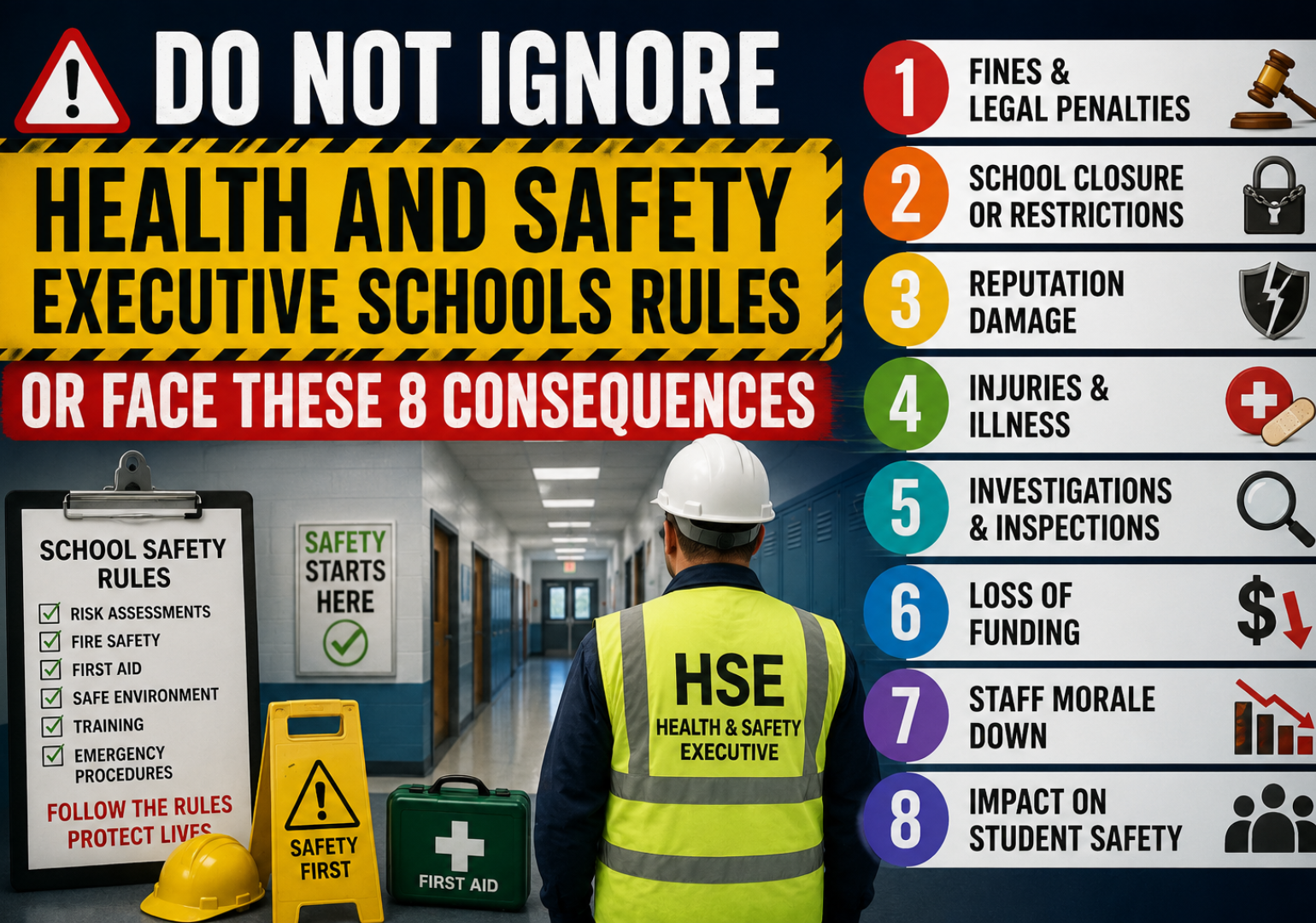
The eight consequences laid out in this article — improvement notices, prohibition notices, criminal prosecution, civil claims, Ofsted implications, staff retention problems, reputational damage, and insurance complications — are not worst-case scenarios drawn from the farthest edges of possibility. They are documented outcomes that schools have faced when health and safety executive schools requirements were treated as optional or low priority. The pattern across those cases is consistent: the failures that led to serious consequences were almost always preceded by smaller warning signs that were not acted on.
The good news is that health and safety executive schools compliance is genuinely achievable for any school that takes it seriously. It requires leadership commitment, adequate resourcing, genuine staff involvement, and consistent documentation. None of that is beyond the reach of a well-run school. The cost of getting it right is manageable. The cost of getting it wrong, as this article has shown, is not.