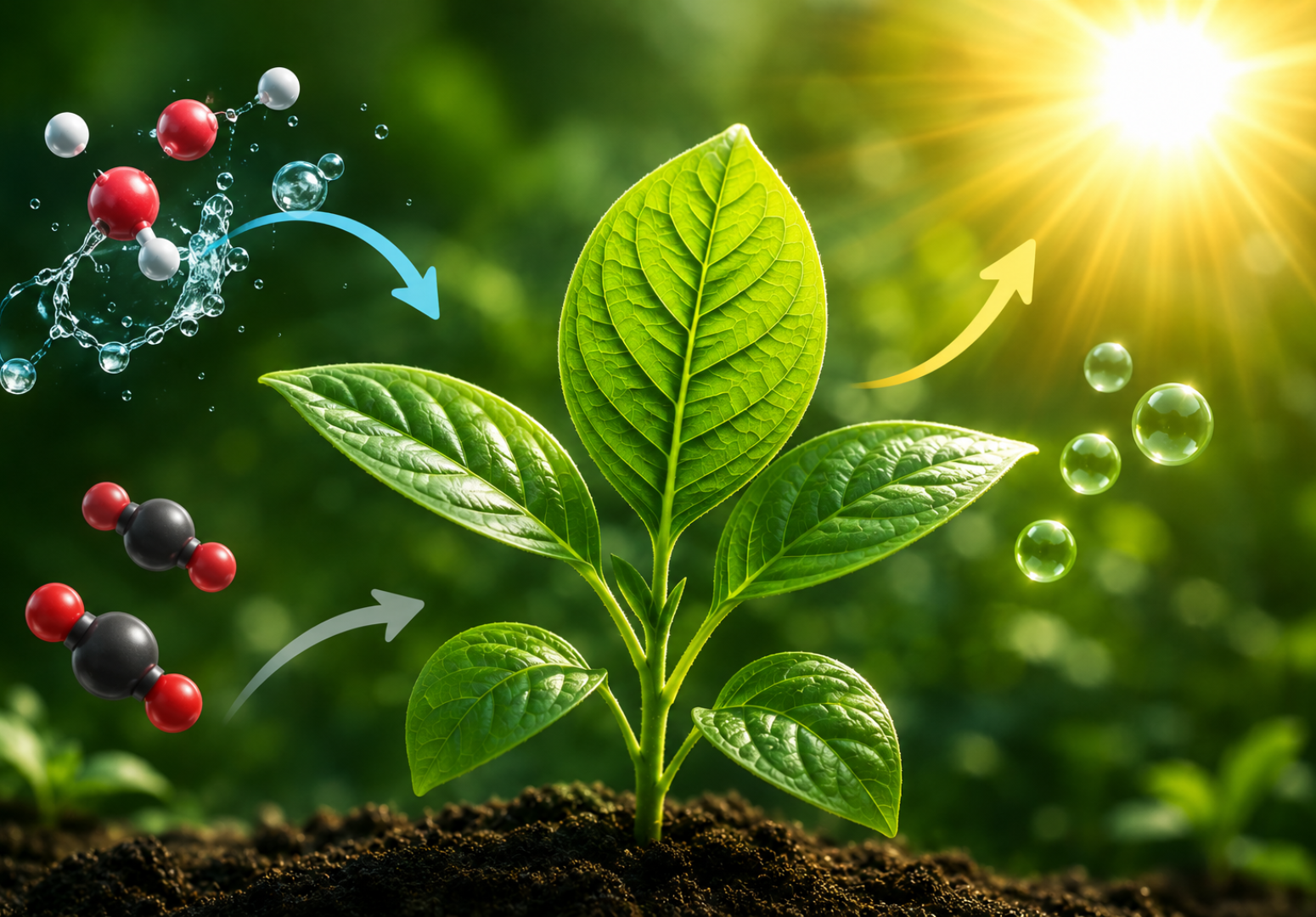
Ask most people what plants eat and they’ll say soil. Understandable guess, but wrong. Plants make their own food using three things: carbon dioxide pulled from the air, water absorbed through their roots, and light energy captured from the sun. Those three inputs are what are the reactants of photosynthesis, and together they drive one of the most important chemical reactions on the planet.
The word reactant simply means something that goes into a chemical reaction and gets transformed into something else. In photosynthesis, the reactants go in, energy gets applied, and what comes out on the other side are glucose and oxygen — the products. That exchange sustains virtually all life on Earth. Every breath of oxygen you take exists because a plant or algae once ran this reaction. Every calorie in your food traces back to it. Knowing what are the reactants of photosynthesis isn’t just a biology exam answer — it’s the key to understanding how energy moves through every living system on the planet. Students and teachers alike find that what are the reactants of photosynthesis becomes one of those foundational questions that opens up entire fields of science once answered clearly.
Defining Photosynthesis Reactants
A reactant is any substance consumed during a chemical reaction. In the context of photosynthesis, the reactants are the raw materials that plants, algae, and certain bacteria take in and convert into usable energy and matter. The overall equation for photosynthesis is: 6CO2 + 6H2O + light energy → C6H12O6 + 6O2. The left side of that arrow shows what are the reactants of photosynthesis: six molecules of carbon dioxide, six molecules of water, and light energy.
It’s worth pausing on the word “light energy” here, because it behaves differently from the other two reactants. Carbon dioxide and water are physical substances — molecules with mass that enter the plant and get chemically transformed. Light energy is electromagnetic radiation, not a molecule. It doesn’t get incorporated into the glucose molecule; instead, it powers the chemical machinery that makes the transformation possible. Some textbooks list only carbon dioxide and water as the reactants and treat light separately as an energy input, but in practice all three are necessary starting conditions for what are the reactants of photosynthesis to function properly. You cannot remove any one of them and still get glucose or oxygen as output.
Carbon Dioxide as Reactant
Carbon dioxide is the carbon source for photosynthesis, and it enters plants almost entirely through tiny pores on leaf surfaces called stomata. Each stoma is flanked by two guard cells that can open or close the pore depending on conditions — light availability, water status, and CO2 concentration all influence whether stomata stay open or shut. When they’re open, CO2 diffuses in along its concentration gradient from the atmosphere (where it currently sits at around 420 parts per million) into the leaf interior.
Once inside, carbon dioxide moves into the mesophyll cells where photosynthesis happens. In the second stage of photosynthesis — the Calvin cycle, which takes place in the stroma of chloroplasts — CO2 is captured by an enzyme called RuBisCO, which attaches each CO2 molecule to an existing five-carbon compound called RuBP. This is carbon fixation: the process of pulling inorganic carbon out of the atmosphere and locking it into organic molecules. What are the reactants of photosynthesis without carbon dioxide? Nothing would get fixed, no organic molecules would form, and no food would be made. CO2 is the carbon skeleton around which glucose is built, six molecules at a time. For educators connecting this to broader science topics with students, science education resources can offer creative ways to bring these reactions to life in the classroom.
Water’s Critical Role
Water is the second molecular reactant of photosynthesis, and its role is distinct from that of carbon dioxide. While CO2 provides the carbon atoms that end up in glucose, water provides the hydrogen atoms that are used to reduce CO2 and build the sugar. Water also provides the electrons that power the entire light-dependent stage of photosynthesis. When students ask what are the reactants of photosynthesis, water is often the one they underestimate most.
In the light-dependent reactions, which happen in the thylakoid membranes of chloroplasts, water molecules are split in a process called photolysis. The enzyme responsible, the oxygen-evolving complex (part of Photosystem II), uses light energy to break the O-H bonds in water: 2H2O → 4H+ + 4e− + O2. The electrons released replace those lost by chlorophyll molecules when they absorb light and become energized. The hydrogen ions (protons) contribute to building ATP through a process called chemiosmosis. The oxygen atoms pair up and leave the leaf as O2 — which is the oxygen that goes into the atmosphere and into your lungs. So when you ask what are the reactants of photosynthesis, water is the one whose fate is most surprising: it goes in as a liquid and comes out as the gas that makes animal life possible.
Light Energy Input
Light energy is the driving force behind photosynthesis. Without it, the other two reactants — carbon dioxide and water — simply sit inert. Light provides the energy needed to split water, power the electron transport chain, generate ATP and NADPH, and ultimately drive carbon fixation. Every glucose molecule produced by photosynthesis represents stored solar energy that was once electromagnetic radiation. This is why light is always included when we describe what are the reactants of photosynthesis — it is not optional and cannot be substituted.
Plants capture light primarily through chlorophyll, the green pigment found in chloroplasts. Chlorophyll absorbs light most efficiently in the red (around 680 nm) and blue (around 450 nm) wavelengths and reflects green light — which is why most plants appear green to our eyes. But plants don’t rely on chlorophyll alone. Accessory pigments including carotenoids (which absorb blue and green light and reflect yellow and orange) and phycobilins in algae extend the range of wavelengths that can be harvested for photosynthesis. This broadens the light-capturing capacity of the plant and helps maximize the efficiency of the system across different lighting conditions. Any serious study of what are the reactants of photosynthesis must account for how light is captured and used.
Where Reactants Enter Plants
Plants have specialized structures for taking in each reactant, and the elegance of these intake systems is worth appreciating. Carbon dioxide enters through stomata, which are distributed mainly on the lower surface of leaves in most plant species. The stomatal aperture is regulated dynamically — plants open their stomata in daylight when photosynthesis is possible and close them at night or during drought to conserve water. Understanding where each input enters helps clarify what are the reactants of photosynthesis and how the plant manages all three simultaneously.
Water enters through a completely different route: the roots. Root hair cells have enormous surface area that absorbs water from the soil by osmosis, pulling it in because the cell contents have a lower water potential than the surrounding soil solution. From the roots, water travels upward through the xylem vessels — hollow, dead cells that form continuous tubes from roots to leaves. The driving force is a combination of root pressure, capillary action in the narrow xylem tubes, and most importantly transpiration pull from the leaves, where water evaporating through stomata creates a tension that draws more water up from below. Light, the third reactant, enters through transparent epidermal cells and is captured by chlorophyll in the mesophyll cells beneath. These three intake systems operate simultaneously and independently, converging inside the chloroplast where photosynthesis actually happens.
What Are the Reactants of Photosynthesis in Light Reactions
The light-dependent reactions are the first stage of photosynthesis, and this is where two of the three reactants — water and light — are directly consumed. These reactions happen in and across the thylakoid membranes, which are stacked into structures called grana inside the chloroplast. Light hits chlorophyll molecules in Photosystem II, exciting electrons to a higher energy level. Those energized electrons pass through a series of protein complexes called the electron transport chain, releasing energy that is used to pump protons across the thylakoid membrane.
As protons flow back across the membrane through the enzyme ATP synthase, the energy released is used to produce ATP from ADP and inorganic phosphate. Meanwhile, the electrons eventually reach Photosystem I, where a second absorption of light re-energizes them, and they’re used to reduce NADP+ to NADPH. Both ATP and NADPH are energy carriers that will power the second stage of photosynthesis. The water that was split at the start has donated its electrons to keep this whole chain running, and its oxygen atoms have left as O2. Light energy has been converted into chemical energy stored in ATP and NADPH. What are the reactants of photosynthesis doing in this stage? Being completely consumed and transformed — light into chemical energy, water into protons, electrons, and oxygen. This transformation is at the core of why what are the reactants of photosynthesis matters as a question.
Calvin Cycle Uses CO2
According to research published by the National Institutes of Health, the Calvin cycle — also called the light-independent reactions or carbon fixation cycle — is where carbon dioxide is finally converted into organic molecules using the ATP and NADPH generated in the light reactions. This happens in the stroma of the chloroplast, and the cycle runs continuously as long as ATP and NADPH are available. The Calvin cycle is where one of what are the reactants of photosynthesis — CO2 — meets its chemical fate.
The cycle has three phases. In carbon fixation, CO2 is attached to RuBP by RuBisCO, forming an unstable six-carbon compound that immediately splits into two molecules of 3-phosphoglycerate (3-PGA). In the reduction phase, ATP and NADPH are used to convert 3-PGA into glyceraldehyde-3-phosphate (G3P), a three-carbon sugar that is the actual carbohydrate output of photosynthesis. Most G3P is used in the third phase — regeneration of RuBP — to keep the cycle running. A small fraction exits the cycle and is used to build glucose, sucrose, starch, and other organic compounds. Six turns of the Calvin cycle, each fixing one CO2, are needed to produce one molecule of glucose. Carbon dioxide, one of what are the reactants of photosynthesis, ends its journey here — no longer a gas floating in the atmosphere, but carbon locked into sugar.
Oxygen as Photosynthesis Byproduct
Oxygen is the most famous product of photosynthesis, and it comes entirely from the splitting of water molecules during the light-dependent reactions. This is worth emphasizing because it’s commonly misunderstood — some people assume the oxygen released by plants comes from CO2, but isotope tracing experiments in the 1930s and 1940s confirmed unambiguously that it comes from H2O. The water that is listed among what are the reactants of photosynthesis is the direct source of every oxygen molecule a plant releases.
The oxygen produced by photosynthesis has transformed Earth’s atmosphere over billions of years. Before photosynthesis evolved in early cyanobacteria around 2.7 billion years ago, Earth’s atmosphere contained almost no free oxygen. The Great Oxidation Event, roughly 2.4 billion years ago, marked the point where photosynthetic oxygen production began to accumulate in the atmosphere, eventually reaching today’s level of about 21%. Every multicellular aerobic organism on Earth — including every animal that has ever lived — owes its existence to this accumulation. When you consider what are the reactants of photosynthesis, it’s humbling to realize that water going in and oxygen coming out reshaped the planet’s entire chemistry and made complex life possible.
Glucose the Primary Product
Glucose is the primary organic product of photosynthesis and the molecule that stores the solar energy captured by plants. The molecular formula C6H12O6 represents the final destination of all six CO2 molecules that entered the Calvin cycle and the hydrogen atoms stripped from water during the light reactions. Glucose is energy-dense — it contains about 2,870 kilojoules per mole — and it’s the universal fuel that drives cellular respiration across almost all living organisms.
Plants don’t use glucose only as fuel. They convert it into sucrose for transport through the phloem, into starch for long-term energy storage in roots, seeds, and tubers, into cellulose for cell wall construction, and into countless other organic compounds including amino acids (when nitrogen is available), lipids, and secondary metabolites. The six carbon atoms and associated hydrogen and oxygen atoms that make up every glucose molecule were, just hours or days before, separate molecules of carbon dioxide in the air and water in the soil. That transformation — from gas and liquid into solid organic matter — is what photosynthesis does, and it all starts with what are the reactants of photosynthesis doing their jobs at the molecular level inside the chloroplast.
Photosynthesis in Aquatic Organisms
Photosynthesis isn’t limited to land plants. Aquatic photosynthesizers — including algae, cyanobacteria, and aquatic plants — carry out the same basic reaction with the same reactants, but their environment presents different challenges for obtaining them. Carbon dioxide, for instance, dissolves in water and is available in aquatic environments, but its concentration and availability vary with temperature, pH, and water movement. Cold water holds more dissolved CO2 than warm water, and photosynthetic organisms near the ocean surface compete intensely for available CO2 when light is abundant.
Phytoplankton — microscopic photosynthetic organisms floating in the upper ocean layers — are collectively responsible for roughly 50% of global oxygen production. That’s half of every breath you take coming from organisms too small to see with the naked eye. They access light at the surface, absorb dissolved CO2 and minerals from the water around them, and carry out photosynthesis at an enormous collective scale. Kelp forests and seagrass meadows are other major aquatic photosynthesizers, providing habitat, carbon storage, and oxygen simultaneously. What are the reactants of photosynthesis in aquatic systems? The same three — CO2, H2O, and light — but dissolved and dispersed through a medium that changes their availability in ways that land plants never have to deal with. Aquatic ecosystems show clearly that what are the reactants of photosynthesis remains constant even as the environment around them shifts dramatically.
Factors Affecting Reactant Availability
The rate of photosynthesis depends directly on how available each reactant is, and when any one of them becomes limiting, the whole process slows down regardless of how abundant the others are. This is called the law of limiting factors, and it has practical implications for agriculture, ecology, and climate science. Farmers and researchers who want to boost crop yields must consider what are the reactants of photosynthesis and which one is in shortest supply.
Light intensity is often the limiting factor in shaded environments or at dawn and dusk. As light increases, photosynthesis rate rises until CO2 or water becomes limiting. Carbon dioxide concentration limits photosynthesis in many agricultural crops — this is why greenhouse growers sometimes pump CO2 into their greenhouses, raising concentrations to 1,000 ppm or higher to boost yield. Water availability is the most common limiting factor in dryland environments, where drought stress causes plants to close their stomata to conserve water, inadvertently shutting out CO2 and halting photosynthesis. Temperature also affects the rate of enzyme-catalyzed reactions in the Calvin cycle — too cold and enzymes work slowly, too hot and they denature. Understanding what are the reactants of photosynthesis is only half the story; knowing what controls their availability is what connects the biochemistry to real-world plant growth.
Photosynthesis Efficiency Rates
Photosynthesis is impressively sophisticated but not particularly efficient in energy conversion terms. Most plants convert only about 1 to 2% of the sunlight hitting their leaves into stored chemical energy under field conditions. Theoretical maximum efficiency for C3 plants (which includes wheat, rice, and most trees) is around 11%, and for C4 plants (corn, sugarcane, sorghum) around 6% under realistic conditions. The gap between theoretical and actual efficiency is due to light saturation, photorespiration, reflection, and energy used in plant maintenance.
C4 plants have evolved a mechanism that concentrates CO2 around RuBisCO, reducing the wasteful process of photorespiration and improving efficiency in hot, bright, dry conditions. Some aquatic algae and cyanobacteria also use carbon-concentrating mechanisms. Researchers are actively working on engineering improved versions of RuBisCO and other components of the Calvin cycle to boost photosynthetic efficiency in crop plants. Even a modest increase from 1% to 2% efficiency could have significant impacts on global food production. All of these research directions trace back to the same starting point: what are the reactants of photosynthesis, and how can we help plants use them better and more efficiently than they currently do?
Photosynthesis and Climate Change
The reactants of photosynthesis sit at the center of the global carbon cycle, which makes photosynthesis directly relevant to climate change. Carbon dioxide is a greenhouse gas — it traps heat in Earth’s atmosphere — and atmospheric CO2 levels have risen from around 280 ppm before industrialization to over 420 ppm today. Photosynthesis is the primary biological mechanism that removes CO2 from the atmosphere and locks it into organic carbon. Grasping what are the reactants of photosynthesis helps explain why forests are so critical to climate stability.
Forests, grasslands, and ocean phytoplankton collectively absorb roughly 11 billion tonnes of CO2 per year through photosynthesis — about 30% of annual human emissions. This natural carbon sink is why deforestation matters so much to climate projections: clearing forests doesn’t just release the carbon stored in wood, it also eliminates the future photosynthetic capacity that would have continued absorbing CO2. At the same time, rising CO2 concentrations are changing how plants photosynthesize — many plants grow faster with more CO2 available (the CO2 fertilization effect), but this is offset by reduced nutritional quality, changes in water use, and ecosystem disruptions. The reactants of photosynthesis aren’t just a biology lesson — they’re core variables in the systems keeping Earth’s climate stable.
Comparing Reactants and Products
A clean way to appreciate what photosynthesis accomplishes is to compare what goes in versus what comes out. The reactants — carbon dioxide, water, and light energy — are simple, inorganic, and in two cases invisible. The products — glucose and oxygen — are materially and energetically richer than the inputs. That contrast is what makes what are the reactants of photosynthesis such a satisfying thing to study: you start with humble ingredients and end with the molecules that power all of life.
That enrichment is the point. Photosynthesis is fundamentally an energy-capturing reaction — it takes low-grade energy (diffuse sunlight) and packages it into high-grade chemical energy (glucose bonds). The carbon dioxide and water are the raw materials; the light energy is what drives the thermodynamically uphill process of turning them into sugar. Without this energy input, the reaction simply can’t happen — carbon dioxide and water are thermodynamically stable and have no tendency to spontaneously combine into glucose. What are the reactants of photosynthesis, really? They are the inputs to a machine that runs on sunlight and produces the food and oxygen that everything else depends on — and appreciating that changes how you see every plant you walk past.
FAQ of What Are the Reactants of Photosynthesis
What are the reactants of photosynthesis and where do they come from?
The reactants of photosynthesis are carbon dioxide, water, and light energy. Carbon dioxide enters through leaf stomata from the atmosphere, water is absorbed through plant roots from the soil, and light energy comes from the sun and is captured by chlorophyll in chloroplasts. All three must be present simultaneously for photosynthesis to proceed and produce glucose and oxygen.
Why is light included when listing what are the reactants of photosynthesis?
Light is included because it is consumed during the reaction — converted from electromagnetic energy into chemical energy stored in ATP and NADPH. Without light, water cannot be split and the Calvin cycle cannot run. Even though light is not a molecule, it is a necessary input that gets transformed during the process, which is why most biologists include it when answering what are the reactants of photosynthesis.
What happens to water during photosynthesis?
Water is split during the light-dependent reactions in a process called photolysis. The oxygen-evolving complex in Photosystem II breaks water molecules into hydrogen ions, electrons, and oxygen gas. The electrons power the electron transport chain, the hydrogen ions help produce ATP, and the oxygen is released into the atmosphere. This is why the oxygen animals breathe comes from water, not from CO2.
How does carbon dioxide become glucose in photosynthesis?
Carbon dioxide is fixed during the Calvin cycle by the enzyme RuBisCO, which attaches each CO2 molecule to a five-carbon compound called RuBP. The resulting six-carbon compound splits into two three-carbon molecules that are then reduced using ATP and NADPH to form G3P, a simple sugar. After six turns of the cycle fixing six CO2 molecules, enough G3P accumulates to build one glucose molecule — completing the transformation of one of what are the reactants of photosynthesis into stored food energy.
Conclusion of What Are the Reactants of Photosynthesis
Asking what are the reactants of photosynthesis seems like a simple question, but the answer connects to almost everything in biology, ecology, and Earth science. Carbon dioxide, water, and light energy go into the reaction. Glucose and oxygen come out. That exchange, happening in chloroplasts too small to see, powers every food chain on the planet and maintains the atmospheric oxygen content that animals depend on for survival. Every time you return to the question of what are the reactants of photosynthesis, there is another layer worth examining.
What makes this particularly striking is the scale. A single large tree may fix 22 kilograms of carbon per year through photosynthesis. The Amazon rainforest absorbs roughly 2 billion tonnes of CO2 annually. Global photosynthesis moves an estimated 120 billion tonnes of carbon per year from the atmosphere into organic matter. All of that movement, all of that transformation, begins with the same three reactants that students learn about in secondary school biology. What are the reactants of photosynthesis? They are carbon dioxide, water, and light — three ordinary things combining to do something extraordinary, sustaining the biosphere one glucose molecule at a time. When the full picture comes into view, what are the reactants of photosynthesis stops being a textbook question and becomes one of the most important facts in all of science.