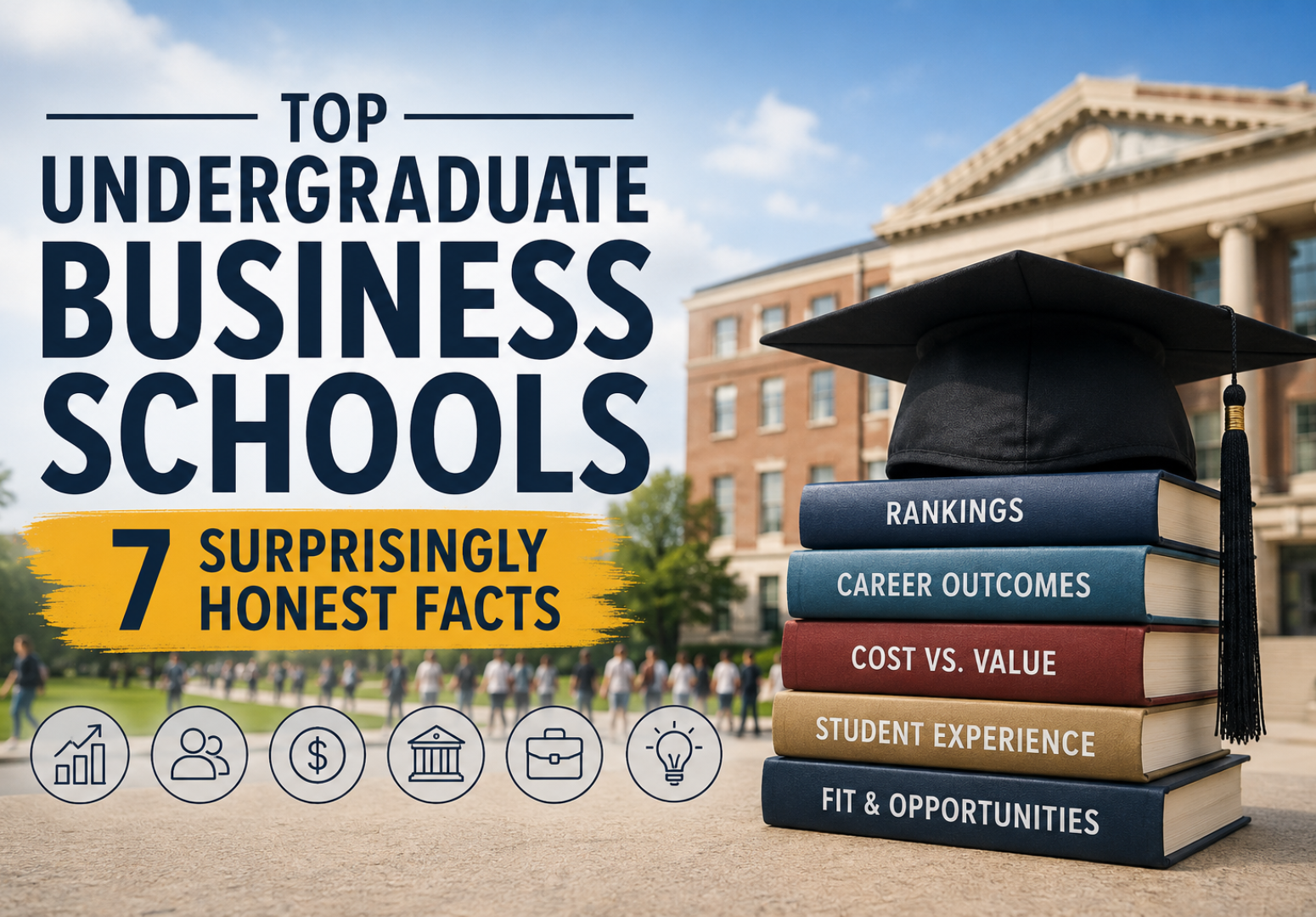
Top Undergraduate Business Schools : When people talk about getting a business degree, they usually jump straight to MBA programs. But here’s the thing — the undergraduate years are where the real foundation gets built. The habits, networks, and thinking patterns you develop between ages 18 and 22 can shape decades of professional life. The top undergraduate business schools in the United States are not just prestigious names on a diploma. They are ecosystems — built with career pipelines, faculty research, and alumni networks that genuinely move the needle.
That said, choosing the right school is not as simple as chasing rankings. A school ranked third nationally might be a better fit for you than the one ranked first, depending on your goals, learning style, and industry interest. This article cuts through the noise and gives you an honest, grounded look at what separates good programs from genuinely exceptional ones.
What Rankings Actually Measure in Top Undergraduate Business Schools
Business school rankings get treated like gospel, but they are measuring a pretty specific set of variables. Most major rankings — U.S. News, Bloomberg Businessweek, Poets & Quants — weight things like average starting salaries, student selectivity, faculty credentials, and peer assessment scores. Each methodology is slightly different, which is why a school can rank 4th on one list and 11th on another.
What rankings rarely capture is culture fit, class size dynamics, or how much access students actually get to professors. A school that ranks in the top ten might still have 300-student lecture halls where you never speak to a faculty member directly. Knowing what the rankings measure — and what they miss — helps you use them as one data point rather than the final word.
Top Schools and Their Strengths
The University of Pennsylvania’s Wharton School consistently sits at or near the top of rankings for the top undergraduate business schools. Its strength lies in quantitative rigor, finance depth, and an alumni network that stretches across Wall Street, consulting, and private equity. Students coming in need to be comfortable with numbers because the curriculum does not ease you in gently.
The Ross School of Business at the University of Michigan is known for its action-based learning model, where students work on real business problems from their first year. University of Virginia’s McIntire School of Commerce is smaller, more intimate, and produces exceptionally well-rounded graduates. Indiana University’s Kelley School and the University of Texas at Austin’s McCombs School round out a strong middle tier that consistently delivers excellent placement rates without the same selectivity pressure. You can read more about innovative education models that are reshaping how learning institutions approach skill-building at the undergraduate level.
Acceptance Rates and Selectivity
Here is a number worth sitting with: Wharton’s undergraduate acceptance rate hovers around 8 to 9 percent. That is more selective than many Ivy League liberal arts programs. NYU Stern, Georgetown McDonough, and Emory Goizueta are all in similar territory — you are looking at applicant pools where the average SAT score clears 1450 and most students arrive with serious extracurricular track records.
What this means practically is that applying to top undergraduate business schools requires the same level of preparation as applying to any elite university. Essays matter. Demonstrated interest in business — internships, entrepreneurship, business clubs — matters more than most applicants expect. A high GPA alone does not get you through the door at these programs.
Cost Versus Return on Investment
Four years at a top undergraduate business school can cost anywhere from $200,000 to $280,000 when you factor in tuition, housing, and living expenses at a private university. That is a significant number, and it deserves honest scrutiny. The question is not whether the degree is worth it in abstract — it is whether it is worth it for you, given your financial situation and career goals.
Graduates from the top undergraduate business schools in fields like investment banking or consulting typically land starting salaries between $85,000 and $110,000, with signing bonuses that can add another $10,000 to $30,000. In those fields, payback periods can be surprisingly short. But if you are planning to enter a lower-compensation field like nonprofit work or education, the ROI math looks very different and deserves careful thought before you take on six-figure debt.
Curriculum Differences Worth Knowing
Not all business curricula are built the same way. Some schools — like Wharton — front-load quantitative coursework and expect students to hit the ground running with statistics and economics. Others, like Ross, emphasize project-based and experiential learning from day one, which tends to suit students who learn better by doing than by absorbing theory in a classroom.
A few schools let students customize heavily. McIntire at UVA has a structured two-year commerce curriculum that students enter as juniors, meaning the first two years are spent in liberal arts — something that produces genuinely broader thinkers. Kelley’s Integrated Core is a cohort-based first-year experience that simulates a real business environment. Understanding these structural differences helps you match your learning style to the right program rather than just chasing a name.
Campus Culture and Peer Networks
The students you sit next to in class become your first professional network. This sounds like a cliché, but it is true in a very literal way at top undergraduate business schools. The person who helps you study for your accounting midterm in sophomore year might be the person who refers you for a job in year five of your career.
Schools with strong cohort systems — where a group of students moves through core courses together — tend to build tighter peer bonds. Kelley, Ross, and McIntire all lean into this model. Larger programs at NYU Stern or USC Marshall offer different trade-offs: more diversity of background and interest, larger alumni networks, but sometimes less of that tight-knit culture. Neither is better universally — it depends on how you build relationships and what kind of environment brings out your best work.
Career Placement and Recruiting Access
This is arguably the most practical metric to research when evaluating the top undergraduate business schools. According to the Bureau of Labor Statistics, business and financial occupations are projected to grow 7 percent through 2033, adding roughly 963,000 new jobs. The schools that place students well are the ones that have built sustained relationships with major employers — not just posted job boards.
Wharton, Ross, and Kelley are known for on-campus recruiting pipelines that bring in Goldman Sachs, McKinsey, Deloitte, and hundreds of other firms each year. Students at these schools do not need to cold-email their way into interviews — the infrastructure exists to bring opportunities to them. That said, the students who perform best in recruiting are still the ones who put in the preparation work. Firm relationships open doors; your performance inside the room determines what happens next.
Public Versus Private School Debate
There is a real and ongoing conversation in college counseling circles about whether expensive private business schools are worth it over strong public alternatives. For in-state students, programs like McCombs at UT Austin, Kelley at Indiana, or the Haas School at UC Berkeley represent extraordinary value. Berkeley-Haas, in particular, is hard to argue against — it sits in the top five nationally and charges in-state tuition that is a fraction of what Penn or NYU costs.
The honest answer is that for students with in-state access to a top-ranked public business program, the value proposition is usually superior. The degree quality, recruiting access, and alumni network are comparable — and sometimes better — at a much lower price point. Private school makes more sense when the brand differential is significant for your specific target industry, or when strong merit aid brings the net cost down considerably.
International Business Concentrations
With global supply chains and cross-border business increasingly becoming the norm rather than the exception, the top undergraduate business schools have invested heavily in international business concentrations. Thunderbird at Arizona State, Georgetown’s McDonough School, and NYU Stern all have strong global business offerings backed by study abroad infrastructure and international faculty.
If you know you want to work in international finance, global consulting, or cross-border trade, the program’s global curriculum and study abroad options should factor heavily into your decision. A semester studying at a partner institution in Europe or Asia is not just resume decoration — it rewires how you think about markets, negotiations, and professional relationships. Some schools make this nearly automatic; others treat it as optional. Know which kind you are applying to.
Entrepreneurship Programs on Campus in Top Undergraduate Business Schools
Ten years ago, entrepreneurship programs at undergraduate business schools were mostly elective sideshows. Now they are genuine differentiators. Schools like Babson College are purpose-built around entrepreneurship and have been ranked number one in that specialty for decades. Wharton has the Weiss Tech House and the Venture Initiation Program. Rice University’s Jones School and Tulane’s Freeman School both punch above their weight in startup culture.
If founding a company or joining an early-stage startup is where you see yourself in five years, paying attention to the entrepreneurship ecosystem at a school — mentors, funding competitions, incubator access, alumni founders — matters as much as the core curriculum. The top undergraduate business schools increasingly understand this and are building infrastructure accordingly.
How Accreditation Affects Your Degree
AACSB accreditation is the gold standard for business schools worldwide. Schools without it are simply not in the same conversation when it comes to employer recognition and graduate school admissions. All of the top undergraduate business schools carry AACSB accreditation, but it is worth verifying for any school outside the well-known tier.
Beyond AACSB, look at program-specific accreditation and rankings for the concentration you are targeting. A school might have middling overall rankings but an accounting or supply chain program that is genuinely elite in its specialty. If you know your direction, drilling into program-level quality rather than overall school rankings often gives you a more accurate picture of where you should apply.
Application Strategy for Competitive Programs
Getting into the top undergraduate business schools requires a focused, intentional application strategy — not just good grades. Schools want to see a student who has thought about why business, why this school, and how the two connect. Vague essays about wanting to be a leader do not work. Specific essays about a market problem you want to solve, or a business experience that shifted your thinking, land much better.
Demonstrated interest also plays a role. Campus visits, info sessions, and alumni interviews signal genuine engagement. Letters of recommendation from teachers who can speak to your analytical and collaborative abilities — not just your GPA — add real weight. And applying early decision to your top choice, if your financial situation allows, statistically improves your odds at most of these programs.
Dual Degree and Combined Programs in Top Undergraduate Business Schools
One underrated feature of several top undergraduate business schools is the availability of dual degree or accelerated combined programs. Penn’s M&T program lets students pursue simultaneous degrees in Wharton and the School of Engineering. Cornell offers a program combining business and engineering through its interdisciplinary model. These tracks are extraordinarily competitive but produce graduates with genuinely rare skill sets.
Even within a single school, double majoring in business and a STEM field, computer science, or data analytics has become increasingly popular — and increasingly valued by employers. The students who combine business acumen with technical fluency are the ones most insulated from automation trends reshaping white-collar work. If you have the capacity to pursue a dual track, it is worth serious consideration.
Geography and Industry Proximity of Top Undergraduate Business Schools
Where a school sits geographically shapes what industries it feeds most naturally. NYU Stern’s location in downtown Manhattan puts students 20 minutes from Wall Street. USC Marshall’s position in Los Angeles makes entertainment, media, and tech a natural recruiting focus. Tuck at Dartmouth, despite being in rural New Hampshire, has cultivated consulting and private equity pipelines that rival much larger schools through sheer alumni density and program reputation.
Think about where you want to live and work after graduation. Being in that city — or near it — during your undergraduate years gives you internship access, networking proximity, and market familiarity that a geographically isolated school cannot fully replicate. Top undergraduate business schools in major metros give you four years of professional market immersion, which is a form of value that does not always show up in rankings.
Diversity and Inclusion Initiatives of Top Undergraduate Business Schools
The best top undergraduate business schools have moved beyond surface-level diversity statements and built programs with real structural backing. This includes first-generation student support offices, scholarship pipelines for underrepresented groups, mentorship programs connecting diverse students with alumni, and inclusive recruiting partnerships with firms that have demonstrated hiring commitments.
If you are a first-generation college student or from an underrepresented background, research this layer of the school’s infrastructure carefully. Schools that have dedicated funding, staff, and programming for these communities will give you a meaningfully different experience than those that treat inclusion as a checkbox. The numbers matter too — look at the demographic breakdowns in the student body and among faculty.
Life After Graduation Outcomes from Top Undergraduate Business Schools
Graduate outcomes tell the real story of a business school’s value. Look at five-year post-graduation data, not just first-year placement rates. The top undergraduate business schools track where their alumni land, what they earn, and how their career trajectories develop over time. Poets & Quants publishes detailed employment reports for many of these programs and is worth bookmarking as a research resource.
Wharton undergraduates appear consistently in Fortune 500 C-suites. Ross graduates have disproportionate representation in tech and consulting leadership. Kelley’s direct-admit model produces a high percentage of students who move seamlessly into accounting, finance, and corporate roles with structured pipelines. None of these outcomes are guaranteed — but they reflect the cumulative infrastructure that each school has built over decades, and they are worth studying before you send in an application.
Frequently Asked Questions about Top Undergraduate Business Schools
What makes the top undergraduate business schools different from average programs?
The difference comes down to three things: faculty quality, recruiting infrastructure, and alumni network density. At the top programs, firms actively recruit on campus, professors bring real-world credibility alongside research credentials, and the alumni network functions as an actual door-opener rather than just a LinkedIn filter.
Which top undergraduate business schools offer the best financial aid?
Several elite programs offer strong need-based aid. Penn, for example, meets 100 percent of demonstrated financial need. Emory, Georgetown, and Notre Dame also have significant aid programs. The net cost after aid can sometimes make a private top-tier school comparable to — or cheaper than — an out-of-state public option.
Is it better to apply to a business school directly or transfer in as a junior?
Both paths work, but they come with different trade-offs. Direct admission gives you earlier access to resources, cohort bonding, and recruiting timelines. Junior-year transfer programs — like McIntire at UVA — give you two years to build your GPA and clarify your direction before committing. The right answer depends on how confident you are in your goals at 17 or 18 versus at 20.
How important is the GMAT or SAT for getting into top undergraduate business schools?
At the undergraduate level, the SAT or ACT matters more than any graduate-style test. Most top programs are now test-optional but still report median scores for admitted students. A strong score still helps. More importantly, the rest of your application — essays, activities, recommendations — carries significant weight alongside any standardized test result.
Conclusion about Top Undergraduate Business Schools
Choosing among the top undergraduate business schools is one of the more high-stakes decisions a young person will make, and it deserves more than a quick Google search of rankings. The best school for you is not necessarily the one with the highest U.S. News number — it is the one whose curriculum structure, campus culture, industry focus, and financial profile align with where you are headed.
The top undergraduate business schools collectively represent some of the strongest professional launch pads available in higher education. But the students who get the most out of them are the ones who arrive with clarity about their goals and the willingness to build relationships, pursue internships, and engage deeply with what the program offers. The infrastructure is there. What you build on top of it is entirely up to you.
Do your homework on placement data, talk to current students, visit campuses when possible, and look beyond the brand name to the actual experience. Four years is a long time, and the environment you choose will shape how you think about business, people, and problems for the rest of your career. Make the decision carefully, and make it yours.