What Makes Public Universities Great
Public universities in the USA have a reputation for being second-best, which is honestly unfair. Some of the most respected research institutions in the world are public schools funded by state governments. They produce Nobel laureates, Fortune 500 CEOs, and groundbreaking scientists at a rate that rivals any private institution you can name.
The difference is cost. Public universities charge significantly lower tuition — especially for in-state students — which means you graduate with less debt and more financial freedom. When you factor in the quality of education per dollar spent, many public schools come out way ahead of private alternatives that charge three or four times as much.
Why Rankings Often Mislead Students
Most college ranking systems prioritize research output, alumni donations, and selectivity. These metrics don’t necessarily translate into a better experience for the actual student sitting in the classroom. A school ranked 40th nationally might have a better engineering program, more internship connections in your city, or smaller class sizes than a school ranked 10th.
The best public universities in USA are not always the ones plastered on magazine covers. Some genuinely excellent institutions fly under the radar because they haven’t invested in marketing their reputation. This article cuts through that noise and looks at what actually matters for students.
University of California Berkeley Excellence
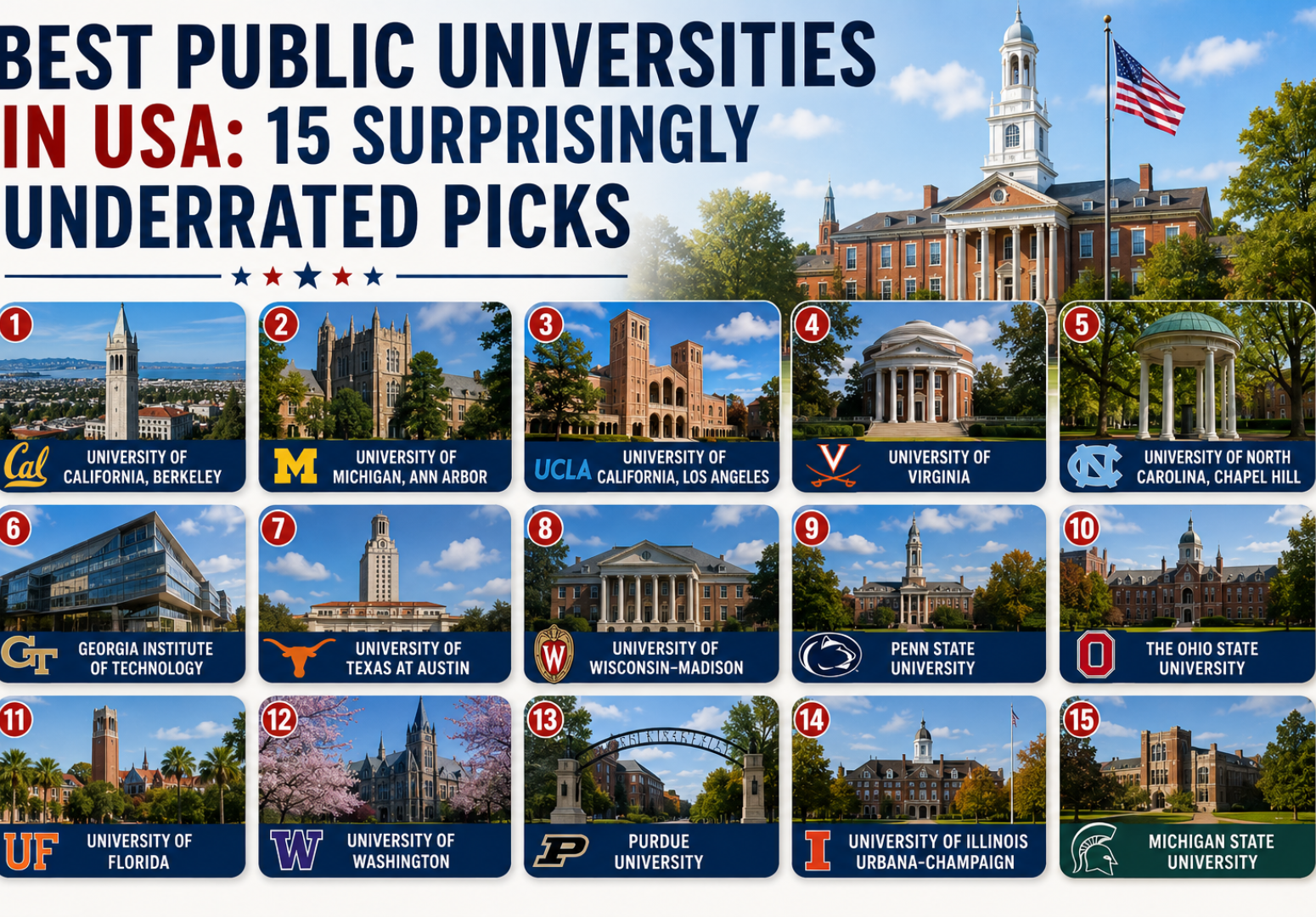
UC Berkeley sits at the top of nearly every credible list of best public universities in USA, and the reasons are hard to argue with. The school has produced over 30 Nobel laureates among its faculty and alumni. Its programs in engineering, computer science, law, and business are consistently ranked in the top five nationally.
Berkeley’s location in the San Francisco Bay Area gives students direct access to Silicon Valley internships, startup culture, and tech company recruiting pipelines. Google, Apple, and Meta all actively recruit from Berkeley campuses. For in-state California students, the tuition is a fraction of what comparable private schools charge, making it one of the best value propositions in American higher education.
University of Michigan Academic Strength
The University of Michigan in Ann Arbor is one of those schools that excels across almost every discipline simultaneously. Its medical school, law school, business school, and engineering programs are all ranked among the best in the country. That kind of breadth across disciplines is genuinely rare, even among elite institutions.
Michigan also has one of the most active alumni networks in American higher education. The university has over 630,000 living alumni spread across every industry and every continent. That network has real value when you are looking for jobs, mentors, or business connections after graduation. Michigan graduates tend to hire other Michigan graduates, which creates a genuine advantage in competitive job markets.
UCLA Research and Career Opportunities
UCLA gets slightly overshadowed by Berkeley in national conversations, but it probably shouldn’t. The school’s programs in film, arts, medicine, and public policy are among the strongest anywhere in the country. Its location in Los Angeles gives it something Berkeley can’t fully replicate — direct proximity to the entertainment industry, healthcare systems, and one of the most diverse business ecosystems in America.
If you are interested in higher education career paths, UCLA produces an exceptional number of faculty members and researchers who go on to teach at universities nationwide. The campus culture also tends to be more collaborative than cutthroat, which matters more than people admit when you are spending four years somewhere.
University of Virginia Hidden Prestige Factor
The University of Virginia, founded by Thomas Jefferson, carries a quiet prestige that doesn’t always show up in the numbers. Its undergraduate business program at the McIntire School of Commerce is consistently ranked among the top three in the country. The Darden School of Business is one of the most respected MBA programs in the world.
UVA also has one of the highest four-year graduation rates among public universities — around 87%, which is remarkable. Students actually finish on time, which matters enormously when you are calculating the real cost of a degree. A fifth year at any university adds tens of thousands of dollars to your total investment.
University of North Carolina Chapel Hill
UNC Chapel Hill has been producing influential graduates since 1789, making it the oldest public university in the United States. Its journalism school, public health programs, and pharmacy school are routinely ranked in the top five nationally. The research conducted here in biomedical sciences and public policy shapes actual government decisions.
The Research Triangle — which includes UNC, Duke, and NC State — creates an unusually dense concentration of academic talent in one geographic region. That density attracts pharmaceutical companies, tech firms, and research organizations, which translates directly into internship and employment opportunities for students. Tuition for North Carolina residents is among the most affordable in the country for the quality of education offered.
Georgia Tech Engineering and Technology Focus
Georgia Tech is arguably the best engineering and technology-focused public university in the United States. Its computer science program is frequently ranked number one or two in the country, depending on the year. The school has a strong cooperative education program where students alternate between academic semesters and paid work terms with real employers.
The employment outcomes at Georgia Tech are striking. According to the National Science Foundation, STEM graduates from institutions like Georgia Tech consistently earn starting salaries significantly above the national median for college graduates. Georgia Tech graduates are recruited aggressively by companies like Boeing, Delta, Google, and virtually every major tech employer in the Southeast.
University of Texas Austin Programs
UT Austin is one of the largest universities in the country by enrollment, with around 50,000 students, but it manages to maintain program quality across an impressive range of disciplines. Its McCombs School of Business is a top-tier program. The law school is highly regarded. The engineering school has strong industry connections, particularly in the energy sector.
The best public universities in USA often benefit from being located in economically dynamic cities, and Austin is one of the clearest examples of that advantage. The city has become a major tech hub over the past decade, with Tesla, Apple, Oracle, and hundreds of startups establishing significant operations there. UT Austin students have internship and networking access that students at schools in smaller markets simply don’t.
University of Wisconsin Madison Research
UW Madison is one of the country’s premier research universities, with over $1.3 billion in research expenditures annually. That number matters because research funding means labs, equipment, faculty time, and undergraduate research opportunities that most schools can’t offer. Students who want hands-on research experience before graduate school are well-served here.
The agricultural sciences, pharmacy, and education programs at Wisconsin have particularly strong national reputations. The school also has a strong public service tradition — the Wisconsin Idea is a century-old philosophy that the university’s mission extends beyond campus to benefit all people in the state. That ethos shapes the culture of the institution in ways that feel genuine rather than performative.
Penn State University Wide Reach
Penn State has one of the largest and most active alumni networks in the world — over 700,000 living alumni. For networking purposes, that matters. The university has strong programs in engineering, business, meteorology, and education. Its main campus in State College is a classic college town environment that many students find genuinely enjoyable.
Penn State also operates one of the largest branch campus systems in the country, giving students the flexibility to start at a smaller location before transferring to the main campus. The school’s football program is culturally significant in Pennsylvania in a way that builds institutional identity and alumni loyalty. Whether you care about sports or not, that loyalty translates into a strong professional network.
Ohio State University Career Connections
Ohio State in Columbus is another school that benefits enormously from its city location. Columbus is one of the fastest-growing cities in the Midwest, with a diversifying economy that includes finance, tech, healthcare, and logistics. Ohio State has built deep relationships with employers in all of these sectors, and it shows in employment outcomes for graduates.
The Fisher College of Business at Ohio State consistently ranks among the top 20 public business schools in the country. The college of engineering is strong, and the medical center is one of the largest academic medical centers in the United States. Ohio State is a genuinely comprehensive university that can legitimately compete with more famous names in most academic departments.
University of Florida Affordable Excellence
The University of Florida in Gainesville offers something remarkable: a top-tier education at genuinely affordable prices for Florida residents. In-state tuition and fees run around $6,000 per year, which is extraordinarily low for a school of this academic caliber. Florida consistently ranks among the top 10 public universities in the country by most credible measures.
The best public universities in USA often get credit for research output but not enough credit for value, and UF is a prime example. Its programs in agricultural sciences, law, pharmacy, and engineering are all nationally competitive. The state of Florida’s investments in UF have paid off — this is a school that punches well above its tuition price point.
University of Washington Seattle Advantage
The University of Washington in Seattle is one of the most research-intensive public universities in the country, receiving more federal research funding than almost any other institution. Its medical school and computer science program are elite-level. The proximity to Amazon, Microsoft, and Boeing creates exceptional career pathways for students in tech, business, and engineering.
UW’s location also reflects demographic and economic trends that benefit students long term. The Pacific Northwest has become one of the most economically dynamic regions in the country. Graduates who build relationships there during their university years are well-positioned to participate in that growth. The school’s strong international programs also attract a genuinely global student body.
Purdue University STEM Reputation
Purdue in West Lafayette, Indiana has built one of the country’s strongest STEM reputations over more than 150 years. Its engineering and aeronautical programs are historic — Purdue has produced more astronauts than any other university, including Neil Armstrong. That kind of legacy attracts serious students and serious faculty.
The university has made deliberate efforts to control tuition costs, freezing tuition for over a decade under former president Mitch Daniels. That commitment to affordability is unusual among elite universities and reflects a genuine institutional philosophy about the purpose of public higher education. Strong engineering programs combined with controlled tuition make Purdue one of the best value propositions among the best public universities in USA.
University of Illinois Urbana Champaign
Illinois’s flagship campus has one of the most respected computer science and engineering programs in the world. Its Gies College of Business has been one of the pioneers of online business education. The iMBA program at Illinois was one of the first high-quality online MBA programs offered at a major research university, which says something about the school’s willingness to innovate.
The school’s alumni network in tech is substantial. Illinois graduates are well-represented at major tech firms, and the university has long-standing relationships with employers that date back decades. For students interested in technology, finance, or engineering, Illinois offers access to networks that genuinely open doors.
Michigan State University Underrated Value
Michigan State is often overshadowed by its Ann Arbor rival, but that overshadowing is partly undeserved. MSU has exceptional programs in food science, packaging, veterinary medicine, and education that are nationally ranked without much fanfare. Its communication and journalism programs are well-regarded, and the business school has strong regional employer relationships.
The campus in East Lansing is beautiful and the student life is genuinely engaging. Michigan State tends to attract students who are serious about their chosen fields without the intense competitive pressure that some elite schools cultivate. For many students, that environment is actually more conducive to learning and personal development than a high-pressure rankings-driven culture.
FAQ Section about Best Public Universities in USA
What are the best public universities in USA for engineering?
Georgia Tech, University of Michigan, Purdue, University of Illinois Urbana-Champaign, and UC Berkeley are consistently considered the strongest public engineering schools in the country. Georgia Tech and Michigan regularly trade positions at the top of most rankings. Purdue and Illinois are particularly strong in aerospace, electrical, and computer engineering.
How do I choose between two top public universities?
Look beyond the overall ranking and compare program-specific rankings for your intended major. Visit both campuses if possible. Talk to current students or recent graduates. Consider the job market in each city and whether the alumni network is strong in the industries you want to enter. Tuition difference matters too — run the actual numbers including financial aid offers.
Is in-state tuition worth staying in my home state for college?
Often yes, but not always. The tuition difference between in-state and out-of-state can be $15,000 to $25,000 per year at major public universities. Over four years, that gap is substantial. But if an out-of-state school offers significantly better career outcomes or a much stronger program in your field, the math might still favor leaving. Calculate expected starting salary, debt load, and career trajectory together.
Do the best public universities in USA compare to Ivy League schools?
For many fields and career outcomes, yes. UC Berkeley, University of Michigan, and UCLA graduates compete directly with Ivy League graduates in hiring processes at top firms. In fields like engineering and computer science, public school graduates often outperform Ivy League peers simply because the programs are stronger. The salary premium for Ivy League degrees exists in some industries — finance and consulting especially — but is smaller than most people assume.
Conclusion about Best Public Universities in USA
The best public universities in USA represent some of the strongest academic institutions anywhere in the world, not just in America. Schools like UC Berkeley, Georgia Tech, University of Michigan, and UNC Chapel Hill produce graduates who compete at the highest levels across every industry. The common thread is not prestige for its own sake — it is genuine academic quality, strong research infrastructure, and career networks that open real doors.
What often gets lost in the conversation is value. Public universities charge significantly less than their private counterparts, and the gap in outcomes is often smaller than the gap in tuition. A student who graduates from the University of Florida or Purdue with modest debt is in a fundamentally better financial position than a student who graduates from a private school ranked slightly higher with $200,000 in loans.
The best public universities in USA also tend to reflect something important about American democratic ideals — the belief that high-quality education should be accessible to people who work hard, not just people who can afford elite private schools. That mission shapes campus culture in ways that matter. These are institutions built to serve broad populations, and many of them do exactly that with impressive results.
If you are evaluating college options, take these schools seriously. Run the real numbers on tuition and outcomes. Talk to graduates. Visit campuses. The rankings tell part of the story, but the full picture is more nuanced — and often more favorable to public universities than the conventional wisdom suggests.