University of Toronto acceptance rate is one of the most searched topics among students applying to Canadian universities. Whether you’re a domestic student from Ontario or an international applicant from halfway across the world, knowing your odds before applying changes how you prepare. This article gives you the full picture — program by program, faculty by faculty — so nothing catches you off guard.
Overall Admission Rate Today
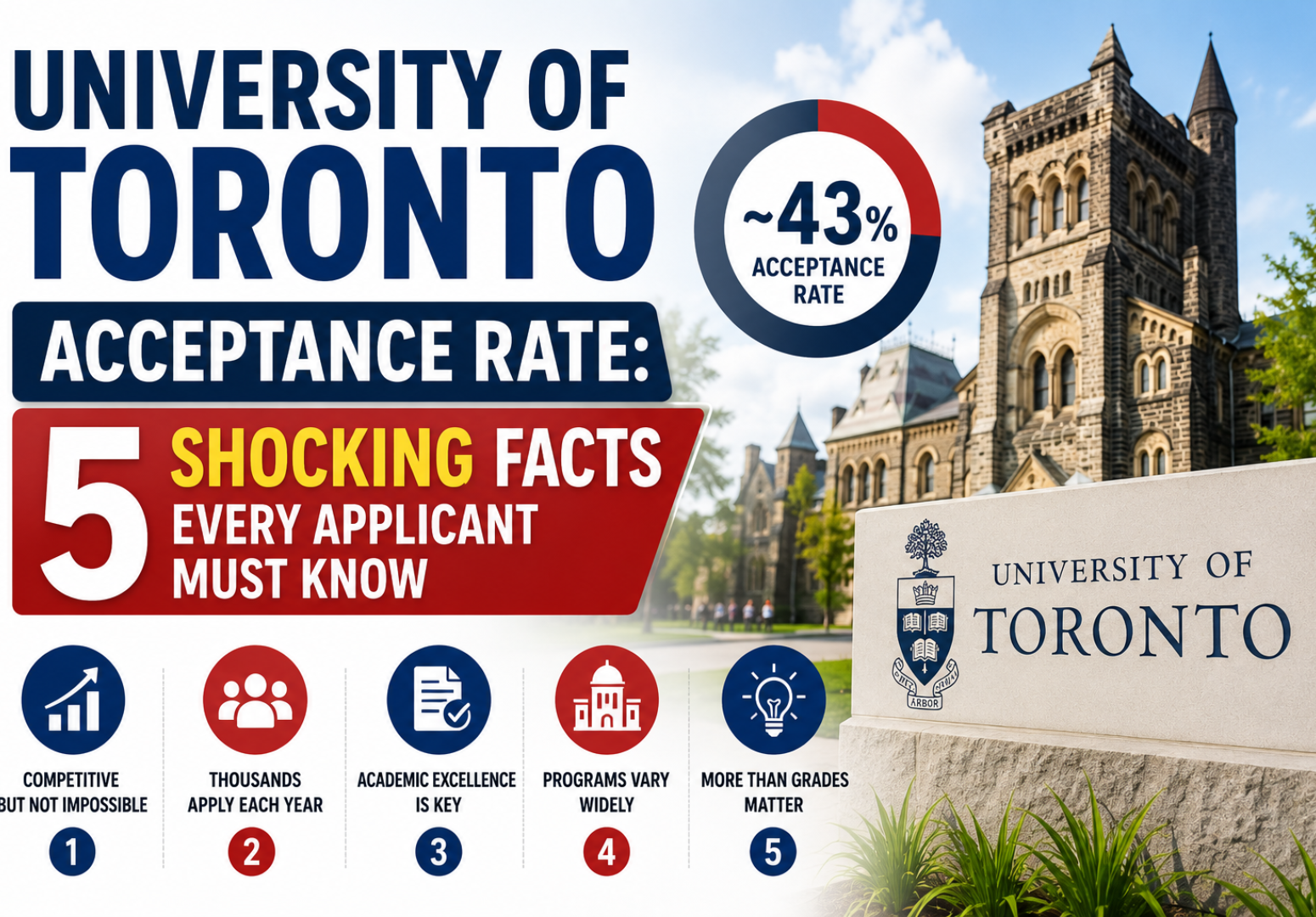
The University of Toronto acceptance rate sits at approximately 43% overall across all programs and campuses. That number sounds reasonable until you realize it includes a wide range of programs, some far more competitive than others. The overall rate can give a false sense of comfort if you’re aiming for engineering or life sciences.
For context, UofT receives well over 90,000 applications annually and admits around 17,000 to 19,000 students. That volume makes it one of the largest and most selective universities in Canada. The sheer scale of the applicant pool means even a 43% acceptance rate translates to tens of thousands of rejections every cycle.
Computer Science Admission Odds
Computer Science at the University of Toronto is among the most competitive programs in the country. Acceptance rates for CS at the St. George campus hover around 20% to 25%, with some years dipping lower depending on applicant volume. Strong grades alone are rarely enough to secure a spot.
Successful CS applicants typically present averages in the mid-to-high 90s, along with supplementary applications that demonstrate genuine interest in the field. The program evaluates technical aptitude, academic trajectory, and written communication. If your average is below 90%, your chances at St. George CS drop sharply.
Engineering Program Entry Standards
Engineering at UofT’s Faculty of Applied Science and Engineering is similarly demanding. Acceptance rates for most engineering disciplines fall between 25% and 35%. Programs like electrical and computer engineering trend toward the lower end of that range due to consistently high demand.
Applicants are required to submit a supplementary application in addition to their academic profile. Extracurriculars, work experience, and a short essay all contribute to the final decision. Grades matter most, but the supplemental materials can tip the balance between two otherwise equal candidates.
Life Sciences and Biology Rates
Life Sciences is one of the most popular program choices at UofT, and that popularity shows in the numbers. Acceptance rates for life sciences programs typically fall between 30% and 40%, with top-tier applicants often presenting averages above 90%. This is a high-stakes program for students with medical school ambitions.
The competition intensifies because many students use life sciences as a pre-med pathway. That means you’re not just competing for admission — you’re competing against a cohort that is already highly motivated and academically strong. Standing out in this pool requires more than just a strong transcript.
Business and Rotman Admission
The Rotman Commerce program at St. George is one of the most selective business programs in Canada. Its acceptance rate consistently sits below 30%, and applicants typically need a 90%+ average combined with a strong supplementary application to receive an offer.
Rotman Commerce evaluates leadership, community involvement, and career direction alongside grades. The supplementary application includes short essay questions that test your clarity of thinking and communication skills. Generic answers rarely make an impression — admissions readers can spot them immediately.
International Student Acceptance Gaps
International students face a notably different admissions landscape at UofT. While exact figures vary, acceptance rates for international applicants tend to be lower than those for domestic students in competitive programs. The university prioritizes building a globally diverse class while managing international enrollment caps.
That said, exceptional international applicants with high academic standing do gain admission regularly. The key difference is that international transcripts are evaluated on different grading scales, and UofT’s admissions team converts foreign grades into Canadian equivalents before assessing them. Understanding how your country’s grading system translates is an important early step.
St. George vs. Other Campuses
UofT has three campuses — St. George in downtown Toronto, Scarborough (UTSC), and Mississauga (UTM). Acceptance rates differ meaningfully across them. UTSC and UTM generally have higher acceptance rates than St. George for similar programs, making them strong options for students who want a UofT degree with slightly better entry odds.
Students admitted to UTSC or UTM follow distinct curriculum paths but earn the same University of Toronto degree. Some students intentionally apply to the satellite campuses to gain access to smaller class sizes and more personalized faculty interaction. Neither campus is a lesser choice — they offer different academic environments rather than a watered-down version of St. George.
How Grades Actually Work
UofT calculates its admission averages based on your top six Grade 12 U or M courses in Ontario, with specific required courses depending on your program. For most competitive programs, you need a minimum of 85%, but realistically, admitted students average well above that threshold.
The university does not publish a single cutoff average for most programs. Instead, they release a range of averages for previously admitted students. Checking the admissions profile for your specific program on UofT’s website gives you the most accurate benchmark. Treat the bottom of that range as your floor, not your target.
Supplementary Applications Matter
Many of UofT’s most competitive programs require a supplementary application in addition to your Ontario Student Transcript or international equivalent. These applications ask about extracurricular involvement, community contributions, and personal goals. They’re not optional — skipping them removes your application from consideration entirely.
The quality of your writing in these applications is evaluated closely. Admissions staff read thousands of responses and look for authenticity, specificity, and genuine reflection. Avoid listing accomplishments without context. Instead, explain what you actually did, what you learned, and why it matters to your intended field of study.
Early vs. Late Applications
Applying through OUAC by the early deadline in mid-January gives Ontario applicants the best shot at receiving an offer. UofT does conduct rolling admissions to some degree, and the best spots in certain programs go to early, complete applications. Waiting until the final deadline is a risk not worth taking for competitive programs.
International students applying through direct admission portals should check individual program deadlines, which may differ from domestic timelines. Missing a supporting document submission — transcript, English proficiency test, or reference letter — can delay your file significantly. Set calendar reminders for every deadline well in advance.
English Proficiency Requirements
International applicants whose first language is not English must submit language proficiency scores. UofT typically requires a minimum IELTS score of 6.5 overall with no band below 6.0, or a TOEFL iBT score of at least 100. Some programs set higher minimums — always check at the program level.
Meeting the minimum does not guarantee admission. Strong English proficiency scores signal to the admissions committee that you can handle the academic workload and participate fully in campus life. If your scores are at the minimum, a stronger academic profile becomes even more important to compensate.
Rejection and Reapplication Strategy
Not getting in the first time is more common than people admit. Many students who are now thriving at UofT were rejected on their first attempt. Reapplying with a stronger academic record, a revised supplementary application, and additional experience is a legitimate and often successful path.
If you were rejected, request feedback from the admissions office if it’s available. Some programs offer it, others don’t. Regardless, review your supplementary application honestly and identify where your response may have been vague or generic. The second application should feel noticeably more specific and self-aware than the first.
Alternate Offers and Redirection
UofT sometimes extends alternate program offers to applicants who were not admitted to their first-choice program. These are not consolation prizes — they’re legitimate offers to strong candidates whose specific program was oversubscribed. Accepting an alternate offer and excelling in first year can open transfer pathways into your preferred program.
Internal program transfers at UofT are competitive but possible. Students who perform well in their first year with a high GPA are considered for transfer into programs like CS or engineering. Entering through an alternate offer and grinding through first year is a strategy that has worked for many students.
Graduate Admission Differences
Graduate admission rates at UofT differ significantly from undergraduate figures. Many graduate programs, particularly at the doctoral level, admit only 10% to 15% of applicants. Research fit with a supervisor is often the deciding factor at this level, more so than GPA alone.
Master’s programs vary widely. Professional master’s programs like the MBA or Master of Engineering Management tend to have higher acceptance rates. Research-based master’s programs are more selective and often tied to available funding and faculty capacity. Reaching out to potential supervisors before applying is common practice and often expected.
Post-Graduation Career Outcomes
One reason the University of Toronto acceptance rate matters so much is the weight of the degree in the job market. UofT graduates consistently rank among the most sought-after in Canada by employers. For careers in law, medicine, finance, and technology, a UofT credential carries significant weight in competitive hiring.
According to data published by the University of Toronto’s institutional research office, graduates report strong employment outcomes within six months of graduation across most faculties. The university’s location in Toronto — Canada’s financial and tech hub — means internship and employment networks are accessible throughout your degree, not just after it.
Teaching and Academic Career Paths
For students who aspire to academic or teaching careers after UofT, the path forward involves more than just a degree. Graduate training, research publications, and competitive academic job markets all shape what comes next. If you’re considering a career in education or academia, understanding salary expectations and promotion timelines is just as important as admission odds — a detailed breakdown of the assistant professor career path and salary offers useful context for those weighing the long-term academic route after their UofT education.
Knowing your end goal when applying also helps you choose the right program from the start. Students with clear career direction tend to write stronger supplementary applications and make more deliberate academic choices throughout their degree.
Final Thoughts about the University of Toronto Acceptance Rate
University of Toronto acceptance rate numbers tell part of the story, but they don’t tell all of it. Behind every percentage is a cohort of real students who prepared deliberately, applied strategically, and made their case clearly through grades, applications, and personal statements. The rate isn’t destiny — it’s a benchmark.
If UofT is your goal, start preparing earlier than you think necessary. Build your grades consistently across Grade 11 and 12. Choose your extracurriculars with intention rather than volume. Write your supplementary application like someone who genuinely knows why they want to be there. Admissions readers notice the difference between a student who applied to UofT because of its ranking and one who articulates a specific reason connected to their actual goals.
The university’s three campuses, hundreds of programs, and diverse community mean there’s genuinely a path for many different kinds of students. Don’t fixate on St. George if another campus or a slightly different program offers the same academic rigor and career outcomes. Flexibility in your application strategy increases your actual odds of success without compromising your ambitions.
Ultimately, applying to the University of Toronto is worth the effort for the right student. The acceptance rate is competitive but not discouraging. It rewards preparation, clarity, and academic consistency — all things within your control. Go in with accurate expectations, apply early, write with honesty and specificity, and let your actual record do the talking.
FAQs about University of Toronto Acceptance Rate
What is the University of Toronto acceptance rate overall?
The overall acceptance rate at UofT is approximately 43%, but this varies widely by program. Competitive programs like Computer Science and Rotman Commerce have acceptance rates closer to 20% to 30%.
Is it harder to get into University of Toronto Acceptance Rate as an international student?
Generally yes, especially for high-demand programs. International applicants face additional evaluation steps, including grade conversion and English proficiency requirements. Acceptance rates for international students in selective programs tend to be lower.
What average do I need to get into University of Toronto Acceptance Rate?
Most competitive programs require averages of 90% or higher. Less competitive programs may admit students with averages in the mid-to-high 80s. Always check the specific program admission profile on UofT’s website for the most current data.
Does University of Toronto Acceptance Rate use rolling admissions?
UofT does review applications on a rolling basis for some programs, meaning earlier applicants may receive decisions sooner. Submitting a complete application before the January OUAC deadline gives domestic applicants the best advantage.
Can I transfer into a competitive program after being admitted to a less selective one?
Yes, internal transfers are possible. Students who achieve strong GPAs in their first year can apply to transfer into programs like Computer Science or Engineering. Exact requirements vary by program, so review the transfer criteria before your first semester begins.