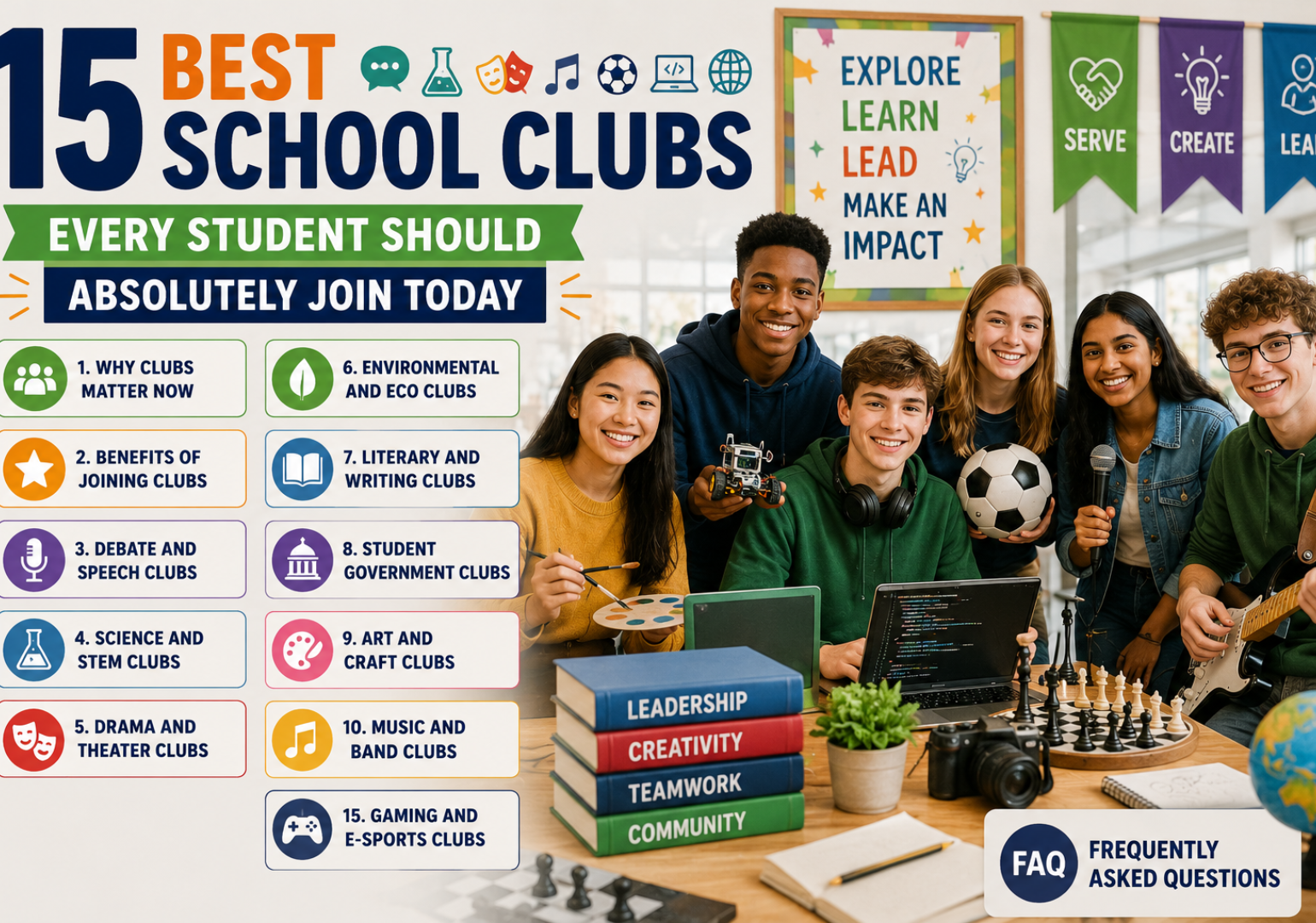
Why Clubs Matter Now
School clubs are one of the most underrated parts of student life. While academics get all the attention, it is often what happens after the bell rings that shapes who a student actually becomes. Clubs teach teamwork, responsibility, communication, and real-world skills that no textbook can fully deliver.
Think about the students who land internships before graduation or walk into job interviews with actual stories to tell. A lot of them were not just good at exams — they were active in clubs. That participation gave them something to talk about, something they built with their own hands and effort.
Benefits of Joining Clubs
The advantages of joining school clubs go far beyond putting something nice on a college application. When students regularly show up for a club, they develop a sense of belonging that is hard to find anywhere else in school. That sense of community keeps them engaged, motivated, and less likely to drift.
Research consistently shows that students involved in extracurricular activities tend to have higher GPAs and better attendance records. There is also the skill-building angle — students learn to manage their time, work with different personalities, and handle pressure in low-stakes environments. These are life skills for students that stay with them long after graduation.
Debate and Speech Clubs
Debate clubs are where quiet students often find their loudest voice. The structure of competitive debate forces students to research both sides of an argument, think on their feet, and present ideas with clarity and confidence. It is uncomfortable at first — and that discomfort is exactly the point.
Speech clubs work differently but target similar outcomes. Whether it is public speaking, storytelling, or oratory competitions, these clubs train students to communicate with purpose. Students who go through a few semesters of debate or speech almost always report feeling more confident in class discussions, presentations, and even everyday conversations.
Science and STEM Clubs
STEM clubs have exploded in popularity over the last decade, and for good reason. School clubs focused on science, technology, engineering, and math give students hands-on experience that classroom labs rarely provide. Building robots, running experiments, writing code — these are real activities with real outcomes.
Science Olympiad, robotics teams, and coding clubs fall under this umbrella. They also create natural mentorship pathways because older members teach newer ones. For students even slightly interested in technical careers, joining a STEM club early is one of the best decisions they can make. The problem-solving mindset it builds carries into every field.
Drama and Theater Clubs
Theater is about much more than acting. School clubs in drama teach students stagecraft, scriptwriting, lighting, sound, costume design, and the hard work of pulling off a live performance in front of real people. Every role on and off stage requires discipline and teamwork.
Students who join theater often surprise themselves. Shy students learn to project. Disorganized students learn to stick to a production schedule. And there is something uniquely powerful about standing on a stage after weeks of rehearsal and delivering something the audience actually feels. Theater builds emotional intelligence in ways that are genuinely difficult to replicate elsewhere.
Environmental and Eco Clubs
Environmental clubs connect students to something bigger than themselves. Whether it is running recycling programs, planting school gardens, organizing clean-up drives, or pushing for sustainable school policies, these school clubs turn awareness into action.
Students in eco clubs often develop a sharper sense of civic responsibility. They learn how to organize a campaign, work with administration, and get community support for a cause. In a time when climate issues dominate global headlines, students who understand sustainability and environmental advocacy are entering a world that desperately needs them.
Literary and Writing Clubs
Writing clubs are a quiet powerhouse among school clubs. Students who join them — whether it is a creative writing group, a poetry collective, or a school newspaper — sharpen one of the most important skills a person can have: the ability to communicate ideas clearly in written form.
School newspapers in particular teach students journalism basics: how to report fairly, write on deadline, edit for clarity, and hold institutions accountable in a small but meaningful way. Creative writing groups provide a safe space to experiment with voice and style. Literary clubs often lead students toward careers in law, communications, marketing, journalism, and publishing.
Student Government Clubs
Student council and government clubs are often dismissed as popularity contests. That is a misread. At their best, these school clubs teach students how real institutions function — how decisions get made, how competing interests get balanced, and how to advocate effectively for a group of people with different needs.
Students in government clubs learn to run meetings, draft proposals, manage budgets, and speak in front of administrators. These are skills that translate directly into adult professional life. Students who take their council roles seriously often walk into college and career environments already knowing how to lead.
Art and Craft Clubs
Art clubs give students a creative outlet that pure academics rarely offer. Whether it is painting, sculpture, digital design, photography, or printmaking, school clubs centered on visual art teach students to observe closely, think visually, and express ideas without words.
Art clubs also build patience and attention to detail — qualities that are undervalued until you actually need them. Students who participate in art programs often develop stronger spatial reasoning and creative problem-solving skills. And in an increasingly design-driven world, visual literacy is becoming a professional asset across almost every industry.
Music and Band Clubs
Learning an instrument is one of the most cognitively demanding things a young person can do. School clubs centered on music — whether a full orchestra, a jazz band, an a cappella group, or a contemporary music ensemble — train the brain in ways that transfer to academic performance.
According to the National Endowment for the Arts, students who participate in music education consistently show improvements in reading comprehension, math skills, and overall academic motivation. Beyond the cognitive benefits, music clubs build discipline, practice habits, and the ability to perform under pressure. These are traits that follow students into every corner of their lives.
Sports and Athletic Clubs
Not every student wants to compete on varsity teams — and that is fine. School clubs in recreational and intramural sports fill an important gap. They give students the physical activity, team experience, and competitive spirit of sport without the intense pressure of elite athletic programs.
Intramural basketball, ultimate frisbee, hiking clubs, chess boxing, badminton — the variety is wider than most students realize. Physical activity directly supports mental health, and school clubs that prioritize movement and fun over rankings help more students stay active and socially connected throughout the school year.
Coding and Tech Clubs
Coding clubs are one of the fastest-growing types of school clubs in the world right now. The reason is straightforward: digital literacy is no longer optional. Students who learn to write code early have a genuine advantage — not just in tech careers, but in virtually every modern industry.
These clubs teach HTML, Python, app development, game design, and cybersecurity basics depending on the school and the teacher. Many coding clubs also participate in national competitions like hackathons, giving students real deadlines and real audiences for their work. The problem-solving habits students build in coding clubs are among the most versatile they will ever develop.
Cultural and Language Clubs
Cultural clubs celebrate the diversity that exists within schools and help students from all backgrounds feel seen. French club, Korean culture club, Hispanic heritage group — these school clubs teach languages, traditions, food, history, and perspectives that the standard curriculum rarely covers in depth.
For students learning a second language, cultural clubs provide real conversational practice in a low-pressure setting. For others, they are a window into worlds they have never encountered. In an increasingly interconnected world, the intercultural awareness students build through these clubs is a professional and personal asset that keeps paying dividends.
Volunteering and Service Clubs
Service clubs like Key Club, NHS, or school-run community service organizations put students directly in contact with real community needs. These school clubs organize food drives, tutoring programs, hospital visits, fundraisers, and advocacy campaigns. They make abstract concepts like empathy and social responsibility into concrete, weekly habits.
Students who consistently volunteer also report lower levels of stress and higher feelings of purpose — outcomes backed by psychological research. Beyond personal benefits, service club involvement signals genuine character to colleges and employers. It shows that a student chose to give time without being required to, and that says something important.
Gaming and E-Sports Clubs
E-sports clubs are relatively new in most schools, but they are growing quickly. Competitive gaming is now a legitimate extracurricular activity with scholarships, college programs, and professional leagues behind it. School clubs in this space teach students strategy, teamwork, fast decision-making, and even media presence through streaming and commentary.
For students who love gaming, having a school-sanctioned club for it legitimizes a hobby and gives it structure. Teams compete, practice schedules are kept, and students learn the same collaboration and communication skills found in traditional sports clubs. The stigma around gaming as a “non-serious” activity is disappearing fast — and rightly so.
FAQ
What are the benefits of school clubs for students?
School clubs help students build real-world skills like teamwork, leadership, public speaking, and time management. They also improve academic performance, mental health, and social connections that last well beyond graduation.
How many school clubs should a student join?
Most counselors suggest one to three clubs depending on a student’s schedule and commitments. Quality of involvement matters more than quantity. Deeply engaging with one club beats showing up passively to five.
Can school clubs help with college applications?
Absolutely. Admissions teams look for sustained extracurricular involvement that shows genuine passion and growth. A student who stuck with a single school club for three years and took on a leadership role tells a far stronger story than one who listed ten clubs they barely attended.
Which school clubs are best for career preparation?
It depends on the field, but debate, student government, coding, journalism, and service clubs consistently appear as strong career-preparation options. Any club that requires students to take on responsibility and work toward a real outcome will build skills that transfer to professional settings.
Conclusion
School clubs are not a side dish to the main meal of academics — they are part of the core experience of growing up and figuring out who you are. The students who engage with even one meaningful club tend to leave school with more confidence, more skills, and a clearer sense of direction than those who never tried.
Whether a student is drawn to drama, debate, robotics, or community service, there is a school club out there that fits. The key is to actually show up, stay consistent, and take on a little more responsibility than feels comfortable. That stretch is where the real growth happens.
School clubs also build the kind of friendships that come from working toward something together — friendships that outlast graduation. In a world where loneliness among young people is increasingly recognized as a public health concern, having a weekly reason to gather around a shared purpose matters more than ever.
Every school has clubs. Not every student uses them. The ones who do — especially those who take them seriously — tend to look back and say it was some of the most valuable time they spent in those years. That is not nostalgia talking. That is just what happens when young people are given the chance to build something real, together.