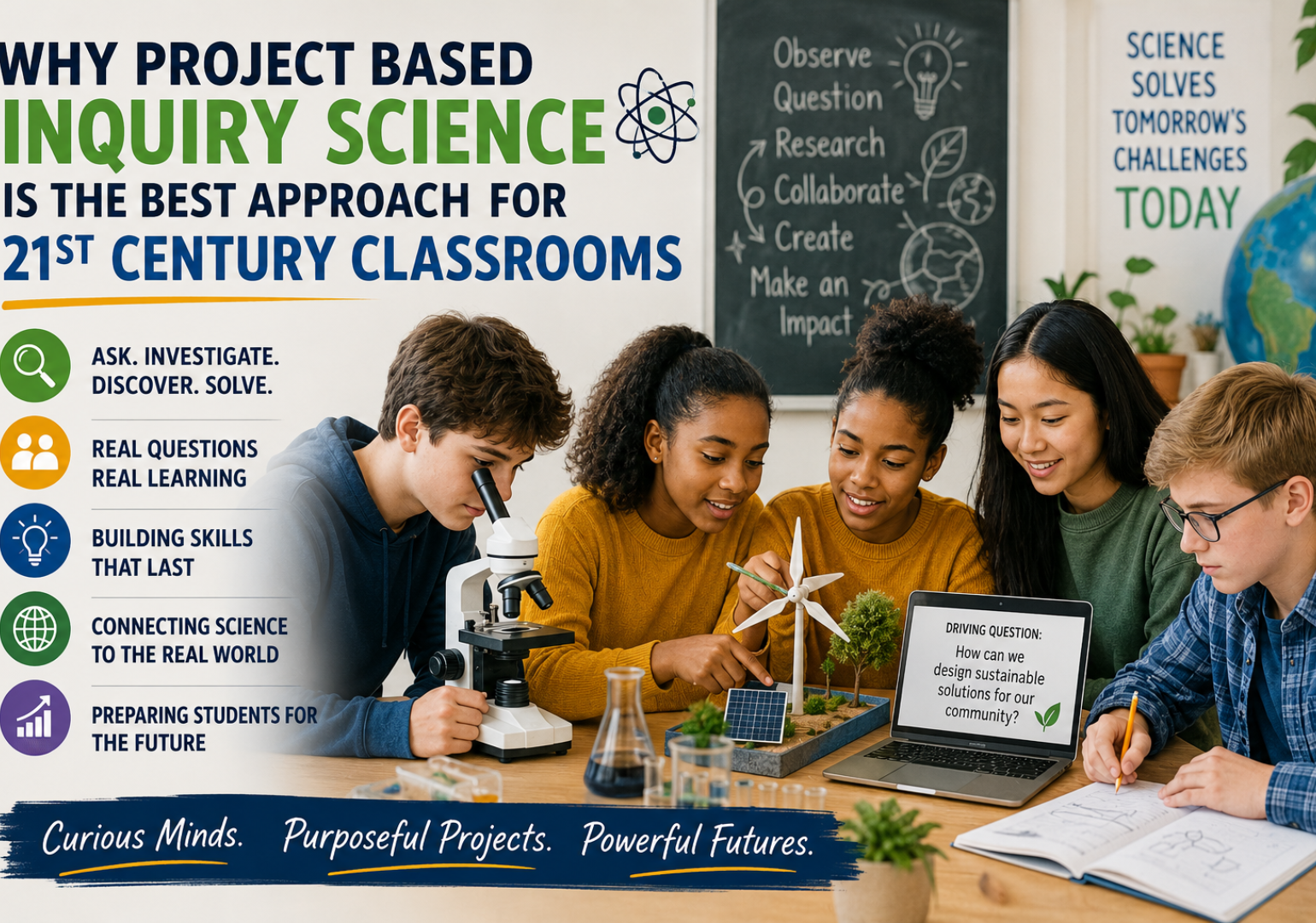
Project based inquiry science is not just another education buzzword. It is a genuine shift in how students experience learning — from passive receivers of information to active investigators who ask real questions, test real ideas, and reach real conclusions. In classrooms where this model runs well, you don’t see students waiting to be told what to think. You see them arguing over data, redesigning failed experiments, and genuinely caring whether their hypothesis holds up.
The 21st century demands more from students than memorization. Employers, universities, and society at large need people who can collaborate, think critically, and adapt when things go sideways. Project based inquiry science builds exactly those capacities — not as a side effect, but as a core intention.
What Project Based Inquiry Science Is
Project based inquiry science is a teaching model that combines two powerful ideas: project based learning and inquiry-driven investigation. Students work on extended, meaningful projects built around real scientific questions. They don’t just read about ecosystems — they study one. They don’t memorize the water cycle — they build a model, observe it, and challenge their assumptions about how it works.
This approach treats curiosity as a starting point rather than a distraction. A student wondering why the school garden drains faster after it rains isn’t going off topic — they’re doing science. The teacher’s job becomes less about delivering answers and more about helping students refine their questions and pursue evidence. That’s a fundamentally different kind of teaching, and it produces a fundamentally different kind of learner.
Why Traditional Science Teaching Falls Short
Most traditional science classrooms follow the same pattern: introduce a concept, demonstrate it, have students practice it, then test them on it. That cycle has value, but it also has serious limits. Students learn to perform understanding without always developing it. They can label a diagram of a cell without knowing what cells actually do or why that matters to them personally.
Research shows that students retain significantly more when they learn through doing rather than listening. Studies suggest active learning strategies can improve retention by up to 75% compared to passive lecture formats. Project based inquiry science addresses this gap directly. When a student spends three weeks investigating water quality in a local stream, the science becomes personal. innovative education systems show this kind of place-based, student-driven science consistently outperforms traditional instruction on both engagement and retention metrics.
The Role of Questioning in Student Learning
Questions are the engine of project based inquiry science. Not the teacher’s questions — the students’ questions. When a class begins a unit by generating their own list of things they genuinely want to know, the dynamic of the room changes. Students feel a sense of ownership over the investigation that no worksheet can produce.
Good questioning doesn’t come naturally to every student at first. Many have spent years in classrooms where the question was already provided and the answer was already known. Teaching students to ask productive scientific questions — ones that can actually be investigated — is a skill that develops over time. But once it clicks, it changes how students interact with everything they learn, not just science.
How Projects Build Real Scientific Skills
A well-designed project in project based inquiry science doesn’t just produce a poster or a presentation. It produces real scientific thinkers. Students learn to form testable hypotheses, collect and analyze data, identify variables, deal with unexpected results, and revise their thinking based on evidence. These aren’t abstract skills — they’re the exact skills used in every scientific field and in most professional environments.
Consider a class investigating the effect of different fertilizers on plant growth. Over the course of a month, students design their experiment, control variables, collect weekly measurements, graph their results, and write up their findings. At every stage, they’re making decisions that real scientists make. The subject matter is simple enough for a middle schooler, but the thinking process is sophisticated. That’s what project based inquiry science does well — it makes rigorous thinking accessible.
Collaboration as a Core Component
Science rarely happens alone, and project based inquiry science reflects that reality. Students work in teams, divide responsibilities, debate interpretations, and sometimes reach different conclusions from the same data. Learning to navigate that kind of collaborative messiness is genuinely valuable — not just for future scientists, but for future humans in any field.
Group work in this model isn’t filler. It’s structured around real roles and real accountability. One student might lead data collection while another manages the documentation and a third prepares the presentation. When something goes wrong — and it often does — the group has to figure out together why it went wrong and what to try next. That process builds problem-solving habits that last far longer than any specific science fact.
Project Based Inquiry Science Across Grade Levels
One of the strongest arguments for project based inquiry science is how well it scales. A kindergarten class can investigate which materials absorb the most water. A third-grade class can study local bird populations. A high school class can analyze air quality data from their own neighborhood. The depth and complexity adjust, but the core process stays the same — question, investigate, analyze, communicate.
This consistency matters. When students experience inquiry-based learning from early grades onward, it becomes their default mode for approaching problems. By the time they reach high school, they’re not learning how to think scientifically for the first time — they’re applying a habit of mind they’ve been building for years. That kind of cumulative development is hard to achieve through isolated units or one-off experiments.
Teacher’s Shifting Role in the Classroom
In a project based inquiry science classroom, the teacher is not the primary source of information. That shift makes some educators uncomfortable at first, and honestly, that’s understandable. Teaching this way requires a different kind of preparation and a higher tolerance for uncertainty. You can’t always predict where a student’s investigation will lead.
According to the National Science Teaching Association, effective inquiry-based science instruction requires teachers to act as facilitators who guide student thinking rather than direct it. That means asking questions instead of giving answers, resisting the urge to correct every misconception immediately, and trusting the process enough to let students struggle productively. It’s harder than lecturing, but the results speak clearly.
Assessment Looks Different Here
Traditional tests don’t capture what project based inquiry science develops. A multiple-choice exam can check whether a student knows what photosynthesis is, but it can’t show whether that student can design an experiment to observe it, interpret the results, and explain what they mean to someone else. Assessment in this model has to match what’s actually being learned.
Performance-based assessment is the natural partner of project based inquiry science. Students present their findings, defend their conclusions, and respond to questions from peers and teachers. Portfolios document the evolution of their thinking over the course of a project. Rubrics evaluate process as well as product. This approach is more work to design, but it gives a much more accurate picture of what students actually know and can do.
Connecting Science to Real Community Issues
Some of the most powerful projects in project based inquiry science connect directly to issues students already care about in their own communities. Water quality, urban heat islands, local food systems, air pollution — these are real problems that real scientists are studying, and they’re problems students can investigate at a meaningful level with proper guidance.
When a class in an urban neighborhood spends a semester measuring particulate matter levels near a busy intersection and comparing them to a quieter street two blocks away, science stops being abstract. The data they collect is real. The implications are real. And the experience of doing actual science — with real stakes and real uncertainty — is completely different from reading about how scientists do science in a textbook.
Standards Alignment and Curriculum Fit
A common concern about project based inquiry science is whether it aligns with required standards. The answer, in most cases, is yes — but it requires intentional planning. The Next Generation Science Standards were built with inquiry in mind. They emphasize practices like asking questions, planning investigations, analyzing data, and constructing explanations, all of which are central to this model.
The key is backwards design. Start with the standards you need to hit, then build a project that requires students to engage with those standards meaningfully. Done well, a single project can address multiple standards across several weeks while also developing skills that no standard can fully capture. The curriculum fit isn’t accidental — it’s built in from the start.
Technology’s Role in Inquiry Projects
Technology extends what’s possible in project based inquiry science without replacing the core experience of investigation. Students can use sensors and data loggers to collect more precise measurements than the human eye allows. They can connect with scientists and researchers through video calls. They can access real datasets from NASA, NOAA, or local environmental agencies and analyze data that was collected in the field.
The technology shouldn’t drive the project — the question should. But when the right tool is available at the right moment, it can dramatically expand the scope and quality of student investigations. A group studying local weather patterns gains a lot from access to historical climate data they couldn’t collect themselves. That’s technology serving inquiry, which is exactly the right relationship.
Parent and Community Understanding
One friction point in rolling out project based inquiry science is that it looks very different from what most parents experienced in school. When their child comes home talking about an experiment that “didn’t work,” some parents worry the class isn’t covering the material. That’s a communication challenge worth taking seriously.
Schools that do this well make the learning visible early. They share the driving questions, the project timelines, and the checkpoints along the way. They invite parents to presentations and exhibitions where students explain what they investigated and what they found. When families can see the rigor and depth of the work, skepticism usually gives way to genuine enthusiasm. It just takes consistent, proactive communication to get there.
Common Mistakes Schools Make
Not every attempt at project based inquiry science lands well, and it’s worth being honest about why. One common mistake is designing projects where the outcome is predetermined. If the teacher already knows what the students are supposed to find, it’s not really inquiry — it’s a guided activity with a science costume on. Real inquiry means genuine uncertainty about the outcome, and that requires teachers to trust students with real open-ended questions.
Another mistake is skipping the scaffolding. Inquiry doesn’t mean students are just set loose with no support. Young learners especially need structured frameworks for forming questions, planning investigations, and interpreting results. The scaffolding should fade over time as students build competence, but it shouldn’t disappear entirely in the early stages. The goal is independence — not confusion.
Evidence That This Model Works
The research base for project based inquiry science is solid and growing. Multiple studies have shown that students in inquiry-based science programs outperform peers in traditional programs on both conceptual understanding and science process skills. A 2021 meta-analysis found that inquiry-based approaches produced significantly higher learning gains across elementary and middle school populations.
Beyond test scores, the effects on student engagement and scientific identity are striking. Students who experience project based inquiry science are more likely to describe themselves as someone who can do science. That shift in identity matters enormously — especially for students from groups historically underrepresented in STEM fields. Feeling like a scientist, not just a student in science class, changes trajectories.
Getting Started Without Overhauling Everything
You don’t need to redesign your entire curriculum to start using project based inquiry science. The most practical approach is to begin with a single unit — ideally one where students already show curiosity or where you have access to a real local context. Replace the traditional lesson sequence with a driving question. Let students generate sub-questions. Build in time for investigation and revision.
It won’t be perfect the first time. The first project you run will teach you more about your students’ capacity for inquiry than any assessment you’ve ever given. Pay attention to where they get stuck — those are the places where your next project can offer better scaffolding. Improvement is iterative, which is appropriate given that project based inquiry science is fundamentally a model built on learning from what doesn’t work.
Long Term Impact on Student Futures
The skills developed through project based inquiry science don’t stay in the classroom. Students who have spent years asking good questions, testing ideas, working in teams, and revising their thinking based on evidence carry those habits into every context they enter. College professors notice it. Employers notice it. Even students themselves often report that their science experiences in earlier grades shaped how they approach problems in completely unrelated fields.
Science is ultimately a way of thinking — a commitment to evidence, a tolerance for uncertainty, and a willingness to be wrong in service of getting it right. Project based inquiry science teaches that way of thinking at an age when it can genuinely take root. And once it does, it tends to stay.
FAQ
What is project based inquiry science and how is it different from regular science class?
Project based inquiry science combines project-based learning with inquiry-driven investigation. Unlike regular science class where teachers lead instruction and students follow along, this model starts with a real question and lets students drive the investigation. The teacher facilitates rather than delivers, and the learning emerges through doing rather than listening.
What grade levels benefit most from project based inquiry science?
Every grade level benefits, from kindergarten through high school. The complexity of the projects scales with the age and development of the students, but the core process — question, investigate, analyze, communicate — works across all grades. The earlier students are introduced to this approach, the more naturally it becomes their default way of engaging with problems.
How do teachers assess students in a project based inquiry science classroom?
Assessment shifts from traditional tests to performance-based approaches. Students present their findings, create portfolios that document their thinking process, and defend their conclusions to peers and teachers. Rubrics evaluate both the process and the product, giving a fuller picture of what students have actually learned compared to a multiple-choice exam.
Can project based inquiry science meet required curriculum standards?
Yes. When planned with backwards design — starting with the required standards and building the project around them — project based inquiry science can address multiple standards within a single extended investigation. The Next Generation Science Standards in particular were written with inquiry practices in mind, making them a natural fit for this model.
Conclusion
Project based inquiry science is not a trend. It is a well-researched, practically effective model that aligns with how students actually learn and what the world actually needs from them. When students investigate real questions, work through genuine uncertainty, collaborate with peers, and communicate their findings, they are doing science — not just studying it.
The 21st century classroom cannot afford to keep treating science as a set of facts to be memorized and tested. The challenges students will face — environmental, technological, medical, social — require people who know how to think scientifically, not just people who know scientific terms. Project based inquiry science builds those thinkers. It does so in ways that are engaging, standards-aligned, scalable across grade levels, and grounded in decades of evidence.
Starting small is fine. Running one inquiry project in a semester is better than running none. Watching what happens when students are trusted with real questions tends to be convincing enough to keep going. The approach earns its reputation in practice, not just in theory, and that is exactly what you would expect from a model built on the value of firsthand experience.