

Looking for H Net Jobs? Discover the latest job openings, career opportunities, recruitment updates, and employment resources to help you find the right position and advance your career.
If you are in the academic, research, or humanities field, navigating the job market can be overwhelming. There are dozens of job boards, university postings, and professional networks, but finding positions that align with your training and expertise is challenging. One of the most trusted platforms for academic job seekers is H Net Jobs, also known as the H-Net Job Guide.
H Net Jobs focuses specifically on opportunities in the humanities and social sciences, providing targeted listings that are highly relevant to graduate students, postdoctoral researchers, early-career scholars, and academic professionals. Unlike general job boards, H Net is curated for a specific audience, meaning the listings are more relevant, less cluttered, and more likely to match your qualifications and career goals.
In this guide, we will explore the platform in depth, including how it works, how to navigate its features, common mistakes to avoid, and advanced strategies to maximize your success. Whether you are looking for faculty positions, research fellowships, administrative roles, or non-traditional academic opportunities, this guide will give you the tools to succeed.
What is H Net Jobs?
Origins and Purpose
H Net, short for Humanities & Social Sciences Online, is a nonprofit academic network founded in the 1990s to connect scholars in the humanities and social sciences. Its primary mission is to facilitate communication, collaboration, and professional development among researchers.
The H-Net Job Guide is one of its most important features. It is a specialized job board that caters to academic professionals, offering listings for faculty positions, research roles, administrative jobs, and fellowships. Its focus on humanities and social sciences makes it unique compared to mainstream job boards like Indeed, Monster, or LinkedIn.
Who Should Use H Net Jobs?
H Net Jobs is useful for a variety of professionals:
- Graduate Students: Those completing a master’s or doctoral degree can use it to understand the academic job landscape and prepare early for applications.
- Postdoctoral Researchers: Offers access to short-term research appointments, fellowships, and full-time positions.
- Early-Career Faculty: Ideal for tracking openings for assistant or associate professor positions.
- Librarians, Archivists, and Museum Professionals: Positions in these fields are often listed alongside traditional faculty roles.
- Nonprofit and Research Professionals: Some academic-adjacent positions, such as research coordinators or program directors, appear on H Net Jobs.
The platform is global, with many positions in the U.S., U.K., Canada, Australia, and other English-speaking countries, as well as some international opportunities.
How H Net Jobs Works
Navigating the Platform
H Net Jobs offers a clean interface with features designed to help academic professionals find relevant roles:
- Browse by Discipline: History, literature, philosophy, social sciences, digital humanities, and interdisciplinary studies.
- Filter by Institution Type: Universities, research institutes, libraries, museums, or nonprofit organizations.
- Search by Geography: Domestic and international roles, allowing users to explore opportunities across countries.
- Deadline Tracking: Each posting includes deadlines and application instructions.
The platform also allows advanced searches using keywords, discipline codes, or combined filters. Using these features strategically is key to finding positions that match your skills.
Anatomy of a Job Posting
Most H Net listings include:
- Job Title: Examples include Assistant Professor of History, Research Fellow in Digital Humanities, or Program Director of Cultural Studies.
- Institution Name: The university or organization offering the position.
- Location: City, state, and country.
- Required Qualifications: Education, experience, publications, and specific skills.
- Application Deadline: Essential for timely submissions.
- Submission Instructions: CV, cover letter, teaching/research statement, references, or other documents.
Understanding these elements allows you to quickly assess whether the position is a good fit.
Types of Jobs on H Net
H Net Jobs offers a wide variety of roles beyond traditional faculty positions:
- Tenure-Track Faculty: Assistant or associate professor positions, usually requiring a PhD and a record of research.
- Adjunct and Lecturer Roles: Non-tenure teaching positions, sometimes with flexible or part-time schedules.
- Postdoctoral Fellowships: Short-term research positions to develop your scholarship.
- Research and Administrative Positions: Research coordinators, program managers, librarians, archivists, and museum curators.
- Fellowships and Grants: Opportunities to fund independent research or collaborative projects.
By broadening your search beyond just tenure-track roles, you can discover opportunities that match your expertise and career goals.
Maximizing Your H Net Job Search
Building an Effective Strategy
- Use Advanced Filters: Target by discipline, location, or institution type to reduce irrelevant results.
- Set Up Alerts: Email or RSS alerts ensure you see new postings immediately.
- Bookmark Searches: Save search parameters for efficiency.
- Track Deadlines: Academic applications often have strict, early deadlines.
- Use Multiple Keywords: Combine job titles, disciplines, and skills for comprehensive searches.
Preparing Your Materials
Applications require precision and clarity. Essential documents include:
- Curriculum Vitae (CV): A detailed academic CV including education, publications, research projects, teaching experience, awards, and professional service.
- Cover Letter: Tailored for each position, emphasizing alignment with the institution’s mission and needs.
- Teaching Statement: Describe your teaching philosophy, methods, and experience.
- Research Statement: Outline ongoing and future research agendas.
- References: Secure letters from mentors, supervisors, or collaborators who can speak to your qualifications.
- Portfolio: Include publications, writing samples, or digital projects as needed.
Common Mistakes and How to Avoid Them
Many applicants misuse H Net Jobs by:
- Applying only to faculty roles and ignoring postdoc, research, or administrative opportunities.
- Submitting generic applications without tailoring materials.
- Waiting until the last minute to prepare documents.
- Focusing solely on prestigious institutions and ignoring smaller universities or research institutes.
- Not leveraging repeated keyword variations or checking multiple search filters.
Avoiding these mistakes increases your chances of success.
H Net Jobs vs Other Academic Job Boards
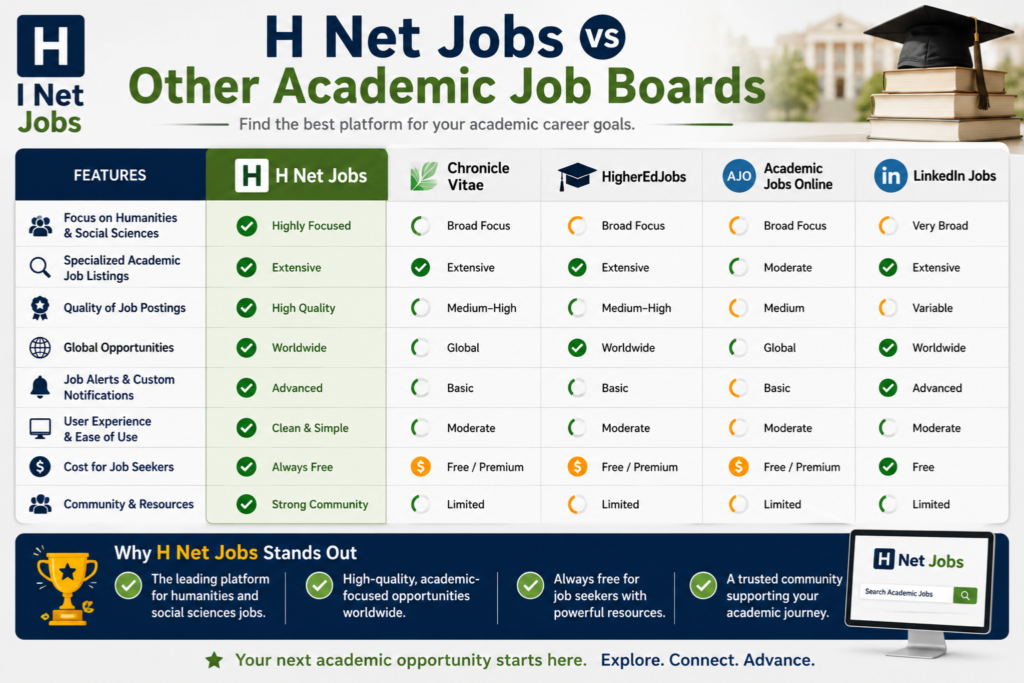
| Feature | H Net Jobs | ChronicleVitae | HigherEdJobs |
|---|---|---|---|
| Humanities Focus | ✔ | ✔ | Partial |
| Faculty Positions | ✔ | ✔ | ✔ |
| Postdoc & Fellowship | ✔ | Partial | ✔ |
| International Listings | ✔ | Moderate | Moderate |
| Email Alerts | ✔ | ✔ | ✔ |
H Net Jobs is especially valuable for humanities-focused candidates because of its specialization and community network.
How to Read a Listing Like a Pro
- Assess the Title Carefully: Look beyond the label. A “Lecturer” in one school may be more stable than a “Visiting Assistant Professor” elsewhere.
- Focus on Qualifications: Match required vs preferred qualifications against your profile.
- Understand Duties: Teaching, research, service, or administrative responsibilities.
- Check Documentation Requirements: Missing documents can disqualify you immediately.
- Analyze Language: Look for keywords like “interdisciplinary,” “diversity,” or “digital humanities” to tailor your materials.
Advanced Job Search Tips
- Create a Master Spreadsheet: Track postings, deadlines, and application status.
- Maintain Updated Profiles: Faculty pages, LinkedIn, ResearchGate, and Google Scholar.
- Network Strategically: Contact department heads, program directors, and colleagues.
- Study Trends: Review postings regularly to understand emerging skills, preferred experience, and common requirements.
- Tailor Applications: Customize cover letters, research statements, and CVs to every posting.
Case Studies: Examples of H Net Jobs

Tenure-Track Faculty
- Position: Assistant Professor of Medieval History
- Requirements: PhD, publications in peer-reviewed journals, teaching experience
- Notes: Demonstrates competitive standards and deadlines.
Research & Administrative Roles
- Position: Digital Humanities Coordinator
- Requirements: Experience in archiving, data management, digital tools
- Opportunity: Broader applicability for interdisciplinary candidates.
Frequently Asked Questions (FAQs)
Q1: What is H Net Jobs?
A: An academic and humanities-focused job board for research and teaching roles worldwide.
Q2: Who uses H Net Jobs?
A: Graduate students, postdocs, early-career faculty, librarians, archivists, and nonprofit researchers.
Q3: Is it free?
A: Yes, job seekers can browse and apply without cost.
Q4: How often are postings updated?
A: Weekly, particularly during academic hiring seasons.
Q5: Can non-academics benefit?
A: Yes, some administrative and research positions are listed.
Conclusion
H Net Jobs is more than a job board—it is a gateway into the academic world of the humanities and social sciences. By understanding its structure, leveraging advanced search features, preparing tailored applications, and exploring non-faculty roles, candidates can find relevant opportunities efficiently.
Whether your goal is tenure-track teaching, postdoctoral research, or interdisciplinary projects, H Net Jobs provides a focused, curated, and valuable resource for serious academic job seekers.—it’s a gateway to global academic networks.