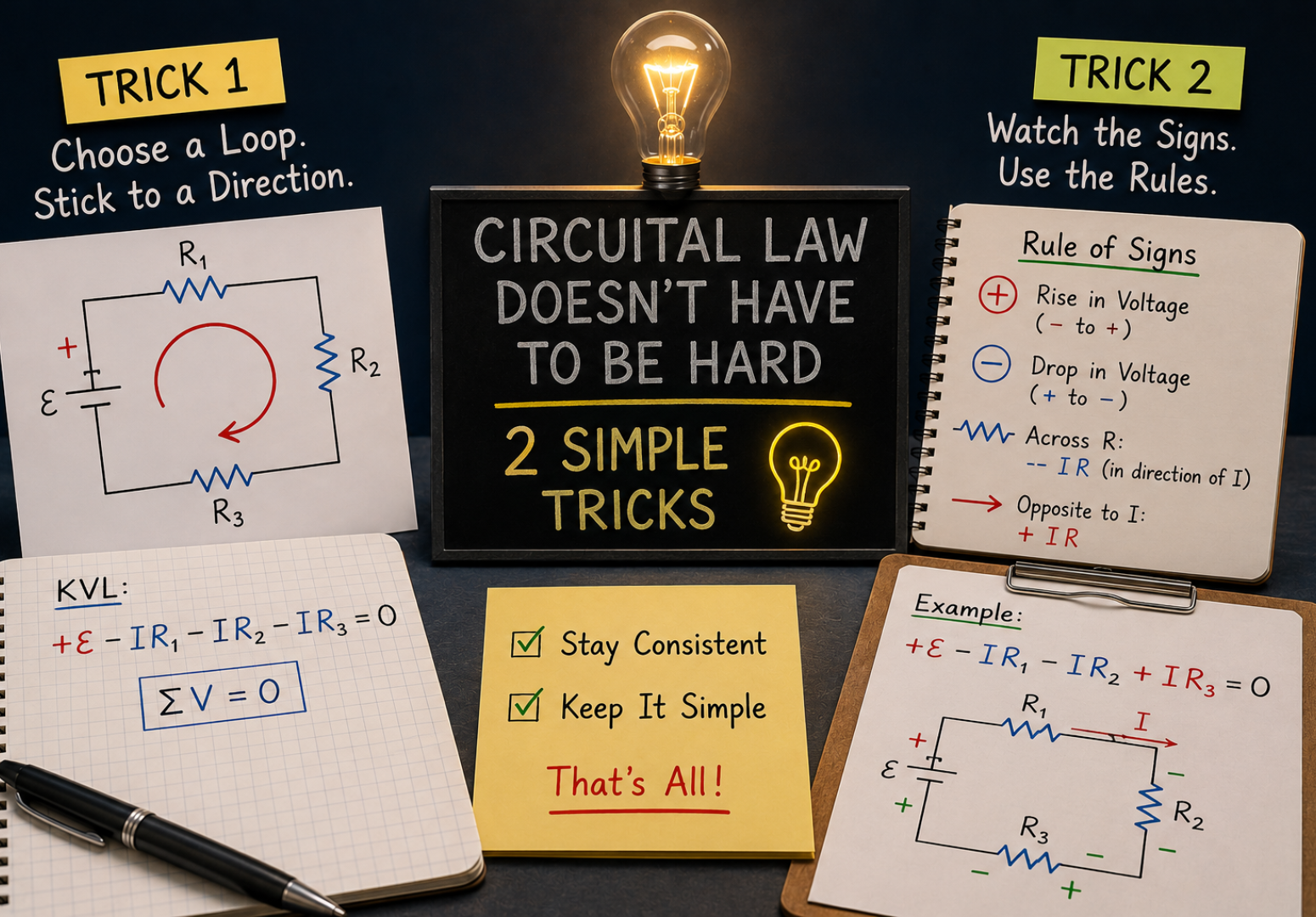
Circuital law has a reputation for being scary, but honestly, that reputation isn’t fair. Most students panic the moment they see the formula written on the board, yet the actual idea behind circuital law is pretty straightforward once someone explains it without all the jargon. This article is going to do exactly that — break circuital law down into pieces that actually make sense, using plain language instead of textbook talk.
At its core, circuital law connects electric current to the magnetic field surrounding it. Picture a wire carrying current. Around that wire, a magnetic field forms in circular loops. Circuital law gives us a mathematical way to describe that relationship without needing to calculate every single point in space individually. That’s the entire point of it — efficiency and elegance rolled into one rule.
We’ll walk through where circuital law came from, why it matters in real life, how it connects to Maxwell’s equations, and where you’ll actually use it outside the classroom. By the time you finish reading, circuital law should feel less like a wall and more like a doorway.
The Origin Story Behind
Circuital law traces back to André-Marie Ampère, a French physicist who noticed something strange while watching currents interact with magnets. In the early 1800s, he observed that current-carrying wires could push and pull each other depending on the direction of current flow. That observation eventually grew into a formal mathematical statement we now call Ampere’s circuital law.
Ampère wasn’t working alone, though. His findings built on earlier work by Hans Christian Oersted, who first noticed that a compass needle deflects near a current-carrying wire. Ampère took that strange little observation and turned it into something measurable and predictable. That’s the beauty of physics history — one curious accident often leads to decades of refined theory.
What makes this origin story interesting is how practical it was. Ampère wasn’t trying to write equations for fun. He was trying to explain something he saw happening right in front of him. Circuital law grew out of genuine curiosity, not abstract theorizing, and that’s part of why it still feels so grounded today.
What The Law Actually States
In plain terms, circuital law states that the magnetic field traveling around a closed loop is proportional to the electric current passing through that loop. There’s a constant involved, called the permeability of free space, but don’t let that intimidate you. It’s just a number that helps the units work out correctly.
Mathematically, this gets written using something called a line integral, which sounds complicated but really just means “add up the magnetic field contributions along the entire loop.” If you check this concept against resources like the one found on knowledgeopedia’s calculus guide, the connection between integration techniques and physics formulas becomes a lot less abstract. Circuital law leans heavily on integral calculus, so brushing up on that topic helps tremendously.
The law also assumes certain symmetry in many textbook problems, which is why you’ll often see examples involving straight wires, solenoids, or toroids. These shapes make the math manageable because the magnetic field behaves predictably around them. Once a student gets comfortable with these standard shapes, circuital law stops feeling like a mystery and starts feeling like a tool.
Why Symmetry Matters So Much
Symmetry is the secret weapon behind solving circuital law problems quickly. Without it, that line integral we mentioned earlier becomes nearly impossible to calculate by hand. With it, entire problems simplify into a few lines of algebra.
Take a long straight wire as an example. Because the magnetic field around it is the same distance from the wire at every point along a circular path, circuital law allows us to pull the magnetic field value straight out of the integral. Suddenly, a seemingly intimidating calculation becomes a simple multiplication.
This is exactly why physics textbooks love throwing symmetrical examples at students before introducing anything messy. It builds confidence first. Once that foundation feels solid, applying circuital law to slightly irregular shapes becomes far less intimidating, because the underlying logic hasn’t actually changed — only the geometry has.
Real World Devices Using It
Circuital law isn’t just classroom theory. It directly explains how transformers, electric motors, and inductors function. Every time current flows through a coil of wire, the resulting magnetic field follows the exact behavior circuital law predicts.
Transformers, for instance, rely on changing magnetic fields to transfer energy between coils. Engineers designing these devices use circuital law concepts to calculate how many turns of wire are needed, how strong the magnetic field will be, and how efficient the energy transfer process will turn out. Without this law, transformer design would basically be guesswork.
Electric motors operate on a similar principle. The magnetic fields generated by current-carrying coils interact with permanent magnets to produce rotational motion. Engineers rely on circuital law calculations daily, even if they don’t always stop to think about Ampère’s original 1820s discovery while doing it.
Connecting It To Maxwell
James Clerk Maxwell later expanded circuital law into something even more powerful. He noticed a gap: the original law didn’t account for changing electric fields, only steady currents. So he added a term that fixed this limitation, creating what we now call the Ampere-Maxwell law.
This modification turned out to be huge. It allowed physicists to predict electromagnetic waves mathematically, years before anyone detected them experimentally. Maxwell’s tweak to circuital law essentially predicted the existence of radio waves, light waves, and eventually the entire electromagnetic spectrum we rely on today.
It’s worth pausing here because this shows something important about science. Circuital law wasn’t perfect when Ampère first wrote it, but instead of discarding it, Maxwell refined it. That’s how good scientific ideas usually evolve — through patient correction rather than complete reinvention.
Common Mistakes Students Make
A lot of students mix up the direction conventions used in circuital law. The right-hand rule helps here: point your thumb in the direction of current flow, and your curled fingers show the direction of the magnetic field loop. Skipping this step often leads to sign errors that throw off entire calculations.
Another frequent mistake involves choosing the wrong loop shape, called an Amperian loop, for a given problem. If the loop doesn’t match the symmetry of the current distribution, the math becomes unnecessarily complicated or outright unsolvable using basic techniques. Picking the right loop shape is honestly half the battle when applying circuital law correctly.
Students also forget to account for multiple currents passing through the same loop. Circuital law only cares about the net enclosed current, not each individual wire separately. Forgetting to add currents with proper sign conventions trips up even strong students during exams.
How Engineers Apply It
According to the National Institute of Standards, accurate magnetic field measurement plays a critical role in calibrating sensitive scientific instruments, many of which rely on principles drawn directly from circuital law. Engineers designing magnetic resonance imaging machines, for example, depend on precise magnetic field predictions that trace straight back to Ampère’s original work.
In power generation, circuital law helps engineers design generators that convert mechanical energy into electrical energy efficiently. Every coil winding, every magnet placement, gets calculated using principles rooted in this fundamental relationship between current and magnetic fields. A small miscalculation here can mean massive efficiency losses at industrial scale.
Even in consumer electronics, tiny inductors inside phone chargers and laptop power supplies are designed using circuital law math. It’s wild to think that a 200-year-old physics principle is quietly running inside the device charging your phone right now.
Solenoids And Their Behavior
Solenoids are coils of wire that produce strong, uniform magnetic fields when current flows through them. Circuital law makes calculating this field surprisingly simple, especially when the solenoid is long compared to its diameter. The magnetic field inside becomes nearly constant, while outside it drops close to zero.
This predictable behavior makes solenoids incredibly useful in real applications. MRI machines, electric door locks, and even some types of speakers rely on solenoid behavior governed by circuital law. The uniformity of the internal field is what makes these devices reliable and consistent.
Students often practice circuital law problems specifically using solenoids because the math stays clean. It’s a great entry point before moving on to messier, real-world geometries that don’t offer such convenient symmetry.
Toroids And Magnetic Confinement
Toroids are donut-shaped coils, and they show off circuital law in a particularly elegant way. Because of their closed loop shape, the magnetic field stays almost entirely confined within the toroid itself, with very little leakage outside.
This containment property makes toroids valuable in transformer design and in certain types of fusion research equipment, where controlling magnetic fields precisely is absolutely critical. Researchers studying plasma confinement for fusion reactors use circuital law extensively when modeling how magnetic fields behave inside these donut-shaped chambers.
Toroidal inductors are also common in everyday electronics because their shape minimizes electromagnetic interference with nearby components. That clean containment, again, comes straight from the geometry working perfectly with circuital law’s underlying assumptions.
Comparing It To Gauss Law
Circuital law and Gauss’s law often get confused by students because both deal with field relationships using closed surfaces or loops. Gauss’s law relates electric flux to enclosed charge, while circuital law relates magnetic field circulation to enclosed current. They’re cousins, not twins.
One key difference is that magnetic field lines never start or end — they form closed loops. Electric field lines, on the other hand, originate at positive charges and terminate at negative ones. This distinction shapes how each law gets applied mathematically, even though the overall structure of both equations looks similar on paper.
Understanding this contrast actually helps reinforce circuital law itself. Seeing how it differs from a closely related concept often clarifies what makes it unique, rather than treating it as just another formula to memorize.
Limitations Worth Knowing About
Circuital law in its original form only works cleanly for steady, unchanging currents. The moment current starts varying rapidly over time, the original version starts producing inconsistent results, which is exactly why Maxwell’s correction became necessary in the first place.
Another limitation involves complex geometries lacking symmetry. While circuital law remains technically valid everywhere, solving it without symmetry usually requires numerical methods or computer simulations rather than simple algebra. Real-world engineering problems often fall into this messier category, requiring software tools to handle the calculations.
It’s worth remembering that no physical law works perfectly in every situation. Circuital law is incredibly useful within its proper domain, but recognizing its boundaries is part of using it responsibly and accurately in serious technical work.
Teaching Tricks That Actually Work
Teachers who explain circuital law successfully tend to start with analogies before diving into equations. Comparing the magnetic field loop to ripples spreading outward from a stone dropped in water helps students visualize circulation before they ever see a line integral.
Drawing diagrams by hand, rather than just showing pre-made textbook images, also seems to help retention. When students physically sketch the current direction and apply the right-hand rule themselves, the concept sticks better than passive reading ever could.
Breaking circuital law problems into small, sequential steps rather than jumping straight to the final formula reduces panic significantly. Step one: identify symmetry. Step two: choose the loop. Step three: calculate enclosed current. This structured approach turns an intimidating topic into a manageable checklist.
Practice Problems Worth Trying
If you genuinely want circuital law to feel natural, practice problems are non-negotiable. Start with a single straight wire calculation, then move to a solenoid, then attempt a toroid. Each step adds complexity gradually rather than throwing everything at once.
Try working backward sometimes too. Instead of calculating the magnetic field from current, given a known field, work out what current would be required to produce it. This reverse approach strengthens understanding far more than repetitive forward calculations alone.
Group study sessions also help enormously here. Explaining circuital law out loud to a classmate, even if you’re not totally confident yet, forces your brain to organize the concept logically. Teaching, even informally, remains one of the most effective ways to learn anything technical.
Why Students Eventually Like It
It sounds strange, but plenty of students end up genuinely liking circuital law once they push past the initial confusion. There’s something satisfying about a single elegant equation explaining so much physical behavior across wildly different devices and situations.
Part of the appeal comes from seeing circuital law connect to other branches of physics. It links directly to calculus, electromagnetism, and even quantum theory eventually. Watching these connections form across different classes makes physics feel less like isolated topics and more like one interconnected system.
There’s also a confidence boost that comes from finally solving a circuital law problem without help. That moment when the math clicks, when the loop integral actually simplifies the way it’s supposed to, sticks with students long after the exam is over.
Tips For Exam Preparation
Before an exam involving circuital law, review the right-hand rule until it becomes automatic. Sign errors caused by direction confusion are probably the single biggest point-loser on these types of problems, and they’re entirely avoidable with enough repetition.
Memorize the standard geometries — straight wire, solenoid, toroid — along with their respective formulas. Most exam questions pull from these three categories repeatedly, just with different numbers plugged in. Recognizing the pattern instantly saves valuable time during timed tests.
Don’t skip units either. Circuital law calculations involve specific units for current, magnetic field strength, and permeability, and professors notice when these get mixed up. Double-checking units at the end of a calculation often catches mistakes before they cost you marks.
Future Applications On Horizon
Researchers are continuing to apply circuital law principles in emerging technologies like wireless charging systems and advanced magnetic levitation transport. These innovations depend on precisely predictable magnetic fields, something circuital law has reliably provided for two centuries now.
Quantum computing research also touches circuital law indirectly, particularly in designing superconducting circuits that require extremely precise magnetic field control. Even as physics pushes into increasingly exotic territory, this foundational 19th-century relationship keeps proving relevant.
It’s honestly a little remarkable that a principle discovered through simple wire-and-compass experiments continues shaping cutting-edge engineering nearly 200 years later. Circuital law isn’t going anywhere anytime soon — it’s too fundamental to electromagnetism for that.
Frequently Asked Questions
What is circuital law in simple terms?
Circuital law describes the relationship between electric current flowing through a closed loop and the magnetic field generated around that loop, allowing predictable calculations without measuring every point individually.
Who discovered circuital law?
André-Marie Ampère developed the original version in the early 1800s, building on earlier observations made by Hans Christian Oersted regarding current and magnetic deflection.
Why did Maxwell modify the original law?
The original version only worked for steady currents. Maxwell added a term accounting for changing electric fields, which allowed the law to correctly predict electromagnetic wave behavior.
Is circuital law still used in modern technology?
Yes, it remains essential in designing transformers, motors, inductors, MRI machines, and even emerging technologies like wireless charging and magnetic levitation systems.
Final Thoughts
Circuital law doesn’t deserve the intimidating reputation it often gets in classrooms. At its heart, it’s simply describing how electric current and magnetic fields relate to each other, using a loop-based approach that becomes manageable once symmetry and direction conventions click into place.
Throughout this article, we’ve covered where circuital law came from, how it works mathematically, where engineers apply it in real devices, and why Maxwell’s later correction made it even more powerful. We also walked through common mistakes, practical study tips, and why so many students eventually grow to appreciate this concept rather than fear it.
If you’re still studying circuital law right now, give yourself permission to struggle a little before it clicks. That struggle is normal, and honestly, it’s part of how real understanding gets built. Practice the standard geometries, nail down the right-hand rule, and trust that the math will eventually feel less like a wall and more like a familiar tool you reach for naturally.