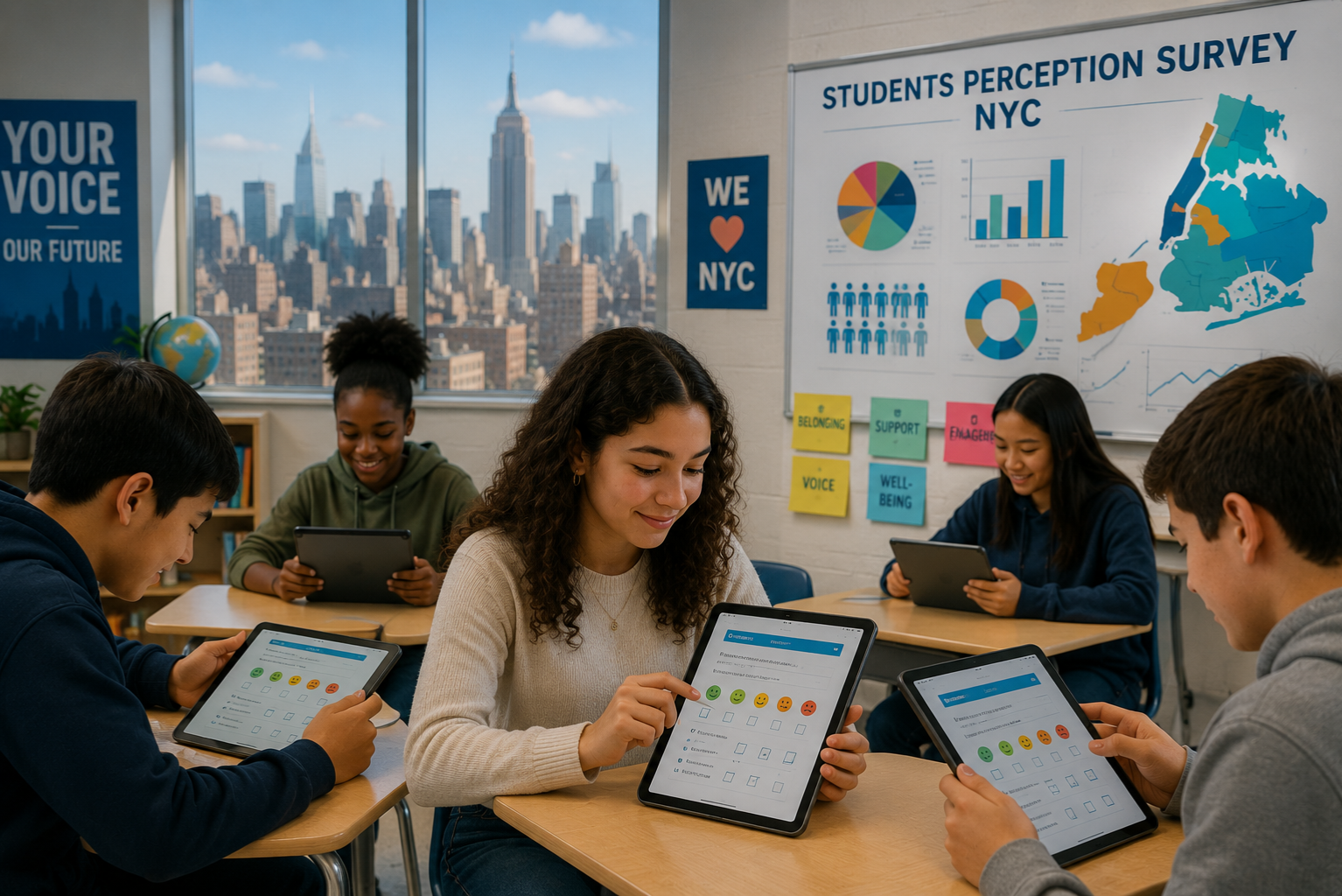
New York City runs one of the most ambitious public school feedback systems in the entire country, and the students perception survey NYC program sits at the heart of that effort. Every year, hundreds of thousands of students across all five boroughs complete structured surveys that capture how they experience their classrooms, their teachers, their school buildings, and the overall climate of their learning environments. The scale alone is staggering — no other urban district in the United States collects student feedback at this volume or with this level of institutional commitment. Understanding what the students perception survey NYC actually measures, how the data is used, and what recent findings reveal about the state of public education in the city gives parents, educators, and policymakers a far richer picture than test scores and graduation rates alone can provide. This article unpacks all of it in practical, accessible terms.
The NYC Department of Education has refined its survey infrastructure considerably over the past decade, evolving from a relatively simple feedback form into a sophisticated multi-stakeholder instrument that captures student, parent, and teacher perspectives simultaneously. The student component — which is the focus here — asks learners to reflect on experiences that directly shape their academic engagement, sense of belonging, and belief in their own ability to succeed. When those responses are analyzed with rigor and disaggregated thoughtfully, the students perception survey NYC becomes one of the most honest mirrors the school system has.
NYC Survey Program Overview
The NYC School Survey, which houses the students perception survey NYC component, is administered annually to students in grades six through twelve across all public schools in the district. Elementary-aged students participate through a separate, age-adapted instrument, but the secondary survey is the most analytically rich due to the complexity of questions it can reliably ask older learners. Participation is not optional in any meaningful sense — schools are expected to facilitate survey administration during the school day, and participation rates factor into school quality assessments conducted by the Department of Education.
The survey covers several core domains that the Department of Education has identified as predictors of student success and school quality. These include rigorous instruction, collaborative teachers, supportive environment, and school leadership. Each domain contains multiple items that students rate on frequency scales, and the resulting scores are published publicly through the NYC School Quality Reports, making the data accessible to families researching schools and to journalists tracking system-wide trends. The transparency of publication is one feature that distinguishes the students perception survey NYC from feedback programs in other large urban districts.
What Students Actually Report
When you look at aggregated results from the students perception survey NYC over recent years, a few patterns emerge that are both encouraging and sobering in equal measure. On the positive side, most NYC students consistently report that they have at least one adult in their school who knows them well and cares about their success. This relationship metric is among the strongest predictors of student persistence and graduation, so its relative strength across the system is meaningful. Schools where students report these trusting relationships tend to outperform schools where they do not, even after controlling for demographic variables.
On the more challenging side, the students perception survey NYC has persistently surfaced concerns about rigorous instruction — specifically, whether students feel sufficiently challenged, whether they have opportunities to engage in complex thinking rather than rote recall, and whether their lessons connect to real-world relevance. These findings have been consistent enough across multiple survey cycles that they have directly shaped professional development priorities at the district level, pushing instructional coaches and curriculum teams to focus more deliberately on inquiry-based and project-based learning approaches.
Equity Gaps in Responses
One of the most important analytical practices applied to the students perception survey NYC data is disaggregation by student subgroup. When results are broken down by race, income level, disability status, and English language learner classification, patterns emerge that aggregate school-wide scores completely hide. Black and Latino students in particular have historically reported lower feelings of belonging and safety in certain school contexts than their white and Asian peers attending the same institutions — a finding that demands honest examination rather than dismissal.
Students with disabilities represent another subgroup whose survey responses frequently diverge from school-wide averages in ways that signal unmet needs. When students receiving special education services consistently rate their classroom experience as less supportive or less engaging than general education peers at the same school, that disparity points to structural issues in how inclusion is being implemented rather than just individual teacher behavior. The students perception survey NYC, because of its scale and public reporting structure, creates accountability pressure around these equity gaps that more private feedback systems do not generate. For context on how other innovative school models approach student equity, the Innova School model offers an instructive international comparison worth exploring.
Borough-Level Differences
New York City’s five boroughs are not a monolithic educational landscape, and the students perception survey NYC data reflects the significant variation in school experience across different parts of the city. Schools in the Bronx, which serves a disproportionately high percentage of students from low-income families and students in temporary housing, have historically shown lower scores on the supportive environment domain than schools in Staten Island or parts of Queens with more economically stable student populations. This is not a reflection of teacher effort or dedication — it reflects the compounding effects of poverty, housing instability, and community-level stress on students’ capacity to feel safe and supported in school.
Manhattan’s school landscape produces some of the widest internal variation of any borough, largely because of the extreme economic stratification between neighborhoods. Students attending schools in lower Manhattan or the Upper East Side report dramatically different experiences on the students perception survey NYC than students attending schools in East Harlem or Washington Heights, even when those schools share the same district-level policies and curriculum frameworks. This within-borough variation is often more informative for equity analysis than between-borough comparisons.
School Climate Findings
School climate is the domain where the students perception survey NYC generates its most actionable and sometimes most alarming findings. Climate captures whether students feel physically safe, emotionally respected, and free from bullying or harassment — conditions that are absolute prerequisites for learning and that no amount of curriculum improvement can substitute for when they are absent. Schools with strong climate scores tend to show stronger academic growth metrics, and the correlation is robust enough that the Department of Education treats climate improvement as a legitimate academic intervention rather than a soft peripheral concern.
Bullying data surfaced through the students perception survey NYC has been particularly important for identifying schools where reported incident rates in administrative systems significantly undercount the actual student experience. When administrative bullying reports are low but survey data shows substantial percentages of students reporting feeling unsafe or harassed, that gap signals underreporting rather than genuine safety. This discrepancy has prompted the Department of Education to invest in restorative practice training and anti-bullying program expansion at schools where survey-administrative gaps are widest.
Teacher Quality Perceptions
The collaborative teachers domain of the students perception survey NYC asks students to rate whether their teachers communicate high expectations, provide helpful feedback, explain things clearly when confusion arises, and treat students with genuine respect. These items are among the most sensitive in the entire survey because they touch directly on the professional practice of individual educators, even though results are only reported at the school aggregate level rather than by individual teacher. This aggregation protection is intentional and important — it allows honest student reporting without exposing individual teachers to retaliation risks.
According to research published by the Measures of Effective Teaching project, student perception data predicts teacher effectiveness on value-added measures more reliably than principal observations alone, particularly when surveys are designed to capture specific instructional behaviors rather than general satisfaction. NYC’s survey instrument reflects this research basis, asking about observable practices rather than subjective impressions. The result is a domain that generates findings school leaders can connect directly to professional development content, rather than vague dissatisfaction that offers no clear direction for improvement.
Family and Community Context
The students perception survey NYC does not exist in isolation — it is one component of a broader NYC School Survey that also collects feedback from parents and teachers simultaneously. The triangulation of these three perspectives on the same school creates an unusually rich analytical opportunity. When students report low safety scores, parents report communication concerns, and teachers report insufficient administrative support all in the same school in the same survey cycle, the convergence of those signals creates a compelling case for targeted intervention that no single data source could establish alone.
Community context shapes how students respond to survey questions in ways that survey designers at the Department of Education have increasingly tried to account for. Schools serving large immigrant populations, for example, sometimes show elevated non-response rates on certain climate items, particularly those touching on relationships with authority figures — a pattern that reflects cultural norms around expressing criticism rather than actual indifference to school conditions. Training survey administrators to address these cultural dynamics explicitly before administration has improved response quality at schools where this pattern was previously most pronounced.
Using Data for Improvement
The gap between collecting students perception survey NYC data and actually using it for meaningful school improvement is where many schools have historically struggled. Data arrives in school dashboards shortly after survey administration concludes, but translating dashboard numbers into specific instructional or cultural changes requires capacity that not every school leadership team possesses without support. The Department of Education has invested in school support specialists who help principals and leadership teams read their survey data, identify priority areas, and connect findings to existing improvement planning processes.
The most effective schools treat their students perception survey NYC results as a conversation starter rather than a verdict. They bring data to faculty meetings not to assign blame but to spark collective inquiry — asking teachers to hypothesize why certain patterns exist and to propose responses they are willing to own. This collaborative approach to data use produces more durable change than top-down directives, because teachers who help interpret findings and design responses feel invested in the outcomes rather than defensive about the critique.
Comparing Year Over Year
Longitudinal analysis of students perception survey NYC data reveals which schools are genuinely improving their learning environments over time versus which schools show short-term fluctuations without sustained directional change. Schools that show consistent multi-year improvement in climate and instructional quality scores — particularly those starting from lower baselines — represent some of the most important success stories in the NYC public school system, because they demonstrate that survey-informed improvement is achievable even in high-need contexts.
Year-over-year comparison also serves an important accountability function for schools that receive targeted support or intervention resources. When the Department of Education invests additional coaching, programming, or staffing in a school based on poor survey performance, tracking whether subsequent survey cycles show improvement provides evidence of whether those investments are working. This creates a feedback loop between resource allocation decisions and their measured impact that strengthens the overall accountability architecture of the system.
High School Specific Findings
High school students in NYC bring a particular candor to the students perception survey NYC that produces some of the most revealing data in the entire system. Older adolescents are more willing than younger students to name specific concerns about teaching quality, fairness in discipline, and relevance of curriculum to their actual lives and futures. The high school data consistently surfaces concerns about college readiness preparation — specifically, whether students feel their schools are genuinely preparing them for postsecondary demands rather than just meeting graduation requirements.
Career and technical education programs show consistently stronger student perception scores than traditional academic tracks on several dimensions, particularly around real-world relevance and student engagement. This finding has contributed to the Department of Education’s expansion of CTE pathways in recent years, as school leaders and policymakers have recognized that students themselves are signaling a preference for applied, contextualized learning experiences that connect to identifiable futures. The students perception survey NYC, in this sense, has directly influenced system-level programming decisions with millions of dollars of investment attached.
Middle School Climate Patterns
Middle school years represent a particularly vulnerable window in students’ educational trajectories, and the students perception survey NYC data from grades six through eight reflects the turbulence of early adolescence in predictable but important ways. Safety and belonging scores typically dip in middle school compared to elementary and high school, reflecting both the social dynamics of early adolescence and the structural transition from self-contained classrooms to departmentalized instruction where fewer adults know each student deeply.
Schools that buck this middle school dip — maintaining strong climate and belonging scores through the sixth-through-eighth-grade transition — tend to share several features that the survey data itself helps identify. These include advisory or homeroom structures where one adult maintains consistent relationships with a small group of students, explicit social-emotional learning programming that is integrated into the school day rather than treated as supplementary, and discipline approaches that prioritize restoration over punishment. The students perception survey NYC data has been instrumental in identifying these protective factors by comparing schools that maintain strong scores against those that do not.
Pandemic Impact on Scores
The COVID-19 pandemic created a natural disruption in the students perception survey NYC longitudinal dataset that researchers and policymakers are still analyzing. Survey cycles that captured the remote and hybrid learning periods showed sharp declines in student-reported connection, engagement, and sense of belonging — findings that aligned with national research documenting the profound social and academic costs of pandemic disruption for school-aged children. What has been particularly interesting to track is the recovery trajectory as schools returned to full in-person instruction.
Recovery has been uneven. Some schools returned to and even exceeded pre-pandemic survey scores within two years of full reopening, while others have shown persistent deficits in climate and connection scores that have not recovered to 2019 baselines even several years later. The schools that recovered fastest were generally those that treated the return to in-person learning as an explicit opportunity to rebuild community rather than resuming instruction as if the previous two years had not happened. Their students perception survey NYC scores reflect the difference that intentional community rebuilding makes.
Student Voice Beyond Surveys
The students perception survey NYC is the most systematic channel for student voice in the NYC public school system, but it is not the only one, and understanding its place within a broader ecosystem of student engagement structures helps clarify both its power and its limitations. Student government, participatory budgeting programs in which students vote on school improvement spending, restorative circle practices, and student-led conference formats all provide complementary channels through which student perspectives shape school decisions outside the annual survey cycle.
Schools that cultivate multiple student voice channels tend to show stronger survey scores over time, likely because students in those environments experience genuine agency on an ongoing basis rather than only during the annual survey window. When students spend the entire school year in an environment where their opinions demonstrably matter, they approach the formal survey with more trust in the process and more investment in providing honest, thoughtful responses. The students perception survey NYC is most powerful when it sits within a culture of student voice rather than functioning as a substitute for one.
Administrative Response Protocols
What happens after students perception survey NYC results are published determines whether the survey cycle produces genuine improvement or simply generates data that accumulates in dashboards without consequence. The Department of Education requires schools to develop formal Comprehensive Education Plans that incorporate survey findings alongside academic performance data, creating a structural expectation that survey results will inform planning rather than being treated as separate from the school’s improvement agenda.
The quality of administrative response varies enormously across the system’s roughly 1,700 schools. Some principals treat survey data as among the most important information they receive each year, sharing findings transparently with staff, families, and students and building specific action steps into school culture work. Others treat the planning requirement as a compliance exercise, producing documentation that satisfies the administrative requirement without meaningfully changing practice. The Department of Education’s school support structure is designed to close this implementation gap, but the scale of the system makes consistent quality a persistent challenge.
Future of NYC Surveys
The students perception survey NYC is not a static instrument — it has evolved substantially since its early iterations and will continue to develop as the Department of Education’s understanding of student experience and school quality deepens. Current discussions within the district’s research and accountability offices focus on adding items that capture students’ sense of identity affirmation in school, their experience of curriculum as culturally relevant, and their perception of whether discipline practices are applied fairly across different student groups. These additions reflect both the evolution of equity-focused school improvement thinking and the persistent finding in current survey data that these dimensions need more precise measurement.
Technology-enhanced survey formats that allow students to provide audio or video responses to open-ended prompts, rather than only typed text, are being piloted in some schools as a way of reducing the literacy barrier that currently shapes which students provide rich qualitative data and which do not. If these pilots demonstrate equivalent reliability to text-based responses while producing more equitable participation across literacy levels, the students perception survey NYC of the near future may look substantially different from the instrument currently in use — capturing student voice in formats that reflect how young people actually communicate in 2025 and beyond.
FAQs About Students Perception Survey NYC
What is the students perception survey NYC and who participates? The students perception survey NYC is an annual feedback instrument administered by the NYC Department of Education to students in grades six through twelve across all public schools in the city. It captures student perceptions of teaching quality, school climate, safety, and overall learning environment, with results published publicly through school quality reports.
How are students perception survey NYC results used by schools? Schools are required to incorporate students perception survey NYC findings into their Comprehensive Education Plans, which guide improvement priorities for the following school year. Strong school leaders use the data to drive professional development, inform culture work, and demonstrate accountability to their school communities.
Is the students perception survey NYC anonymous? Yes, the students perception survey NYC is designed to be anonymous, with results reported only at the aggregate school level. Individual student responses are not shared with teachers or administrators, and schools are instructed to communicate this anonymity guarantee clearly before administration to encourage honest responses.
Where can families access students perception survey NYC results? Results from the students perception survey NYC are published annually through the NYC School Quality Reports, which are available on the NYC Department of Education’s public website. Families can search for any public school and review its survey scores across all measured domains.How does the students perception survey NYC compare to similar programs in other cities? The students perception survey NYC is among the largest and most transparent student feedback programs in the country. Its public reporting structure, multi-stakeholder design, and integration with formal school quality assessments set it apart from programs in most other urban districts, which typically collect similar data without the same level of public accountability infrastructure.