Understanding Electric Force Basics
Physics has a way of hiding enormous complexity behind deceptively simple equations. The coulomb electrostatic force is one of the best examples of that pattern. A single compact formula describes the force between any two charged objects anywhere in the universe, and the implications of that formula reach from atomic structure to lightning bolts to the electronics sitting in your pocket right now.
The coulomb electrostatic force is the push or pull that exists between electrically charged particles or objects. Like charges repel each other, opposite charges attract, and the strength of that interaction depends on the size of the charges and the distance between them. That much is intuitive. What makes the physics rigorous and useful is the precise mathematical relationship that Charles-Augustin de Coulomb established experimentally in 1785 and that has held up to every experimental test conducted since.
History of Coulomb’s Discovery
Coulomb did not discover electric attraction and repulsion — those phenomena were known long before he was born. What he contributed was precision. Using a torsion balance of his own design, he measured how the force between charged spheres varied with separation distance and with the amount of charge on each sphere. His conclusion was that the coulomb electrostatic force follows an inverse square law, dropping off with the square of the distance between charges rather than the distance itself.
If you enjoy reading about science in education contexts, you will appreciate that Coulomb’s work was a turning point in making electricity a quantitative science rather than a collection of qualitative observations. Before his torsion balance experiments, scientists knew that charges interacted but had no reliable way to measure how strongly. Coulomb changed that permanently, and the law named after him became the foundation for everything that followed in electrostatics and classical electromagnetic theory.
The parallel between Coulomb’s law and Newton’s law of gravitation is not accidental. Both describe forces that obey inverse square relationships and depend on a product of two source quantities divided by distance squared. That structural similarity hinted at a deeper unity in physics that later developments in field theory and quantum mechanics continued to reveal. The coulomb electrostatic force sits at the beginning of that long intellectual thread.
The Core Formula Explained
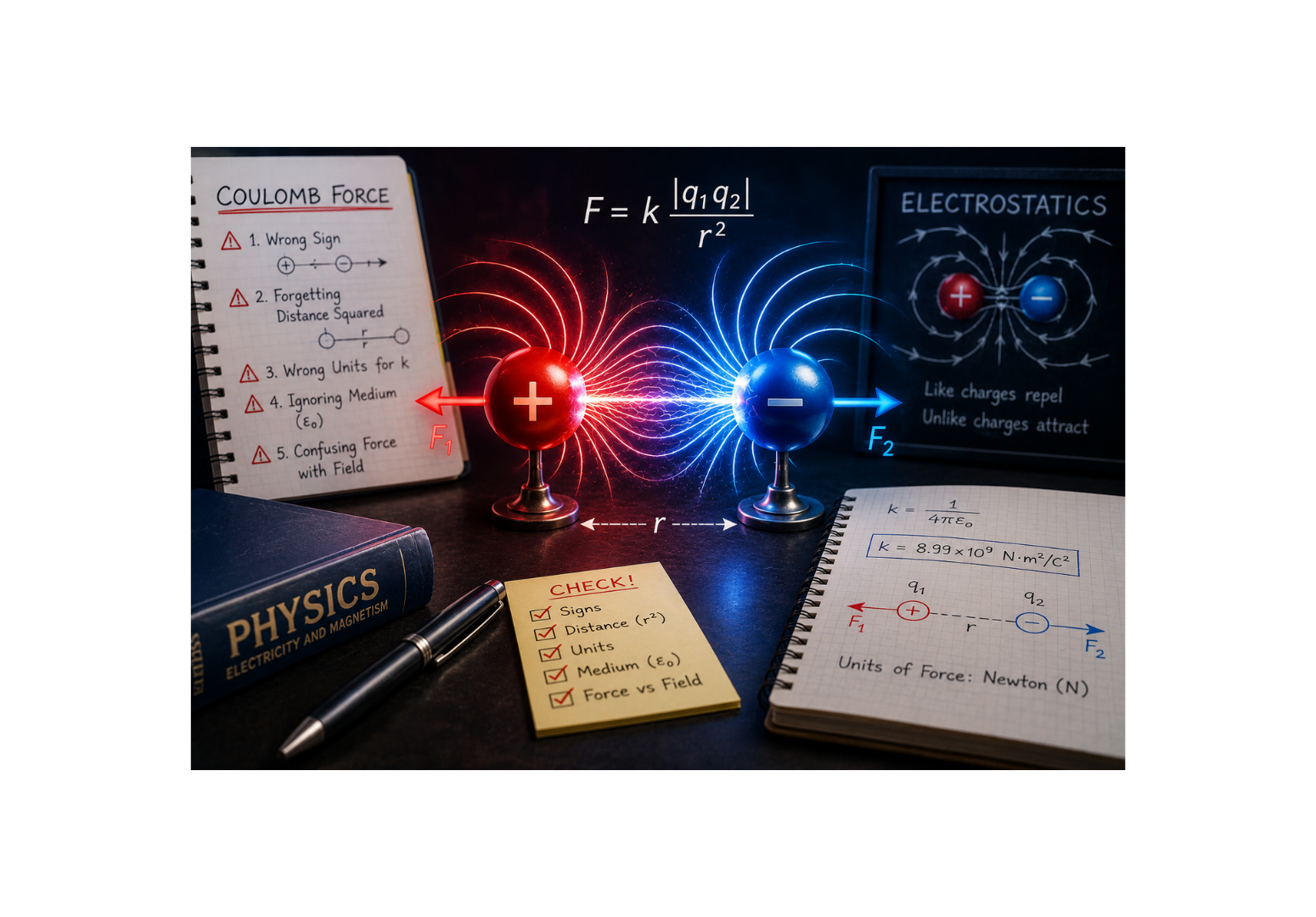
The mathematical statement of the coulomb electrostatic force is F equals k times q1 times q2 divided by r squared. In that equation, F is the force in Newtons, q1 and q2 are the charges of the two objects in Coulombs, r is the distance between them in meters, and k is the Coulomb constant with a value of approximately 8.99 times 10 to the power of 9 Newton meters squared per Coulomb squared.
Every part of that equation carries real physical meaning. The product q1 times q2 captures how the force depends on both charges simultaneously — doubling either charge doubles the force. The r squared in the denominator captures the inverse square dependence — doubling the distance reduces the force to one quarter of its original value. The constant k sets the overall numerical scale, ensuring that the calculated force matches what is actually measured in experiments using standard SI units throughout.
The sign of the product q1 times q2 determines whether the coulomb electrostatic force is attractive or repulsive. If both charges carry the same sign, the product is positive and the force is repulsive — the objects push each other away. If the charges carry opposite signs, the product is negative and the force is attractive — the objects pull toward each other. Getting that sign logic right is one of the first places students go wrong, and it matters enormously in vector problems.
Mistake One: Ignoring the Squared Distance
The most damaging mistake students make when working with the coulomb electrostatic force is forgetting to square the distance in the denominator. The force depends on r squared, not r alone. When a student writes k times q1 times q2 divided by r instead of r squared, the resulting force is off by a factor of r — which for distances measured in centimeters or meters introduces errors of one to two orders of magnitude.
This mistake is especially common when students are working quickly under exam pressure. The formula looks familiar, they fill in the numbers, and they forget that extra squaring step. The answer they get is numerically close enough to seem plausible, which makes the error harder to catch during review. Developing the habit of writing the formula out in full before substituting any numbers is the most reliable way to prevent this.
What makes the inverse square relationship important to internalize rather than just apply mechanically is that it governs how rapidly the coulomb electrostatic force changes with distance. Moving from 1 meter to 2 meters does not halve the force — it reduces it to one quarter. Moving to 3 meters reduces it to one ninth. That rapid falloff with distance is why electrostatic effects are most dramatic at close range and why atoms hold together despite the enormous repulsion between their electron clouds.
Mistake Two: Mishandling Signs and Direction
Sign errors in coulomb electrostatic force problems come in two varieties, and both cause real damage to problem solutions. The first is misidentifying whether the force is attractive or repulsive based on the charge signs. Students who treat the force magnitude as the complete answer and add direction as an afterthought often end up with forces pointing the wrong way, especially in multi-charge vector problems where directions have to be combined carefully.
The second sign error is more subtle. When resolving the coulomb electrostatic force into components in a coordinate system, students sometimes apply the correct magnitude but assign the wrong positive or negative sign to the x or y component based on a hasty geometric judgment. A force pointing to the left has a negative x-component regardless of whether it is attractive or repulsive, and mixing up those two sources of sign information produces component errors that carry through the entire problem.
The fix for both varieties of sign error is the same: draw a clear diagram before doing any calculation. Label each charge, draw arrows showing the direction of each pairwise force, identify whether each force is attractive or repulsive, and only then set up the coordinate components. That two-minute diagram investment prevents the kind of sign confusion that costs students marks on problems they otherwise understand perfectly well.
Mistake Three: Wrong Unit Conversions
The coulomb electrostatic force formula requires consistent SI units throughout. Distances must be in meters, charges must be in Coulombs, and the resulting force comes out in Newtons. Problems frequently give distances in centimeters or millimeters and charges in microcoulombs or nanocoulombs, and students who plug those values in without converting first get answers that are wrong by factors of 10², 10⁶, or more.
A charge of 5 microcoulombs is 5 times 10 to the negative 6 Coulombs, not 5. A distance of 30 centimeters is 0.30 meters, not 30. These conversions are straightforward individually but easy to miss when you are focused on the physics of the problem rather than the arithmetic housekeeping. Missing a factor of 10⁶ on a charge produces a force answer that is a million times too large or too small, which should be obviously wrong but sometimes gets written down anyway.
Building a consistent habit of converting all units to SI before writing the formula helps completely. Do not convert mid-calculation or at the end — do it first, write the converted values clearly, and then substitute. That sequence keeps the arithmetic clean and makes unit errors visible before they propagate into the rest of the solution.
Coulomb Electrostatic Force in Vector Form
The scalar version of the coulomb electrostatic force formula gives you the magnitude of the force, which is enough for simple two-charge problems. Real physics problems involve multiple charges, and those require the vector form, which includes both magnitude and direction. The vector form states that the force on charge q1 due to charge q2 is k times q1 times q2 divided by r squared, multiplied by the unit vector pointing from q2 toward q1.
According to NIST physical constants data, the Coulomb constant used in the vector form is 8.9875517923 × 10⁹ N·m²/C², making the coulomb electrostatic force one of the most precisely characterized forces in classical physics. That precision matters in advanced applications where small force errors compound across large systems, though for classroom problems the rounded value of 9 × 10⁹ N·m²/C² is perfectly adequate.
The unit vector in the vector form is what carries the directional information. It points from the source charge toward the field point, and its sign changes depending on whether you are describing a force on q1 due to q2 or on q2 due to q1. Newton’s third law guarantees these two forces are equal in magnitude and opposite in direction, which serves as a useful consistency check in multi-charge problems where it is easy to lose track of which force acts on which charge.
Mistake Four: Confusing Force and Field
A surprisingly common error among students who are new to electrostatics is confusing the coulomb electrostatic force with the electric field. These are related but distinct quantities. The electric field E at a point in space is defined as the force per unit positive test charge that would be placed at that point. The force on an actual charge q in that field is F equals q times E.
The confusion arises because both quantities use the same Coulomb formula structure. The electric field from a point charge q at distance r is k times q divided by r squared — no second charge in the formula. The force between two charges is k times q1 times q2 divided by r squared — both charges present. Students who blur the boundary between these two sometimes calculate a field when they need a force, or vice versa, and the presence or absence of the second charge in their formula signals which mistake they have made.
Keeping the conceptual distinction clear is the solution. The electric field is a property of space created by one charge — it exists whether or not a second charge is there to experience it. The coulomb electrostatic force is what happens when a second charge actually sits in that field. Both are real and useful, but they answer different questions and must not be substituted for each other in calculations.
Superposition in Multi-Charge Problems
When more than two charges are present, the total coulomb electrostatic force on any one charge is the vector sum of the individual forces from every other charge. This is the principle of superposition, and it extends the two-charge formula into a tool for analyzing any configuration of charges no matter how complicated.
The practical procedure is systematic. Pick the charge you want to find the total force on. Calculate the pairwise coulomb electrostatic force from each other charge individually, treating the problem as a two-charge interaction each time. Then resolve each force into x and y components, sum all the x-components together and all the y-components together, and reconstruct the total force vector from those component sums.
Where students struggle in superposition problems is not usually the formula itself but the geometry. Identifying the correct distance and direction for each pairwise force requires careful reading of the charge configuration and often a well-drawn diagram. Charges arranged in triangles, squares, or along a line each present their own geometric challenges. The coulomb electrostatic force calculation is the easy part — getting the geometry right is where the real problem-solving work happens.
Mistake Five: Skipping Condition Checks
The coulomb electrostatic force law in its standard form applies to point charges — objects whose physical size is negligible compared to the distance between them. Students sometimes apply the formula to extended charge distributions without checking whether the point charge approximation is valid, or without using the more appropriate formulas for continuous charge distributions.
Two conducting spheres separated by a distance much larger than their radii can be treated as point charges with good accuracy. Two conducting spheres nearly touching cannot — the charge distribution on each sphere distorts due to the proximity of the other, making the effective separation poorly defined and the point charge formula unreliable. Recognizing when the approximation breaks down is part of applying the coulomb electrostatic force correctly.
The other condition students skip checking is whether the medium between charges matters. The standard formula applies in a vacuum or air, where the dielectric constant is approximately 1. In other materials — water, glass, plastic — the effective force is reduced by the relative permittivity of the material, sometimes by a factor of 80 or more in water. Ignoring the medium when charges are embedded in a dielectric gives forces that are dramatically overestimated.
Real World Applications
The coulomb electrostatic force is not just a classroom concept. It governs phenomena across an enormous range of scales and disciplines. At the atomic scale, it holds electrons in orbit around nuclei and determines the structure of every atom in the periodic table. At the molecular scale, it drives chemical bonding and explains why certain molecules attract each other strongly while others barely interact.
At larger scales, the coulomb electrostatic force appears in the operation of capacitors, the behavior of charged particles in accelerators, the mechanism of electrostatic painting and powder coating in manufacturing, and the physics of lightning discharge. Photocopiers and laser printers use controlled electrostatic forces to attract toner particles to specific regions of a drum and transfer them to paper. The technology is elegant and entirely dependent on the same inverse square force law Coulomb measured with a twisted wire in 1785.
In biology, electrostatic forces shape the folding of proteins, the binding of enzymes to substrates, and the movement of ions across cell membranes. DNA itself is held in its double helix structure partly by electrostatic interactions between base pairs. The coulomb electrostatic force operates across every scale of life, from the molecular machinery of cells to the nerve impulses that let you read this sentence.
Comparing Electric and Gravitational Force
Putting the coulomb electrostatic force alongside gravitational force reveals one of the most striking contrasts in physics. For two protons separated by 10⁻¹⁵ meters — roughly the scale of an atomic nucleus — the gravitational force between them is approximately 1.87 × 10⁻³⁴ Newtons. The coulomb electrostatic force between the same two protons at the same distance is approximately 230 Newtons. The ratio is roughly 10³⁶ — electric force exceeds gravity by a factor of a trillion trillion.
That comparison immediately raises a question: if electric force is so much stronger than gravity, why does gravity dominate at large scales? The answer is charge neutrality. Most large objects contain nearly equal numbers of positive and negative charges, so their net charge is close to zero and their electrostatic interactions nearly cancel. Mass, on the other hand, is always positive, so gravitational effects accumulate without cancellation across large collections of matter.
This asymmetry between the two forces — one self-canceling, one always additive — explains the large-scale structure of the universe while also explaining why chemistry and biology, which operate at atomic and molecular scales where charge neutrality breaks down locally, are governed almost entirely by the coulomb electrostatic force rather than gravity.
Building Problem-Solving Confidence
Getting genuinely comfortable with the coulomb electrostatic force requires working through problems that progressively increase in complexity. Start with straightforward two-charge problems to lock in the formula, unit conversions, and sign logic. Then move to problems that ask for the electric field from a point charge at a specified location, reinforcing the distinction between field and force.
Progress to three-charge superposition problems arranged in simple geometric configurations — equilateral triangles are a classic starting point. These require setting up a coordinate system, computing each pairwise force correctly, resolving into components, and summing vectors. They are substantially more involved than two-charge problems but they build exactly the multi-step problem-solving skills that physics exams test at every level.
Finally, work through problems that ask about equilibrium — finding the position where a third charge experiences zero net coulomb electrostatic force from two fixed charges. These require setting up an equation where two force expressions balance, solving for the unknown position, and checking that the solution makes physical sense given the signs of the charges involved. That full cycle of setup, calculation, and physical interpretation is what genuine fluency with electrostatics actually looks like.
FAQ Section
What is the coulomb electrostatic force and how is it calculated?
The coulomb electrostatic force is the force between two electrically charged objects, given by F equals k times q1 times q2 divided by r squared. Here k is approximately 8.99 × 10⁹ N·m²/C², q1 and q2 are the charges in Coulombs, and r is the separation in meters. A positive result indicates repulsion between like charges, while opposite charges produce an attractive force pulling the objects toward each other.
How does distance affect the coulomb electrostatic force?
Distance has a dramatic effect because the force depends on the inverse square of the separation. Doubling the distance reduces the coulomb electrostatic force to one quarter of its original value. Tripling the distance reduces it to one ninth. This rapid falloff explains why electrostatic effects are most noticeable at close range — even modest increases in separation cause substantial reductions in force strength.
Does the coulomb electrostatic force work the same inside materials as in air?
No. In materials other than vacuum or air, the effective force is reduced by the relative permittivity of the material. Water has a relative permittivity of about 80, which means the coulomb electrostatic force between charges in water is roughly 80 times weaker than between the same charges in air at the same separation. This reduction explains why ionic compounds dissolve readily in water — the weakened electrostatic attraction between ions allows thermal energy to pull them apart.
What are the most common mistakes when solving coulomb electrostatic force problems?
The five most common mistakes are: forgetting to square the distance in the denominator, mishandling the signs of attractive versus repulsive forces, failing to convert units to SI before calculating, confusing the electric force with the electric field, and applying the point charge formula to situations where extended charge distributions require a different approach. Each mistake is entirely avoidable with careful setup and a clear diagram before starting any calculation.
Conclusion
The coulomb electrostatic force is one of the most fundamental and far-reaching concepts in all of physics. It governs the structure of atoms, the chemistry of molecules, the operation of electronic devices, and biological processes at the cellular level. The formula is compact and elegant, but using it correctly requires attention to detail that students often underestimate until they see where the mistakes lead.
The five critical mistakes — ignoring the squared distance, mishandling signs, skipping unit conversions, confusing force with field, and bypassing condition checks — are all entirely avoidable. Each one has a clear fix rooted in careful problem setup, consistent unit handling, and honest geometric reasoning before any numbers get substituted into the formula.
Getting the coulomb electrostatic force right consistently means treating each problem as a structured process rather than a formula lookup. Draw the diagram. Check the conditions. Convert the units. Apply the formula. Interpret the sign. That sequence, repeated across enough varied problems, builds the kind of reliable fluency that holds up under exam pressure and carries forward into electromagnetic theory, circuit analysis, and beyond.
The coulomb electrostatic force will keep appearing throughout physics and engineering education. Every encounter with it is an opportunity to reinforce correct habits and deepen the physical intuition that transforms a memorized formula into a genuine tool for reasoning about the world.