What Is Morphology Basics
What is morphology is a question that comes up surprisingly often — in linguistics classes, biology labs, and even casual conversations about how words work. At its core, morphology is the branch of linguistics that studies the structure of words. It looks at how words are built, what their smallest meaningful units are, and how those units combine to create meaning. It is one of the foundational pillars of language science.
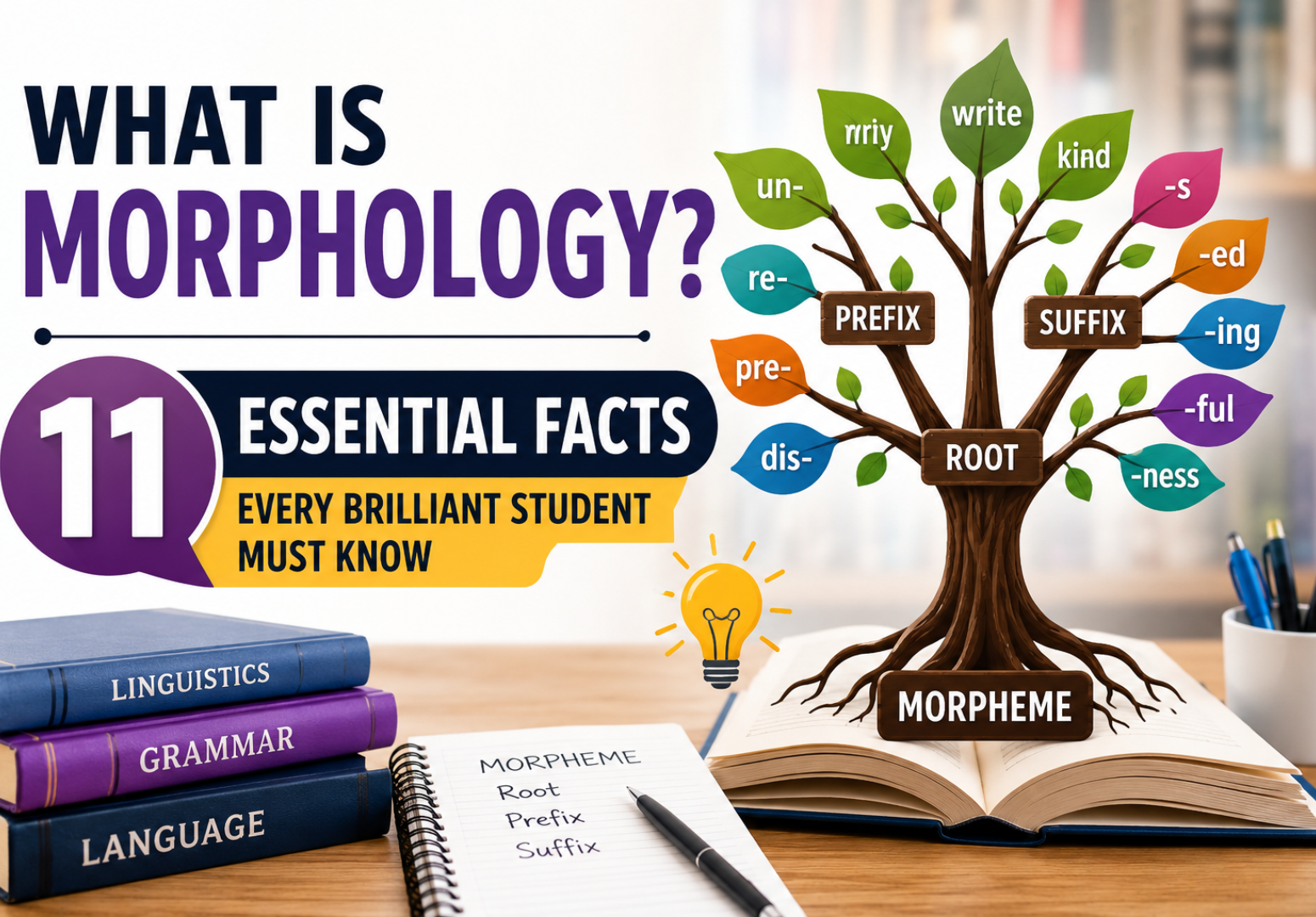
The word itself comes from the Greek words “morphe” meaning form and “logos” meaning study. So morphology is literally the study of form. In linguistics, this means examining how prefixes, suffixes, roots, and bases work together to build the words we use every day. What is morphology really about, then? It is about understanding that words are not random strings of letters but structured, rule-governed units with internal logic.
Morphemes and Their Importance
The central concept in morphology is the morpheme. A morpheme is the smallest unit of meaning in a language. It cannot be broken down any further without losing its meaning. The word “cats,” for example, contains two morphemes — “cat” and “s.” The first carries the core meaning and the second signals plurality. This kind of analysis is exactly what morphology is designed to do.
Morphemes come in two main types — free morphemes and bound morphemes. Free morphemes can stand alone as words. “Book,” “run,” and “happy” are all free morphemes. Bound morphemes cannot stand alone — they need to attach to another morpheme to carry meaning. Prefixes like “un-” and suffixes like “-ness” are classic bound morphemes. Understanding this distinction is one of the first real steps in grasping what is morphology as a field.
What Is Morphology Types
What is morphology without its different branches and types? There are two main divisions that most linguists work with — inflectional morphology and derivational morphology. These two categories handle different aspects of word structure and serve very different purposes in language systems.
Inflectional morphology deals with grammatical changes to a word that do not alter its core meaning or word class. Adding “-ed” to make a verb past tense or “-s” to make a noun plural are inflectional processes. Derivational morphology, on the other hand, creates entirely new words or changes a word’s grammatical category. Turning “happy” into “happiness” or “teach” into “teacher” — those are derivational processes. Both types reveal just how structured and layered language actually is.
Word Structure and Analysis
One of the most practical applications of understanding what is morphology is word structure analysis. When you break a word down into its morphemes, you get a clearer picture of where it comes from and what it means. Take the word “unbreakable” — it contains three morphemes: “un-” meaning not, “break” as the root, and “-able” meaning capable of. Put them together and the meaning becomes perfectly transparent.
This kind of analysis is enormously useful in education. Students who understand morphological structure can decode unfamiliar words far more efficiently than those who have no framework for it. If you know that the prefix “bio-” relates to life and “-logy” means the study of something, you can make an educated guess at what “biology,” “biotechnology,” or “biosphere” mean even if you have never encountered them before. For students looking to sharpen academic skills, resources like this guide on English instructor career paths offer great context on how language knowledge builds professional expertise.
Morphology in English Language
English is a particularly interesting language to study through the lens of morphology because it borrows heavily from Latin, Greek, French, and Germanic roots. This makes English morphology rich and sometimes unpredictable. The same concept might be expressed with a Latin-derived word in formal writing and a Germanic word in casual speech — “paternal” versus “fatherly,” for instance.
What is morphology revealing about English specifically? It shows us that English word formation follows identifiable patterns even when spelling gets inconsistent. The “-tion” suffix almost always marks a noun derived from a verb. The prefix “re-” almost always signals repetition. Once learners internalize these patterns, their reading comprehension, writing quality, and vocabulary acquisition all improve noticeably. Morphology gives English learners a system rather than a guessing game.
Morphology in Biological Sciences
What is morphology in biology is a slightly different but equally important question. In biology, morphology refers to the study of the form and structure of organisms — their physical shape, body parts, and how those features relate to function. It is one of the oldest branches of biological science and remains central to fields like taxonomy, evolutionary biology, and anatomy.
Biologists use morphological analysis to classify species, trace evolutionary relationships, and understand how physical traits adapt to environmental pressures. The shape of a bird’s beak, the structure of a leaf, the arrangement of bones in a limb — all of these fall under biological morphology. The field has expanded significantly with the addition of molecular tools, but traditional morphological observation still drives a huge portion of species identification and ecological research.
Computational Morphology Applications
According to research published by the Linguistic Society of America, morphological analysis has become a critical component of natural language processing and artificial intelligence development. When machines learn to parse human language, they need to understand how words are formed — how a single root generates dozens of related forms depending on context. Computational morphology handles exactly this problem.
Search engines, voice assistants, translation software, and autocorrect tools all rely on morphological rules under the surface. When you type “running” and a search engine also retrieves results for “run” and “runner,” that is morphological normalization at work. What is morphology contributing to AI? Essentially the grammatical backbone that allows machines to process language the way humans instinctively do, without needing to memorize every possible word form independently.
Morphology Versus Syntax Differences
A lot of students confuse morphology with syntax, so it is worth drawing a clear line between them. What is morphology concerned with? The internal structure of individual words. What is syntax concerned with? The way words combine into phrases, clauses, and sentences. They are related but operate at different levels of linguistic analysis.
Think of it this way — morphology is about what happens inside a word, while syntax is about what happens between words. Morphology explains why “walked” is the past tense of “walk.” Syntax explains why “She walked quickly” is grammatically correct but “Quickly she walked quickly” sounds strange. Both fields are essential to a complete understanding of how language works, and they interact constantly in real language production and comprehension.
How Morphology Affects Vocabulary
The connection between morphology and vocabulary development is one of the most practically useful things to understand about this field. Research consistently shows that students who receive explicit instruction in morphological patterns develop larger vocabularies faster than those who rely on context guessing alone. Knowing morphemes gives you a toolkit for generating and recognizing thousands of related words from a small set of roots.
Consider the root “port” meaning to carry. From that single root, you can derive import, export, transport, portable, porter, deportation, and many more. What is morphology giving a learner here? Not just one word but an entire family of related terms that suddenly become accessible. This is why morphological awareness is now considered a key component of literacy instruction in schools across many countries.
Morphology in Child Language Acquisition
One of the most fascinating windows into what is morphology comes from watching children learn language. Children do not learn morphological rules explicitly — nobody sits a two-year-old down and explains inflectional suffixes. Yet by around age three, children begin applying morphological rules spontaneously and even over-generalizing them in revealing ways.
The classic example is regularization errors — a child saying “goed” instead of “went” or “mouses” instead of “mice.” These are not random mistakes. They are evidence that the child has internalized the morphological rule for past tense or plural formation and is applying it systematically. This process tells linguists a great deal about how morphological knowledge is stored and processed in the human brain, making child language acquisition a rich area of morphological research.
What Is Morphology Research Methods
What is morphology as an academic discipline actually doing in research settings? Linguists use a variety of methods to study morphological systems — corpus analysis, experimental tasks, cross-linguistic comparisons, and computational modeling among them. Each method reveals different aspects of how morphological rules operate within and across languages.
Cross-linguistic research is particularly illuminating. Languages vary enormously in their morphological complexity. Turkish and Finnish are highly agglutinative, meaning they stack many morphemes onto a single root to create long, information-dense words. English sits somewhere in the middle — less synthetic than Turkish but more morphologically varied than Chinese, which relies less on internal word structure and more on word order. Comparing these systems deepens the understanding of what is morphology capable of expressing across human language.
Morphological Awareness in Education
Teaching morphological awareness explicitly in classrooms has gained significant traction in educational research over the past two decades. When students learn to recognize and manipulate morphemes, their reading accuracy, spelling, and writing fluency all improve. This is especially true for students learning English as a second language, where morphological patterns provide a reliable bridge between their native language knowledge and new English vocabulary.
Effective morphology instruction does not mean drilling students on lists of prefixes and suffixes. It means helping them notice patterns, generate word families, analyze unfamiliar words, and discuss how meaning changes when morphemes are added or removed. This kind of active engagement with word structure turns passive vocabulary into flexible, generative knowledge that students can apply independently across subjects and contexts.
Inflectional Morphology Deep Dive
Inflectional morphology deserves its own focused attention because it is where grammar and word structure intersect most visibly. In English, inflectional morphemes are relatively limited — there are only about eight inflectional suffixes in the entire language, covering tense, number, possession, and comparison. Despite this small number, they carry enormous grammatical weight.
The “-s” suffix alone serves multiple functions — it marks plural nouns, third-person singular present verbs, and possessives. Context determines which function is active in any given sentence. This kind of ambiguity is what makes English morphology both efficient and occasionally tricky for learners. What is morphology helping us do here? It gives us the analytical tools to distinguish between surface similarity and functional difference in a principled, systematic way.
Derivational Morphology Deep Dive
Derivational morphology is where the creative power of language really shows itself. Through derivation, a single root word can generate an entire network of related terms across different grammatical categories. The verb “act” becomes the noun “action,” the adjective “active,” the adverb “actively,” the noun “activity,” and the verb “activate” — all through derivational processes.
What makes derivational morphology especially interesting is that it is productive — speakers of a language can use derivational patterns to coin new words that other speakers immediately understand, even if they have never heard the specific word before. If someone says “she completely de-cluttered her apartment,” you understand “de-clutter” instantly because you recognize the derivational prefix and the root. This productivity is one of the things that makes human language so powerful and flexible.
Morphology Across World Languages
A global perspective on what is morphology reveals just how differently languages can organize their word structures. Agglutinative languages like Swahili and Hungarian attach strings of morphemes to roots in a clear, one-morpheme-per-meaning pattern. Fusional languages like Spanish and Russian blend grammatical information together in ways that are harder to separate cleanly. Isolating languages like Mandarin use very little morphological modification, relying on separate words and word order instead.
This typological variation is one of the reasons morphology is such a rich field of study. There is no single way that human languages package meaning into words — there is instead a wide spectrum of strategies, each with its own structural logic. Studying morphology across languages reveals both the diversity and the underlying universals of human linguistic capacity.
Morphology and Spelling Connection
The relationship between morphology and spelling is stronger than most people realize. Many English spelling rules that seem arbitrary actually follow morphological logic. The spelling of “nation” versus “national” stays consistent because the root morpheme is preserved even when pronunciation shifts. Understanding this helps learners stop treating spelling as pure memorization and start seeing it as a system with rules.
Research in literacy education has shown that morphological instruction improves spelling outcomes significantly. When students understand that the base word “sign” is preserved in “signal,” “signature,” and “signify” despite pronunciation differences, spelling those words becomes logical rather than arbitrary. What is morphology offering spellers? A memory aid that is far more durable and generative than rote memorization alone.
Conclusion
What is morphology at the end of the day? It is the science of how words are built — the grammar of word structure, the architecture of meaning, and the system that links individual language units into a coherent whole. Whether you are a linguist, a student, a teacher, a biologist, or an AI developer, morphology touches your work in ways both obvious and invisible. Understanding what is morphology equips you to analyze language more sharply, learn vocabulary more efficiently, and appreciate just how elegantly structured human communication really is.
Frequently Asked Questions
What is morphology in simple terms?
What is morphology in the simplest sense? It is the study of how words are structured and how their smallest meaningful units — called morphemes — combine to create meaning in language.
How is morphology different from phonology?
Phonology studies sounds in a language, while morphology studies word structure. What is morphology focused on is meaning-bearing units, not sounds themselves, though the two fields often interact in linguistic analysis.
Why is morphology important for language learners?
Morphology gives language learners a system for decoding unfamiliar words. By recognizing prefixes, suffixes, and root patterns, learners can build vocabulary far faster than through memorization alone.
What is morphology used for in biology?
In biology, morphology refers to the study of the physical form and structure of organisms. It is used for species classification, evolutionary analysis, and understanding how physical features serve functional purposes.
Is morphology relevant to artificial intelligence?
Absolutely. Computational morphology is a key component of natural language processing. AI systems use morphological rules to analyze, generate, and understand human language accurately across different forms and contexts.