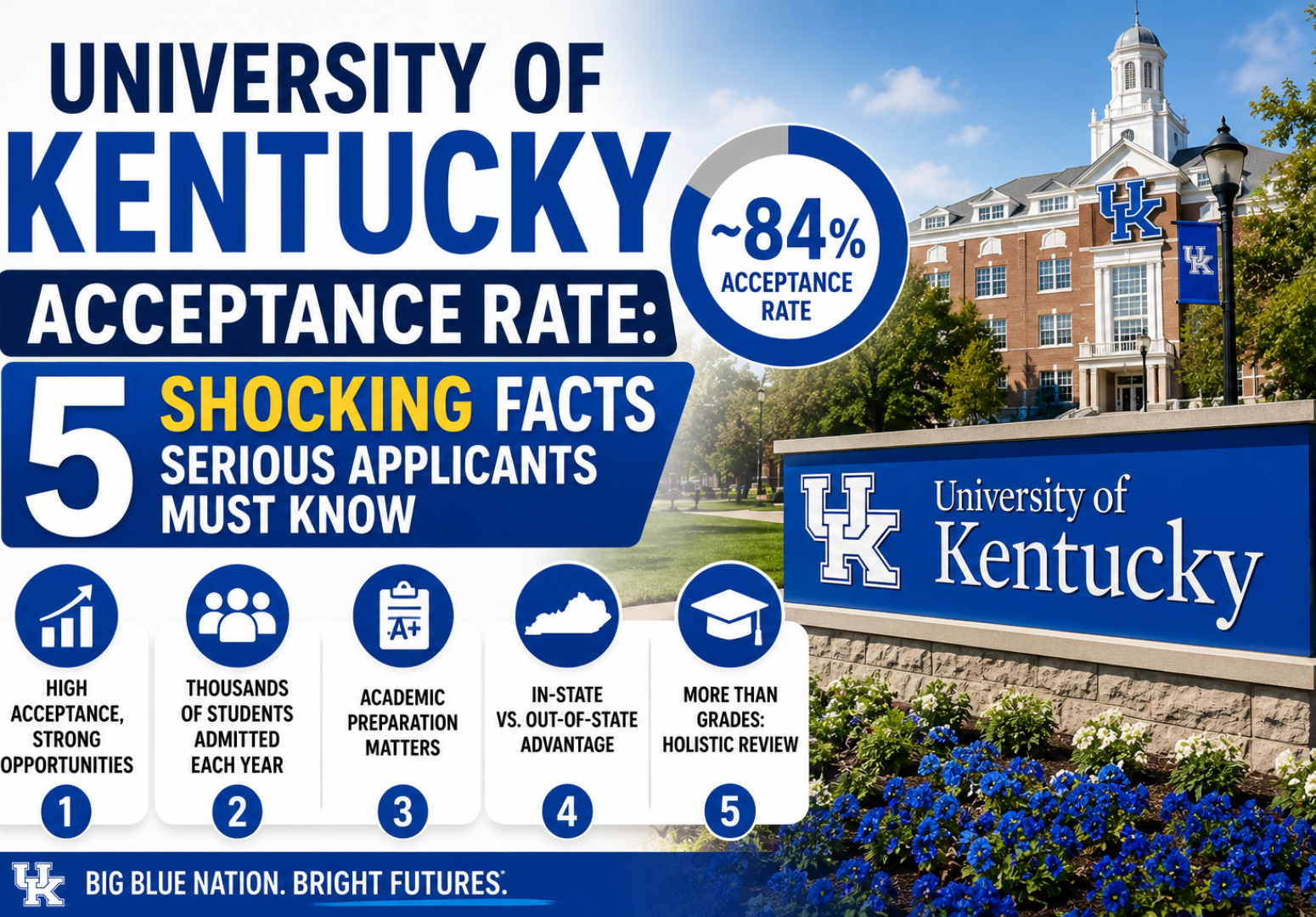
University of Kentucky acceptance rate is one of the first things students research when considering this flagship public university in Lexington. Knowing where you stand before you apply saves time, reduces anxiety, and helps you build a stronger application strategy. This article walks through every angle of UK’s admissions picture so you can make an informed decision.
Overall Admission Rate Numbers
The University of Kentucky acceptance rate sits at approximately 95% for general undergraduate admissions, making it one of the more accessible flagship universities in the United States. This high rate reflects UK’s commitment to serving Kentucky residents and expanding access to higher education across the state. However, a high acceptance rate does not mean all programs admit freely.
Individual colleges and competitive programs within UK operate with significantly tighter admission standards. Pre-med tracks, nursing, engineering, and pharmacy all require stronger academic profiles than the general admission threshold suggests. The overall rate can mislead students who assume acceptance means automatic entry into their desired program.
Freshman Class Academic Profile
The typical admitted freshman at the University of Kentucky presents a GPA between 3.4 and 3.9 on a 4.0 scale. ACT scores for admitted students generally range from 22 to 30, with the middle 50% falling between 24 and 30. SAT equivalents follow a similar spread across the admitted class.
These figures represent the middle range, meaning students above and below this band are regularly admitted. UK uses a holistic review process that considers course rigor, grade trends, extracurricular involvement, and personal background alongside raw test scores. A strong upward grade trend in junior and senior year can offset a weaker sophomore performance.
Nursing Program Admission Standards
The College of Nursing at UK is among the most competitive entry points on campus. Acceptance into the nursing program requires a separate application after completing prerequisite courses, and the acceptance rate for the upper-division nursing program is considerably lower than the university’s overall rate.
Students must typically maintain a cumulative GPA of 3.0 or higher in prerequisite science courses to be considered competitive. Even then, spots are limited and demand is high. Many students spend an extra semester strengthening their science GPA before reapplying to the program.
Engineering College Entry Requirements
The Stanley and Karen Pigman College of Engineering at UK admits students with stronger academic profiles than the university average. Most engineering students present ACT scores of 26 or higher and high school GPAs above 3.5. Calculus readiness is evaluated as part of the admissions picture for most engineering disciplines.
First-year engineering students enter a general engineering curriculum before declaring a specific discipline in their second year. This structure gives students time to adjust to the academic pace before committing to electrical, mechanical, civil, or chemical engineering. It also means your first-year GPA carries real weight for your long-term program placement.
Out-of-State Applicant Differences
Out-of-state students are welcomed at UK and face the same general admission standards as Kentucky residents for most programs. The university actively recruits nationally and maintains a sizable out-of-state enrollment. Acceptance rates for out-of-state applicants in general admissions remain high, though tuition costs differ significantly.
Where differences emerge is in scholarship availability. Kentucky residents have access to state-funded programs like the Kentucky Educational Excellence Scholarship, which out-of-state students cannot access. Out-of-state applicants should research UK’s merit scholarship programs specifically designed for non-residents, as these can meaningfully reduce the cost gap.
International Student Admission Process
International applicants to the University of Kentucky go through a slightly different admissions process than domestic students. Academic transcripts are evaluated against their home country’s grading scale, and English proficiency is required for all non-native English speakers. UK typically requires a minimum TOEFL score of 71 or an IELTS score of 6.0.
Meeting the minimum language requirement gets your application reviewed but does not guarantee admission into competitive programs. International students applying to nursing, pharmacy, or engineering should treat program-specific requirements as their real benchmark. General admission approval and program admission are two separate hurdles.
Pharmacy School Acceptance Odds
The UK College of Pharmacy is one of the most respected programs in the southeastern United States, and its admission standards reflect that reputation. The PharmD program admits a limited number of students each year, with acceptance rates that are dramatically lower than the university’s overall figure.
Competitive pharmacy applicants typically present science GPAs above 3.3, strong PCAT scores, and meaningful healthcare experience. Letters of recommendation from pharmacists or healthcare professionals carry real weight in this process. Students who rush the application without shadowing hours or relevant experience rarely receive offers.
Honors College Admission Criteria
The Lewis Honors College at UK offers a premium academic experience with smaller classes, dedicated faculty mentorship, and enhanced research opportunities. Admission to the Honors College is selective and separate from general university admission. Most accepted Honors students present ACT scores of 30 or higher and GPAs above 3.8.
Applying to the Honors College at the same time as your general application is strongly recommended. Waiting until after admission to apply reduces your chances. Students who enter the Honors College gain access to priority registration, which has practical academic benefits throughout their four years on campus.
Transfer Student Acceptance Rates
Transfer students represent a significant portion of UK’s incoming class each year. The university accepts transfer applicants from Kentucky community colleges, other four-year institutions, and out-of-state schools. Transfer acceptance rates are generally favorable, particularly for students coming from Kentucky Community and Technical College System schools.
UK has formal articulation agreements with several community colleges that streamline the transfer process. Students who complete an Associate of Arts or Associate of Science degree with a strong GPA often find the transfer process straightforward. The challenge comes when transferring into competitive programs like nursing or pharmacy, where separate program applications are required.
GPA Requirements by Program
While the university’s general admission does not impose a strict GPA cutoff for most applicants, individual programs tell a different story. Business, journalism, and social work programs each maintain their own minimum GPA thresholds for entry. Checking program-specific requirements is not optional before you finalize your application.
Students who are admitted to UK but fall short of a program’s GPA requirement are often placed in an exploratory or undeclared status. This is not the end of the road, but it does add time and pressure to your academic plan. Knowing the actual requirements for your intended major before arriving on campus changes how you approach your first semester.
Scholarship Opportunities and Merit Aid
UK offers a range of merit scholarships tied to academic performance at admission. The Presidential Scholarship, one of the most competitive, provides substantial funding for students with exceptional academic records. Most merit scholarships require ACT scores of 28 or higher and GPAs above 3.7 for serious consideration.
Scholarship applications are often due earlier than the general admissions deadline. Missing the scholarship deadline while meeting the admissions deadline means you could gain entry without any financial support. Set your scholarship deadline as your primary calendar target, not the general application deadline.
Campus Visit and Application Tips
Visiting UK’s Lexington campus before applying gives you genuine insight that no website can replicate. The campus culture, the scale of the facilities, and the feel of the student community all factor into whether this is actually the right environment for you. Many students apply to UK without ever visiting and arrive in August surprised by what they find.
The application itself is straightforward through the Common App or UK’s direct portal. Essays are not required for general admission, but competitive program supplemental materials are. Give yourself at least three weeks to complete any written components — rushed essays show, and they cost applicants real consideration in tight admission cycles.
Waitlist Process at UK
Being placed on the University of Kentucky waitlist is more common in competitive programs than in general admissions. Students on the waitlist for nursing, pharmacy, or honors should continue pursuing other options rather than waiting passively. Waitlist movement depends entirely on how many admitted students decline their offers.
If you are waitlisted, send a letter of continued interest to the admissions office. Keep it brief, specific, and genuine. Update them on any new academic achievements or awards since your original application. Admissions offices do read these letters, and a well-written one can make a real difference when spots open up.
Comparing UK to Nearby Schools
When weighing the University of Kentucky acceptance rate against peer institutions, it compares favorably for accessibility. The University of Louisville, UK’s main in-state rival, has a similarly high overall acceptance rate. However, UK’s research profile, campus size, and program depth give it a distinct edge for students focused on graduate or professional school pathways.
Out-of-state comparisons are also worth making. Schools like the University of Tennessee and Ohio State University have comparable overall acceptance rates but different program strengths. Choosing based on program quality in your specific field rather than overall prestige gives you a better return on your investment.
Post-Graduation Employment Outcomes
One reason the University of Kentucky acceptance rate draws so much attention is the value attached to the degree itself. UK graduates in healthcare, engineering, business, and education fields consistently report strong employment outcomes. The university’s ties to Kentucky’s major employers and its growing research reputation support solid career placement across most disciplines.
According to information published by the National Center for Education Statistics, graduates from public flagship universities like UK generally report higher lifetime earnings compared to graduates from regional institutions. Location matters too — Lexington’s growing economy in healthcare and technology provides internship and entry-level opportunities that students can access throughout their degree.
Academic Career Paths After UK
For students who develop a passion for research or teaching during their time at UK, the path forward often leads into graduate school or academic employment. The university produces a meaningful number of PhD candidates and future faculty members each year across its graduate programs. If an academic or instructional career interests you, planning for it early changes the courses and experiences you pursue as an undergraduate.
Those seriously considering a future in academia or instruction will benefit from learning what that career path actually looks like financially and professionally. A thorough breakdown of the assistant professor career path and salary offers honest context for anyone weighing the academic route after completing their degree at UK.
Making Your Final Decision
The University of Kentucky acceptance rate of around 95% makes it an accessible choice, but accessibility should not be the primary reason you apply. Apply because the programs align with your goals, because the campus environment matches how you learn best, and because the financial picture makes sense for your situation. A high acceptance rate at the front door means nothing if you end up in the wrong program.
Visit the campus, talk to current students, and request detailed information about your intended major from the department directly. Ask about internship placement, faculty research involvement, and what recent graduates are doing now. The answers to those questions tell you far more about fit than any acceptance rate figure ever could.
Final Thoughts about University of Kentucky Acceptance Rate
University of Kentucky acceptance rate numbers paint a picture of a welcoming institution that genuinely wants to serve a broad population of students. That accessibility is real and valuable. But the full story requires looking at program-level data, scholarship timelines, and the academic preparation needed to thrive once you arrive — not just to gain entry.
The students who succeed at UK are not necessarily the ones with the highest test scores or the most polished applications. They are the ones who arrive with a clear sense of purpose, a willingness to engage with faculty and peers, and an understanding of what the university actually offers in their field. Preparation matters more than perception, and deliberate planning from the beginning of your senior year dramatically improves both your admission outcome and your first-year experience.
If your academic profile falls within or above the typical admitted range, UK is absolutely worth a serious application. If you are targeting a competitive program like nursing, pharmacy, or the Honors College, treat those specific benchmarks as your real goal and plan your preparation accordingly. The overall acceptance rate gives you confidence that a path exists — your job is to make sure you are genuinely ready to walk it with intention and follow-through from day one.
FAQs
What is the University of Kentucky acceptance rate overall?
The University of Kentucky acceptance rate is approximately 95% for general undergraduate admissions. However, competitive programs like nursing, pharmacy, and the Honors College have significantly lower acceptance rates that require stronger academic profiles.
What GPA do I need to get into the University of Kentucky?
Most admitted students present GPAs between 3.4 and 3.9. Competitive programs require higher GPAs, often above 3.5 to 3.8 depending on the college. Always check program-specific requirements before applying.
Does the University of Kentucky require ACT or SAT scores?
UK considers ACT and SAT scores as part of its holistic review process. The middle 50% of admitted students score between 24 and 30 on the ACT. Test-optional policies may apply — check the current admissions page for the most updated requirements.
Are out-of-state students accepted at the same rate as Kentucky residents?
Yes, general admission rates are similar for both groups. The main difference lies in scholarship eligibility, as state-funded grants are reserved for Kentucky residents. Out-of-state students should research UK-specific merit scholarships to offset higher tuition costs.
Can I transfer into a competitive program like nursing at UK?
Transfer into competitive programs requires meeting program-specific GPA and prerequisite requirements, separate from general transfer admission. Students transferring from Kentucky Community and Technical College System schools with articulation agreements often have a clearer pathway into certain programs.