A polar covalent bond sits at the heart of almost everything chemistry explains about the physical world. Water dissolves salt. DNA holds its double helix together. Proteins fold into precise shapes. Membranes keep cell contents separated from the outside environment. Every one of these phenomena traces back, at least in part, to the way electrons are shared — or more accurately, not shared equally — between atoms. That unequal sharing is exactly what a polar covalent bond is.
The idea isn’t complicated once you see it clearly. When two atoms bond by sharing electrons, those electrons don’t always sit symmetrically between the two nuclei. If one atom pulls harder on the electrons than the other, the shared pair spends more time near the greedier atom. That atom gets a partial negative charge; the other ends up with a partial positive charge. You now have a polar covalent bond — a bond with two ends that behave differently from an electrical standpoint. This article gets into why that matters, how to recognize it, and where it shows up across chemistry and biology.
What Is Polar Covalent Bond
A polar covalent bond forms when two atoms share electrons unequally due to a difference in their electronegativity values. Electronegativity is the measure of how strongly an atom in a molecule attracts the bonding electrons toward itself. When the electronegativity difference between two bonded atoms falls between approximately 0.4 and 1.7 on the Pauling scale, chemists classify the bond as a polar covalent bond. Below 0.4, the bond is considered nonpolar covalent. Above 1.7, it’s ionic.
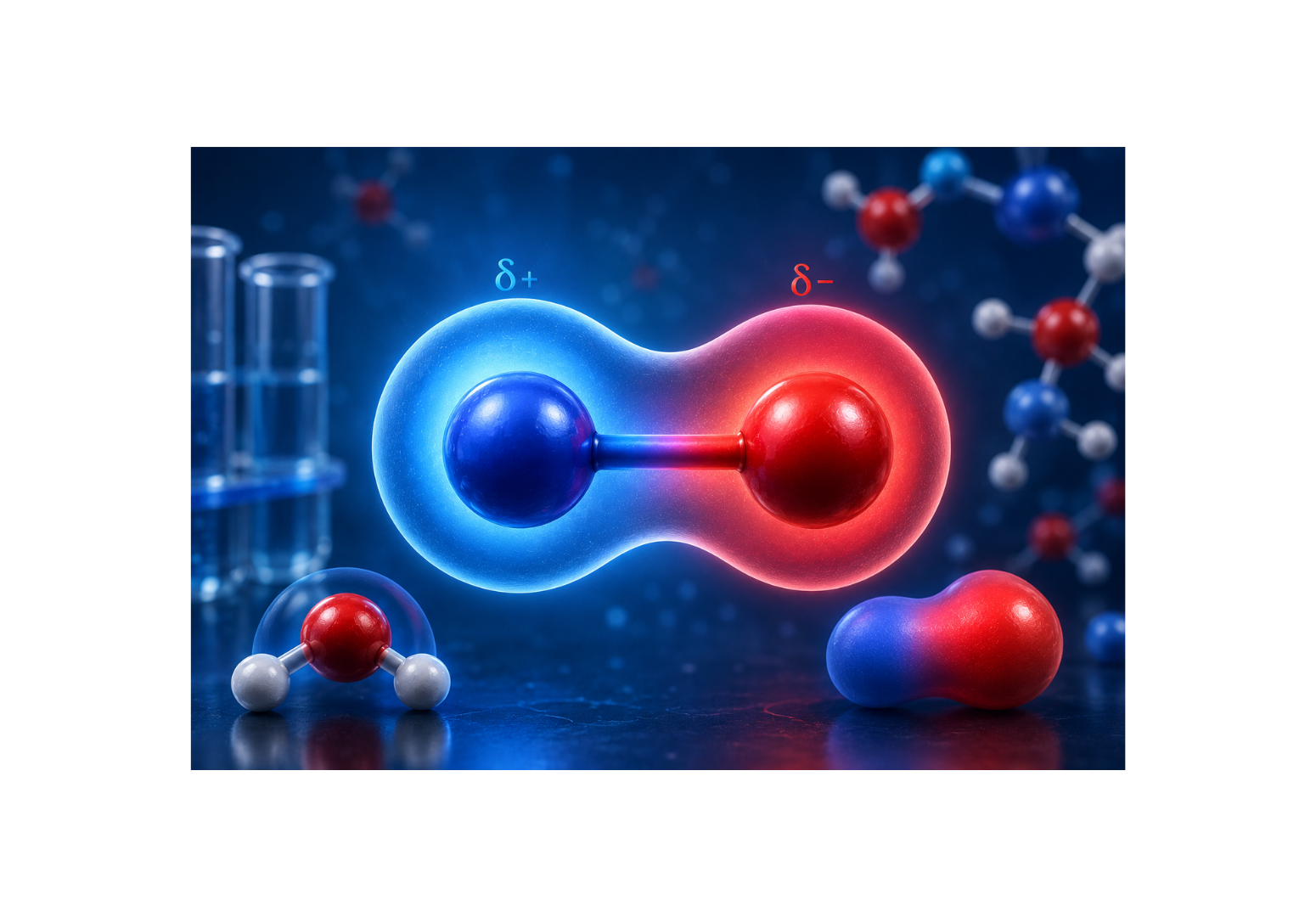
The result of this unequal sharing is a bond with partial charges at each end. Chemists represent these with the Greek letter delta — δ+ for the atom with less electron density and δ− for the atom that pulled more electrons toward itself. These aren’t full charges like you’d see in ions; they’re fractional charges that give the bond a directional electrical property called a dipole moment. That dipole moment is what makes the polar covalent bond so chemically active and so central to molecular behavior.
Electronegativity Drives Bond Polarity
Electronegativity is the engine behind every polar covalent bond. Linus Pauling developed the most widely used electronegativity scale, assigning values to elements based on bond energies and electron affinities. Fluorine sits at the top with a value of 4.0 — the most electronegative element on the periodic table. On the opposite end, cesium and francium have electronegativity values around 0.7. The larger the gap between two bonded atoms, the more polar the bond between them.
You might find this concept comes up in ways students don’t always expect — science teachers who connect chemical bonding to everyday life often find it’s one of those topics that genuinely sticks. If you’re looking for ways to make chemistry engaging in the classroom, science education resources can offer surprising starting points. Back to electronegativity: oxygen has a value of 3.5, nitrogen sits at 3.0, and carbon lands at 2.5. Hydrogen is 2.1. These differences — 1.4 for O-H, 0.9 for N-H, 0.4 for C-H — explain why oxygen-hydrogen bonds are strongly polar, nitrogen-hydrogen bonds are moderately polar, and carbon-hydrogen bonds are only weakly polar.
The Water Molecule Example
Water is the textbook example of a polar covalent bond in action, and for good reason. The O-H bond in water has an electronegativity difference of 1.4, making it a strongly polar covalent bond. Oxygen pulls the shared electrons significantly toward itself, acquiring a partial negative charge. Each hydrogen ends up with a partial positive charge. But water’s polarity goes beyond individual bonds — it extends to the whole molecule.
Because the two O-H bonds are arranged at a 104.5-degree angle (due to the lone pairs on oxygen pushing the bonds together), the dipole moments of both bonds don’t cancel out. They add up, giving water a large molecular dipole moment of 1.85 Debye. That’s why water behaves so differently from carbon dioxide, which also has polar C=O bonds but whose linear geometry causes the bond dipoles to cancel, making CO2 nonpolar overall. Water’s molecular polarity driven by its polar covalent bonds is directly responsible for its high boiling point, its surface tension, its ability to dissolve ionic compounds, and its role as the universal solvent for life.
Recognizing Polar Bonds in Molecules
Identifying whether a bond is a polar covalent bond requires two steps. First, you check the electronegativity difference between the two bonded atoms. If that difference is between 0.4 and 1.7, you’re looking at a polar covalent bond. Second — and this is the step many students skip — you check whether the molecule’s geometry allows those bond dipoles to cancel.
A molecule can contain polar covalent bonds and still be nonpolar overall if the bonds are arranged symmetrically. Carbon tetrachloride (CCl4) is a classic case. Each C-Cl bond is a polar covalent bond with an electronegativity difference of 0.5. But the four bonds point toward the corners of a perfect tetrahedron, so their dipole moments exactly cancel. The molecule has zero net dipole moment and behaves as a nonpolar solvent. This distinction — between bond polarity and molecular polarity — trips up students regularly and is worth getting clear before moving forward.
Comparing Polar and Nonpolar Covalent Bonds
The difference between a polar covalent bond and a nonpolar covalent bond comes down to one thing: how different the two atoms are electronegatively. In a nonpolar covalent bond, the two atoms are either identical (like in H2, O2, or Cl2) or so similar that the electron sharing is essentially equal. In a polar covalent bond, there’s a meaningful electronegativity gap that pulls the electrons off-center.
The practical consequences of this difference are significant. Nonpolar molecules tend to be soluble in other nonpolar solvents — “like dissolves like” is the rule. Polar molecules, which contain polar covalent bonds that don’t cancel out, tend to dissolve in polar solvents like water. This is why oil and water don’t mix: oil is made of nonpolar C-H and C-C bonds, while water is a strongly polar solvent. Drop a salt crystal into water and it dissolves; drop it into hexane and nothing happens. The polarity difference, rooted in how electrons are shared in individual bonds, determines solubility behavior at the macroscopic level.
Dipole Moments and Measurement
The dipole moment is the quantitative measure of a bond’s or molecule’s polarity. For a polar covalent bond, the dipole moment (μ) is calculated as the product of the charge magnitude (q) and the distance between the charges (r): μ = q × r. Dipole moments are measured in Debye units (D), where 1 Debye equals 3.336 × 10⁻³⁰ coulomb-meters. A completely nonpolar bond has a dipole moment of zero; a highly polar bond like H-F has a dipole moment of about 1.82 D.
Measuring dipole moments experimentally involves placing molecules in an electric field and observing how they orient themselves. Polar molecules, with their uneven charge distribution from polar covalent bonds, align with the field; nonpolar molecules don’t. This alignment behavior in electric fields is directly observable and gives chemists a way to confirm theoretical predictions about bond polarity. Modern computational chemistry can calculate dipole moments with impressive accuracy, but the experimental measurements were what first gave chemists confidence that the polar covalent bond model reflected something real about molecular structure.
Polar Bonds in Biological Molecules
The polar covalent bond is everywhere in biochemistry. According to research available through the National Center for Biotechnology Information, the hydrogen bonding that stabilizes DNA’s double helix, proteins’ secondary structures, and enzyme-substrate interactions all depend on the partial charges created by polar covalent bonds between oxygen, nitrogen, and hydrogen atoms. Without the δ+ on hydrogen and the δ− on oxygen or nitrogen, hydrogen bonds simply couldn’t form.
In DNA, the base pairs hold together through hydrogen bonds between complementary bases — adenine with thymine, guanine with cytosine. Each of these hydrogen bonds involves a polar N-H bond on one base interacting with a polar C=O or C-N bond on the complementary base. The entire information storage and retrieval system of life depends on these interactions. Proteins fold into their three-dimensional shapes because of hydrogen bonds between polar covalent bonds in the backbone’s amide groups. Enzymes bind their substrates in active sites lined with polar amino acid residues. The polar covalent bond isn’t a chemistry textbook abstraction — it’s the structural currency of molecular biology.
Polar Bonds and Hydrogen Bonding
Hydrogen bonding is the direct consequence of the polar covalent bond. When hydrogen is bonded to a highly electronegative atom — fluorine, oxygen, or nitrogen — the electron density gets pulled so far toward the electronegative atom that the hydrogen nucleus (a bare proton, essentially) becomes electrostatically exposed. That partially positive hydrogen can then be attracted to a lone pair of electrons on another electronegative atom in a nearby molecule. That attraction is a hydrogen bond.
Hydrogen bonds are typically 5 to 10 times weaker than covalent bonds, but they’re strong enough to produce dramatic physical effects. Water’s boiling point is 100°C; if water behaved like a similar-sized nonpolar molecule, it would boil around −80°C. The difference — 180 degrees — is entirely due to hydrogen bonds between water molecules, which themselves arise from the polar covalent bonds in each water molecule. Ice floats because hydrogen bonding creates a lattice structure in solid water that is less dense than liquid water. These aren’t minor details; they’re the properties that make Earth habitable.
Partial Charges in Polar Molecules
The partial charges that arise from polar covalent bonds — the δ+ and δ− — are not fixed values. They exist on a continuum depending on the electronegativity difference between the bonded atoms. An O-H bond, with a difference of 1.4, has more pronounced partial charges than a C-O bond with a difference of 1.0, which has more than a C-H bond with a difference of 0.4. The greater the electronegativity gap, the more pronounced the partial charges, and the more the bond behaves like an ionic bond.
This continuum is important because it means there’s no sharp line between a polar covalent bond and an ionic bond — just a gradual shift as electronegativity difference increases. At very high differences (above 1.7 or so), the more electronegative atom captures the bonding electrons almost entirely, and you effectively have ion formation. At moderate differences, you have genuine electron sharing but with unequal distribution. This gradual transition from covalent to ionic is one of the more intellectually honest things about modern bonding theory — it reflects the reality that nature doesn’t always sort neatly into the categories chemists find convenient.
Polar Covalent Bond in Organic Chemistry
In organic chemistry, the polar covalent bond is responsible for the reactivity patterns of functional groups. Carbonyl groups (C=O), found in aldehydes, ketones, carboxylic acids, esters, and amides, are strongly polar because the electronegativity difference between carbon and oxygen is 1.0. The carbon end of the carbonyl is δ+, making it an electrophile — a site that attracts electron-rich nucleophiles in chemical reactions.
This simple principle — polar covalent bond creates electrophilic carbon, nucleophiles attack there — explains the mechanism of dozens of important organic reactions. Nucleophilic addition to aldehydes and ketones. Nucleophilic acyl substitution at carboxylic acid derivatives. Ester hydrolysis. Peptide bond formation. Grignard reactions. All of these proceed because the polar covalent bond in a carbonyl group creates a carbon atom that is electron-deficient and therefore reactive toward electron donors. Once you internalize how polarity drives reactivity, organic chemistry stops feeling like a collection of unrelated reactions and starts looking like variations on a small number of themes.
Electronegativity Trends Across Periods
Electronegativity follows predictable trends across the periodic table that help you quickly estimate whether a given bond will be a polar covalent bond and how polar it will be. Electronegativity increases going left to right across a period because increasing nuclear charge pulls electrons more tightly without adding a new electron shell. It increases going up a group because atoms get smaller and the nucleus is closer to the bonding electrons.
These trends mean that bonds between elements in the upper right of the periodic table (excluding noble gases) — like N-H, O-H, F-H, O-N, and F-O — tend to be the most strongly polar. Bonds between elements in the lower left — like C-Si, P-H, or S-H — tend to be only weakly polar. Carbon sits almost in the middle of the electronegativity range, which is part of why organic molecules can be polar or nonpolar depending on what other atoms carbon is bonded to. Silicon, one row below carbon, is slightly less electronegative, making Si-O bonds in silicates highly polar — a fact that shapes the entire chemistry of Earth’s crust.
Real World Applications of Polarity
The polar covalent bond has real engineering and industrial applications that often go unmentioned in textbooks. Detergents and soaps work because their molecules have a polar head (usually a carboxylate or sulfonate group) and a nonpolar tail (a hydrocarbon chain). The polar head interacts with water through dipole-dipole interactions and hydrogen bonding; the nonpolar tail interacts with grease and oils. This dual nature allows soaps to emulsify fats that would otherwise be insoluble in water — a direct application of polarity differences rooted in polar covalent bonds.
Pharmaceuticals are designed with polarity in mind. A drug molecule needs to be polar enough to dissolve in blood (which is mostly water) but nonpolar enough to cross cell membranes (which are made of nonpolar lipid bilayers). Medicinal chemists spend significant effort adjusting the polarity of drug candidates by adding or removing polar covalent bonds, changing functional groups, or altering molecular geometry to hit the right balance. The entire field of drug bioavailability — whether a drug gets absorbed and reaches its target — is fundamentally about managing polarity.
Polar Bonds Versus Ionic Bonds
The line between a polar covalent bond and an ionic bond is blurrier than most introductory chemistry courses suggest. The textbook rule says bonds with electronegativity differences above 1.7 are ionic, while those below 1.7 are covalent (with the polar/nonpolar split at 0.4). These cutoffs are useful as rough guides, but they’re not laws of nature — they’re conventions.
Sodium chloride (NaCl) has an electronegativity difference of 2.1 and is clearly ionic. But even in NaCl, there’s a small amount of electron sharing — the bond isn’t 100% ionic. Hydrogen fluoride has a difference of 1.9 and is technically classified as ionic by the cutoff rule, yet HF is a covalent molecule that forms hydrogen bonds and behaves more like a very polar covalent bond than like a salt. The honest picture is that bond character is a spectrum, with pure nonpolar covalent bonds at one end, pure ionic bonds at the other, and polar covalent bonds covering a wide middle range. The polar covalent bond model is most useful precisely in this middle ground, where neither the ionic nor the pure covalent picture fully captures what’s happening.
Visualizing Polarity With Arrows
Chemists use a specific visual convention to show the direction of polarity in a polar covalent bond: an arrow pointing from the δ+ end to the δ− end, with a cross at the tail to indicate the positive end. This is the dipole moment vector, and it’s a useful tool for figuring out whether a molecule is polar overall.
For water, you’d draw one arrow from each hydrogen toward the oxygen. Because the molecule is bent, both arrows point in roughly the same direction, and their sum — the net molecular dipole — points toward oxygen. For carbon dioxide, you’d draw two arrows pointing from the carbons toward the central oxygen in opposite directions. They cancel exactly, giving zero net dipole. This arrow convention makes it visually straightforward to determine molecular polarity from molecular geometry, which is why it’s taught consistently across chemistry curricula at secondary and university levels.
FAQ
What is a polar covalent bond in simple terms?
A polar covalent bond is a chemical bond where two atoms share electrons, but one atom attracts the electrons more strongly than the other. This creates partial positive and negative charges at opposite ends of the bond. The atom with greater electronegativity gets the partial negative charge (δ−), while the other gets the partial positive charge (δ+). Water’s O-H bonds are the most commonly cited example.
How do you identify a polar covalent bond in a molecule?
Check the electronegativity difference between the two bonded atoms. If the difference is between 0.4 and 1.7 on the Pauling scale, the bond is a polar covalent bond. Common examples include O-H (difference of 1.4), N-H (difference of 0.9), and C-O (difference of 1.0). To determine if the entire molecule is polar, you also need to consider the molecule’s geometry and whether the individual bond dipoles cancel.
Why does a polar covalent bond make water such a good solvent?
Water’s polar O-H bonds give the molecule a net dipole moment, making water strongly polar overall. Ionic compounds dissolve in water because water molecules surround and stabilize the individual ions through ion-dipole interactions. Other polar substances dissolve because water can form dipole-dipole interactions and hydrogen bonds with them. Nonpolar substances don’t dissolve in water because they lack the partial charges needed to interact favorably with water’s polar covalent bonds.
What is the difference between polar covalent and ionic bonds?
Both involve charge separation, but the mechanism differs. In an ionic bond, one atom fully transfers one or more electrons to another, creating distinct positive and negative ions. In a polar covalent bond, electrons are shared but unequally, creating partial charges rather than full ones. The electronegativity difference between bonded atoms determines which type forms — roughly, differences above 1.7 produce ionic bonds, while differences between 0.4 and 1.7 produce polar covalent bonds.
Conclusion
The polar covalent bond is one of chemistry’s most productive ideas — not because it’s complicated, but because such a simple concept explains so much. Unequal electron sharing between two atoms creates partial charges. Those partial charges create dipole moments. Dipole moments enable hydrogen bonding, determine solubility, drive biochemical interactions, and shape molecular reactivity. The whole chain of consequences flows from that one basic observation about how electrons behave when two different atoms pull on them simultaneously.
What makes the polar covalent bond particularly satisfying to study is that you can see its effects everywhere. Water’s properties, soap’s function, drug absorption, DNA stability, protein folding — all of it connects back to the same underlying principle. Once you can picture electrons being pulled unevenly across a bond and understand why that matters, chemistry stops being a collection of facts to memorize and becomes a set of patterns that actually make sense. The polar covalent bond isn’t just a topic in a chemistry course; it’s one of the lenses that makes the molecular world readable.