Mathematics in Games Overview
Mathematics in games is not a background feature. It is the foundation that every game — board game, video game, mobile game, card game — sits on top of. When a character jumps and lands with realistic weight, that’s physics math. When an enemy decides whether to attack or retreat, that’s probability and decision theory. When the map generates around you as you walk, that’s procedural algorithms built on mathematical logic. None of it happens without math running underneath it at every moment.
Most players never think about this, which is actually a sign that the mathematics is working well. When math in a game is done right, it disappears into the experience. The jump feels natural. The enemy feels smart. The world feels real. The moment something breaks — a character clips through a wall, an AI makes a bizarre decision, a physics object flies across the room for no reason — you’re usually looking at a mathematical calculation that went wrong somewhere. That’s how embedded mathematics in games actually is. You notice it most when it fails.
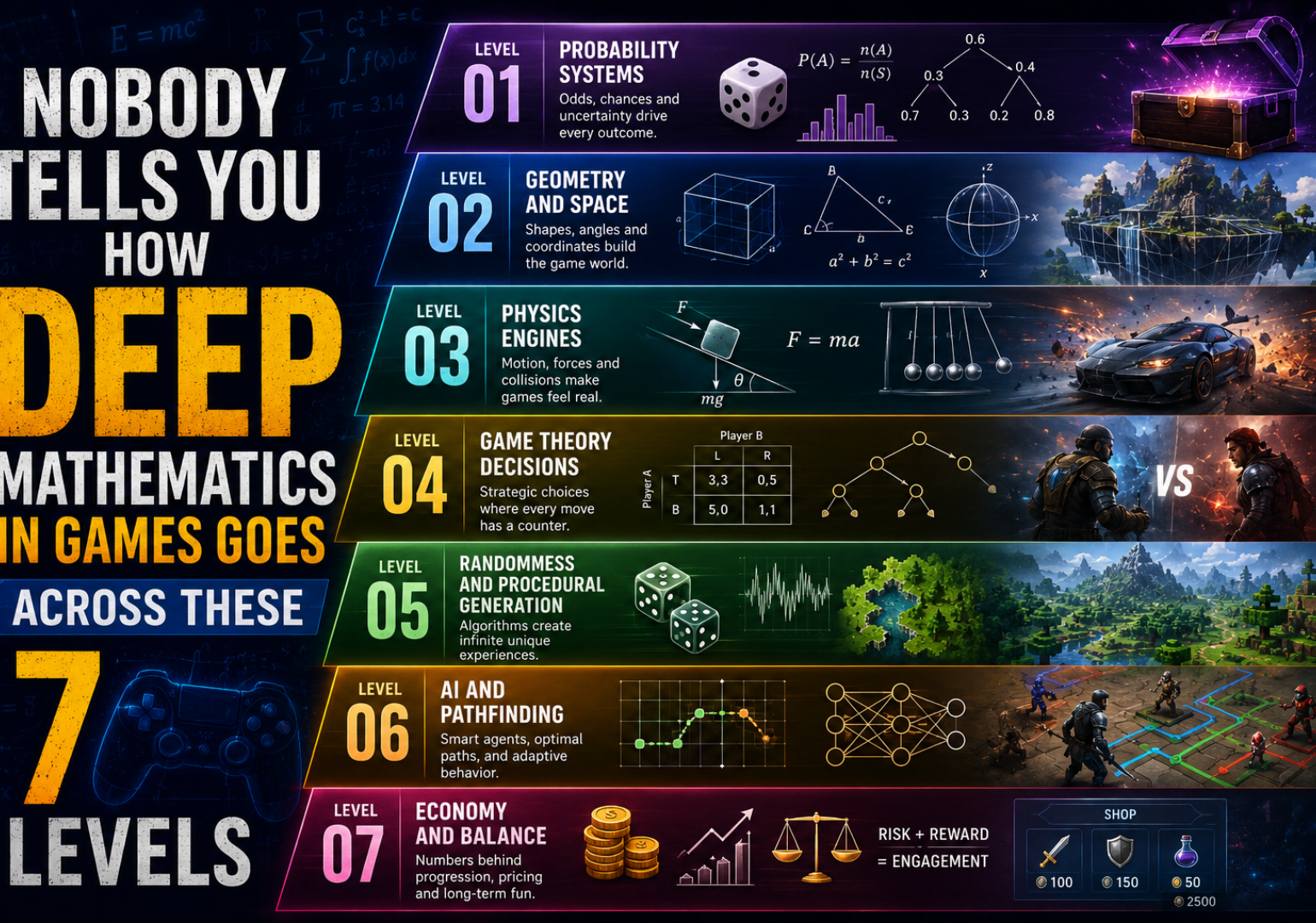
Level One Probability Systems
Probability is the first and most visible layer of mathematics in games, and it shows up in ways that range from obvious to deeply hidden. The obvious version is a dice roll in a board game — you can see the probability, count the outcomes, calculate your odds. The hidden version is inside a loot box in a video game, where the probability distribution determining what you receive is often deliberately obscured from the player.
Students who want to connect academic math to something they already care about will find innovative education approaches increasingly use games as entry points into probability concepts precisely because the engagement is already there. A student who has spent hours calculating drop rates for rare items in an RPG already understands expected value intuitively — they just haven’t connected it to the formal mathematical concept yet. Probability in games teaches players to think statistically about outcomes, weigh risk against reward, and make decisions under uncertainty. These are genuinely useful cognitive skills that transfer well beyond the game itself.
Level Two Geometry and Space
Every game that exists in a visual space — which is nearly every digital game — is built on geometry. The positions of objects, the angles of movement, the detection of collisions between entities, the calculation of what the camera can see at any given moment — all of this is geometric mathematics running in real time. In 3D games, linear algebra handles the transformation of objects in three-dimensional space, rotating and scaling and positioning everything you see on screen.
Collision detection is one of the most computationally intensive geometric problems in game development. When two objects in a game touch — a bullet hitting a wall, a player landing on a platform, a car crashing into a barrier — the engine needs to calculate whether and where those objects intersect, and it needs to do it fast enough that the player never notices the calculation happening. Modern games run these calculations thousands of times per second across dozens or hundreds of simultaneous objects. The geometry involved ranges from simple bounding box checks to complex polygon intersection algorithms, and the mathematical elegance required to do it efficiently is genuinely impressive.
Level Three Physics Engines
Physics engines are where mathematics in games gets visually spectacular. A physics engine is essentially a real-time simulation of classical mechanics — the branch of mathematics and physics that describes how objects move, fall, collide, and interact with forces like gravity and friction. When you watch a stack of boxes tumble realistically in a game, you’re watching hundreds of simultaneous differential equations being solved fast enough to display at 60 frames per second.
Rigid body dynamics, soft body simulation, fluid dynamics, cloth simulation — each of these is a distinct area of applied mathematics that game engines implement in varying degrees of complexity. Full fluid simulation, for instance, is computationally expensive enough that most games approximate it rather than solving it exactly. The art of game physics mathematics is knowing which approximations are good enough to feel real without being accurate enough to require more computing power than the hardware can provide. That tradeoff — mathematical accuracy versus computational efficiency — is one of the central engineering challenges in game development.
Level Four Game Theory Decisions
Game theory is a branch of mathematics that studies strategic decision-making — how rational agents choose actions when outcomes depend on what others do. It was developed primarily as an economic and political science tool, but its application to mathematics in games is direct and deep. Every time an AI opponent makes a decision in a strategy game, it’s applying some version of game theoretic reasoning, whether the developers named it that or not.
The minimax algorithm, used in chess engines and similar strategy games, is a direct implementation of game theory mathematics. It works by assuming both players will always make their best possible move, then calculating the optimal response to that assumption several moves into the future. At high search depths, this produces play that humans find difficult to beat. The mathematics involved is tree search combined with evaluation functions — numerical assessments of how favorable a given board position is — and the combination of these two elements is what makes chess engines so formidable.
Level Five Randomness and Procedural Generation
True randomness is actually quite difficult to generate mathematically, and mathematics in games relies heavily on pseudorandom number generators — algorithms that produce sequences of numbers that appear random but are actually deterministic. Give the same starting seed to a pseudorandom generator and you’ll get the same sequence every time. This is how games can generate the same world from the same seed number, which is why players share seeds to explore identical worlds in games like Minecraft.
Procedural generation takes pseudorandom mathematics and applies it to content creation at scale. Instead of a designer placing every tree, rock, and dungeon room by hand, procedural algorithms use mathematical rules and randomness to generate vast amounts of content automatically. The mathematics behind this ranges from Perlin noise — a gradient noise function used to generate natural-looking terrain — to grammar-based systems that generate text, dialogue, and quest structures. The visual variety and apparent spontaneity of a procedurally generated world is, underneath it all, mathematics executing rules with controlled randomness.
Level Six AI and Pathfinding
Artificial intelligence in games is one of the most mathematically rich areas of game development, and it’s also one of the most directly visible to players. When an enemy finds its way around an obstacle to reach you, when an NPC chooses to flee instead of fight, when a squad of soldiers coordinates an attack from multiple angles — all of that is mathematics in games operating through AI systems.
According to the Entertainment Software Association, over 65% of American adults play video games regularly, which means AI mathematics in games is one of the most widely experienced applications of applied mathematics in everyday life, even if players never frame it that way. Pathfinding algorithms like A-star are graph search algorithms rooted in discrete mathematics. They calculate the shortest or most efficient route through a space represented as a network of nodes and connections. The heuristic functions that make A-star efficient are themselves mathematical choices that balance accuracy against computation speed — a recurring theme across every level of mathematics in games.
Level Seven Economy and Balance
Game economy design is the highest-level application of mathematics in games, and it’s the one that most directly determines whether a game feels fair, rewarding, and worth playing over time. Every game with resources — currency, experience points, crafting materials, health, ammunition — has an underlying mathematical economy that determines how those resources flow in and out of the player’s possession.
Balancing a game economy is an applied mathematics problem involving rates, ratios, exponential growth curves, and feedback loops. If experience points required to level up scale linearly but enemy difficulty scales exponentially, players hit a wall that feels unfair — not because the game is broken, but because the mathematical curves don’t match each other in a way that feels good to play through. Designers use spreadsheets full of formulas and simulation tools to model these economies before players ever touch them, then adjust based on playtesting data. The mathematics isn’t just theoretical — it’s what separates games that feel rewarding from games that feel punishing or trivially easy.
Mathematics in Card Games
Card games are pure mathematics in games with a thin layer of theme on top. Poker is expected value calculation, probability assessment, and game theory combined into a social experience. Bridge is combinatorics and communication strategy. Even a children’s card game like Uno contains mathematical decision trees — which card to play depends on reading the state of the game, predicting opponent behavior, and calculating which moves preserve your options while limiting others.
Trading card games like Magic: The Gathering take this further, layering deck construction mathematics on top of in-game decision mathematics. Building an optimal deck is a combinatorics problem — how do you select 60 cards from thousands of options such that your probability of drawing the right combination at the right time is maximized? Players who become skilled at this are doing applied probability mathematics without necessarily calling it that. The connection between competitive card gaming and mathematical reasoning is close enough that researchers have studied card game players as a population for insights into probabilistic thinking.
Mathematics in Board Games
Modern board games, particularly the wave of complex strategy games that emerged over the past two decades, are extraordinary examples of applied mathematics in games. Games like Terraforming Mars, Wingspan, or Pandemic involve resource management, probability, network theory, and optimization problems that would be genuinely challenging as formal mathematics exercises.
The design of these games requires mathematical sophistication that most players don’t fully appreciate. A game designer creating an engine-building board game needs to ensure that multiple strategic paths through the game are mathematically viable — that no single strategy dominates all others — while also ensuring the game ends within a reasonable time and that the scoring system rewards meaningful decisions rather than arbitrary ones. This balancing work is mathematical modeling, and the best board game designers are, functionally, applied mathematicians working in an unusually enjoyable medium.
Sports and Mathematical Modeling
Sports games sit at the intersection of mathematics in games and sports analytics, and the mathematics involved is more sophisticated than most players realize. A sports simulation game that accurately reflects real player performance is built on statistical models derived from actual game data. Player ratings, performance curves, fatigue modeling, weather effects on gameplay — all of these are mathematical representations of real-world phenomena translated into game mechanics.
The explosion of sports analytics over the past fifteen years has fed directly into sports game development. As real sports teams began using advanced statistics — expected goals in soccer, player tracking data in basketball, launch angle and exit velocity in baseball — sports games incorporated these metrics into their underlying models. The result is that playing a modern sports simulation is interacting with a mathematical model of the sport that is more sophisticated than anything available to fans a generation ago.
Educational Games and Math
Educational games represent the most explicit version of mathematics in games — games designed specifically to teach mathematical concepts through play. The research on their effectiveness is genuinely positive. A 2021 meta-analysis found that students who learned mathematics through well-designed educational games showed significantly greater retention and transfer of mathematical concepts than students who learned through traditional instruction alone.
What makes educational math games work is when the mathematics is intrinsic to the gameplay rather than bolted on as a reward for completing math problems. A game where you solve equations to unlock the next level is using math as a gate. A game where the mathematical relationships are built into the mechanics — where you can’t make progress without intuitively grasping a mathematical concept — is using math as the game. The second approach produces much stronger learning outcomes because the player is applying mathematics to achieve something they actually want, not tolerating mathematics in order to get to the fun part.
Game Development Math Careers
The mathematics in games field creates genuine career pathways that many students don’t know exist. Game developers, particularly those working on physics engines, AI systems, or graphics rendering, need strong backgrounds in linear algebra, calculus, statistics, and discrete mathematics. These are not peripheral skills — they are the core technical requirements for building the systems that make games work.
Graphics programmers need deep knowledge of linear algebra and calculus to implement rendering pipelines. AI programmers need discrete mathematics, graph theory, and increasingly, machine learning mathematics. Game economists and systems designers need statistics, probability, and mathematical modeling. The game industry employs thousands of people whose primary work is applied mathematics, even if their job title says programmer or designer rather than mathematician.
Mathematics Builds Better Players
One underappreciated dimension of mathematics in games is the way games build mathematical intuition in players who never frame it as math. A player who has spent hundreds of hours in a strategy game has developed genuine facility with resource optimization, rate management, and probabilistic reasoning — even if they couldn’t write a formal proof of any of those concepts.
This intuitive mathematics is real and valuable. Research on expert gamers shows that experienced strategy game players outperform non-gamers on certain mathematical reasoning tasks, particularly those involving dynamic systems and optimization under constraints. The mathematics isn’t abstract to them — it’s been learned through thousands of decisions in contexts where the consequences were immediate and visible. That’s a powerful learning environment, and it suggests that the relationship between mathematics in games and mathematical thinking runs in both directions.
Future of Mathematics in Games
The future of mathematics in games is being shaped by machine learning and procedural generation at scales that were impossible a decade ago. Modern AI systems in games are no longer just rule-based — they’re trained on data using mathematical optimization techniques that allow them to develop strategies and behaviors that their creators didn’t explicitly program. The mathematics underlying these systems is more complex than classical game AI, drawing on calculus, linear algebra, and probability at a level that requires graduate-level mathematical training to implement.
Procedural generation is moving toward systems that can generate not just terrain and items but narrative, dialogue, and meaningful character relationships — mathematical systems complex enough to produce experiences that feel genuinely authored rather than algorithmically assembled. The gap between what mathematics in games can produce today and what it could produce in ten years is enormous, and the mathematical sophistication required to close that gap will make game development one of the most mathematically demanding fields in the technology sector.
Frequently Asked Questions about Mathematics in Games
How is mathematics in games used in everyday video games?
Mathematics in games operates across every layer of a video game simultaneously. Physics engines use calculus and differential equations to simulate realistic movement. AI systems use graph algorithms and probability to make decisions. Rendering pipelines use linear algebra to display three-dimensional environments on a flat screen. Economy systems use statistical modeling to balance resource flow. Every frame of a video game is the product of thousands of mathematical calculations running in parallel.
Do you need to be good at math to work in game development?
For certain roles — physics programmer, graphics engineer, AI developer, game economist — strong mathematical ability is genuinely required. For other roles like narrative design, level design, or art, the mathematical requirements are lower, though a basic comfort with numbers and logic helps in almost every game development position. The more technically demanding the role, the more directly mathematical the skill requirements become.
Can mathematics in games actually help students learn math better?
The research suggests yes, with an important condition. Games that embed mathematics intrinsically into their mechanics — where understanding the math is necessary to play well — produce better learning outcomes than games that use math as a gating mechanism between fun activities. When students are motivated to understand probability because it helps them win, or to understand geometry because it helps them build, the mathematical learning that results is more durable than math learned in purely abstract contexts.
What type of math is most commonly used in game design?
The most frequently applied areas are probability and statistics for game balance and randomness, linear algebra for graphics and physics, discrete mathematics for AI and pathfinding, and calculus for physics simulation. At the design level, mathematical modeling and economic thinking are the most relevant tools. Different specializations within game development draw on different mathematical foundations, but linear algebra appears across more game development disciplines than any other single branch of mathematics.
Conclusion Mathematics in Games
Mathematics in games runs deeper than most players ever realize, and that depth is part of what makes games so compelling. The probability that keeps a game uncertain, the physics that makes movement feel real, the AI that makes opponents feel alive, the economy that makes progression feel meaningful — all of it is mathematics, executed at speed, in service of an experience that feels natural precisely because the math underneath it is working correctly.
The seven levels laid out in this article — probability, geometry, physics, game theory, procedural generation, AI, and economy — are not separate systems. They interact constantly. The AI uses probability to make decisions in a space defined by geometry, moving through a world generated procedurally, in an economy balanced by mathematical modeling. Mathematics in games is not modular. It’s a continuous, interlocking system that produces the experiences players love.
For students, for players, and for anyone thinking about careers in technology, the relationship between mathematics in games and mathematical thinking is worth taking seriously. Games are not a break from mathematical thinking — for millions of people, they are the most sustained and motivated mathematical thinking in their daily lives. That’s not a small thing. Mathematics in games is, quietly, one of the largest applied mathematics environments in the world.