What Is Trig Differentiation
derivative of trig functions: Calculus clicks for some students almost immediately, and for others it feels like hitting a wall every single time. The derivative of trig functions sits right at the center of that wall. It is one of those topics that looks simple on the surface but hides a surprising number of traps that catch even careful students off guard.
Sine, cosine, tangent, cosecant, secant, cotangent — six functions, each with its own derivative rule. Get them right and a huge chunk of calculus opens up. Get them wrong and the errors follow you into integration, differential equations, and beyond. The stakes are real, and the mistakes are more common than most students realize.
Why Students Struggle Here
The derivative of trig functions is not hard because the rules are complicated. It is hard because students often rush past the foundational ideas and jump straight to memorizing formulas without truly internalizing them. That shortcut works fine until the exam, and then it falls apart.
There is also the chain rule problem. Most trig differentiation questions are not pure trig — they are trig combined with polynomials, exponentials, or other functions. Students who only practice isolated trig derivatives struggle the moment things get layered. If you have ever spent time on integral calculus topics, you already know how quickly these functions compound in complexity.
Confusing Sine and Cosine Derivatives
This is the most common mistake, and it is also the most avoidable. The derivative of sin(x) is cos(x), and the derivative of cos(x) is negative sin(x). That negative sign on cosine is where students slip up constantly, especially under exam pressure when they are moving fast.
What makes it worse is that the pattern reverses when you go back the other direction. If you keep differentiating, sine and cosine cycle through four stages, alternating between positive and negative versions. Students who do not practice this cycle enough end up guessing on higher-order derivative questions, and guessing in calculus rarely ends well.
The fix is straightforward but requires some effort. Write out the full cycle — sin, cos, negative sin, negative cos, back to sin — and drill it until it feels automatic. Do not just read it; write it, say it, use it in problems. Twenty repetitions beats one passive reading every time.
Forgetting the Chain Rule
The derivative of trig functions gets layered almost immediately in real problems. You rarely see a clean sin(x) sitting alone waiting to be differentiated. More often it looks like sin(3x²) or cos(x³ + 2x), and suddenly you need the chain rule working alongside your trig rules.
Students who forget to apply the chain rule end up with derivatives that are partially correct but missing the inner function’s derivative. On a multi-step problem, that single oversight can erase several marks at once. The answer looks plausible, which makes it even harder to catch during review.
A good habit is to always ask yourself: is there anything inside this trig function other than a plain x? If yes, chain rule applies, no exceptions. Train yourself to spot composite functions before you start writing anything down.
Mixing Up Tangent and Cotangent
The derivative of tan(x) is sec²(x). The derivative of cot(x) is negative csc²(x). These two get swapped more often than instructors would like to admit, and the reason is that students try to derive them from memory without a mental anchor to keep them straight.
Part of the confusion comes from the visual similarity between the functions themselves. Tangent and cotangent are reciprocals, and their derivatives share a structural pattern — both involve squared reciprocal trig functions — but the signs and the specific functions differ in ways that matter enormously in a calculation.
One approach that helps is deriving these formulas from first principles at least once rather than just memorizing them. When you see that tan(x) = sin(x)/cos(x) and apply the quotient rule yourself, the result sticks far better than reading it off a formula sheet. The process builds the understanding that memorization alone cannot give you.
Errors With Secant and Cosecant
Secant and cosecant are where the derivative of trig functions gets genuinely tricky for most students. The derivative of sec(x) is sec(x)tan(x), and the derivative of csc(x) is negative csc(x)cot(x). Both of these involve two trig functions multiplied together, which is already unusual compared to sine and cosine.
According to Khan Academy’s calculus resources, students who skip practicing secant and cosecant derivatives in isolation struggle significantly when these functions appear inside longer expressions. The temptation is to focus only on the four main functions and treat sec and csc as edge cases, but they show up often enough in advanced problems to deserve dedicated attention.
The key is to also apply the chain rule correctly when these functions have composite arguments. A mistake like differentiating sec(x²) as just sec(x²)tan(x²) without multiplying by the inner derivative 2x is extremely common and costs marks that are genuinely easy to keep with the right habits.
Radian Versus Degree Mode Confusion
This mistake does not get talked about enough, and it causes real damage on exams. The standard derivative rules for trig functions — the ones you memorize and use — only hold when angles are measured in radians. Use degrees and the formulas break down, introducing an unwanted constant factor that throws off every answer.
The derivative of sin(x) equals cos(x) specifically when x is in radians. In degree mode, the derivative of sin(x°) picks up a factor of π/180, which almost no student accounts for because they did not realize the mode mattered. Calculators set to degree mode during practice sessions reinforce this mistake silently.
Always check your calculator mode before starting any calculus work. More importantly, internalize why radians are the natural unit for calculus. It is not an arbitrary convention — radians make the derivative rules clean and elegant in a way that degrees simply cannot match.
Neglecting Negative Signs in Rules
Negative signs in trig derivatives are not decorations. They carry mathematical meaning and skipping them changes the answer entirely. The derivatives of cosine, cotangent, and cosecant all carry negative signs, and those signs need to appear in every step of a calculation, not just at the final answer.
A common pattern is that students write the correct formula at the top of their work and then silently drop the negative sign somewhere in the middle, especially when the expression gets long or when they are working quickly. The error is easy to miss in self-review because the structure of the answer looks right even when the sign is wrong.
Slow down on any derivative that involves cosine, cotangent, or cosecant. Double-check the sign before moving to the next step. It takes two extra seconds and it prevents a category of mistakes that are genuinely frustrating to lose marks over.
Applying Product Rule Incorrectly
When two trig functions are multiplied together, students need the product rule. The derivative of trig functions does not distribute over multiplication the way some students instinctively expect. You cannot differentiate sin(x)cos(x) by simply multiplying the individual derivatives together.
The product rule states that the derivative of f(x)g(x) equals f'(x)g(x) plus f(x)g'(x). Applied to sin(x)cos(x), you get cos(x)cos(x) plus sin(x) times negative sin(x), which simplifies to cos²(x) minus sin²(x). Students who skip the product rule and try to shortcut this end up with wrong answers and often no idea why.
This mistake reveals a broader issue: trig differentiation does not exist in isolation. It connects to the product rule, quotient rule, and chain rule constantly. Treating it as a standalone memorization task rather than part of a connected toolkit is what causes these errors to persist even after students think they have learned the material.
Skipping Function Simplification First
Before differentiating, it sometimes pays to simplify the trig expression using identities. Students who jump straight into differentiation on a messy expression often end up with three times the work and twice the chance of making an error somewhere in the process.
For example, sin²(x) + cos²(x) equals 1. If that combination appears in a problem, simplifying first turns a complicated derivative into a trivial one. Similarly, double angle identities and other standard relationships can transform an intimidating expression into something far more manageable before calculus even starts.
This is not about being clever or showing off — it is about making the problem easier and reducing opportunities for mistakes. Spend thirty seconds scanning an expression for identities before starting to differentiate. That habit alone can save significant time and confusion on longer problems.
Practicing With Wrong Problem Types
Students often practice the derivative of trig functions only in clean, isolated settings. They drill sin(x), cos(x), and tan(x) on their own and feel confident. Then an exam question buries a trig function inside a product with a polynomial and everything falls apart because the practice did not match the reality.
Real exam questions mix trig derivatives with other rules almost every time. They appear inside quotients, under radicals, combined with exponential functions, or as part of implicit differentiation problems. If your practice set does not reflect that variety, your confidence before the exam is not a reliable signal of your actual readiness.
Build practice sessions that deliberately combine rules. Take a trig function and put it inside a product. Then put that inside a composition. Then apply the chain rule twice. This kind of layered practice builds the flexible thinking that exams actually test, not just the pattern recognition that isolated drills develop.
How to Actually Get This Right
Getting the derivative of trig functions right consistently comes down to three things: understanding where each rule comes from, practicing with realistic mixed problems, and reviewing mistakes honestly instead of moving on the moment you get a wrong answer.
Most students spend too much time on new material and too little time revisiting errors. A wrong answer on a practice problem is the most valuable feedback available. It shows you exactly where your understanding breaks down, and fixing that specific gap is worth more than completing ten more similar problems correctly.
Set aside time specifically for error analysis. Look at each wrong answer, trace it back to the step where it went wrong, and identify which rule or sign you misapplied. Over time, this process eliminates the repeat mistakes that are quietly dragging down grades.
Tools and Resources That Help
Good resources matter, and the right ones can make the difference between grinding through confusion and actually building solid understanding. Worked examples with detailed step-by-step breakdowns are more useful than answer keys alone, because seeing the reasoning in each step is what builds the mental model you need.
Practice platforms that provide instant feedback help you catch errors while they are still fresh in your mind rather than a week later when context has faded. Video explanations that show the same concept from multiple angles are particularly useful for trig derivatives because the visual pattern of the derivative cycle helps cement the rules in memory.
Do not ignore your textbook’s derivation sections either. Seeing where the derivative of sin(x) comes from — through the limit definition and squeeze theorem — gives you a foundation that makes the rule feel earned rather than arbitrary. That sense of understanding makes the formula far stickier in long-term memory.
Building Long-Term Retention
Memorizing trig derivatives for an exam and actually retaining them for future courses are two very different things. Students who cram and pass often find themselves re-learning the same material in their next calculus course because the knowledge never moved into long-term memory.
Spaced repetition is the most reliable technique for long-term retention. Rather than reviewing all six trig derivatives in one long session, spread brief reviews across several days. Each time you recall a rule successfully, your brain consolidates it a little more firmly. Each time you struggle to recall it, you identify exactly where to focus next.
Mix your review with application. Do not just recite the derivative of sec(x) — use it in a problem. Active recall combined with actual problem-solving builds the kind of durable knowledge that shows up reliably on exams, on future coursework, and in any technical field where calculus matters.
Common Exam Question Patterns
Knowing the derivative of trig functions is necessary but not sufficient. Exams test specific patterns repeatedly, and recognizing those patterns is its own skill. Questions involving the chain rule with trig functions, implicit differentiation of trig equations, and related rates problems using trig functions all appear frequently on calculus exams at every level.
Higher-order derivatives are another common pattern. Finding the second or third derivative of a trig function requires applying the derivative rules multiple times and tracking signs carefully through each step. Students who understand the four-stage cycle of sine and cosine derivatives handle these questions far more confidently than those who treat each differentiation step as an isolated task.
Spend some time collecting past exam questions in these categories and working through them under timed conditions. Pattern recognition under time pressure is a skill that only develops through practice, and it is a skill that can meaningfully change your grade on a calculus exam.
Frequently Asked Questions
What is the derivative of trig functions for the six main functions?
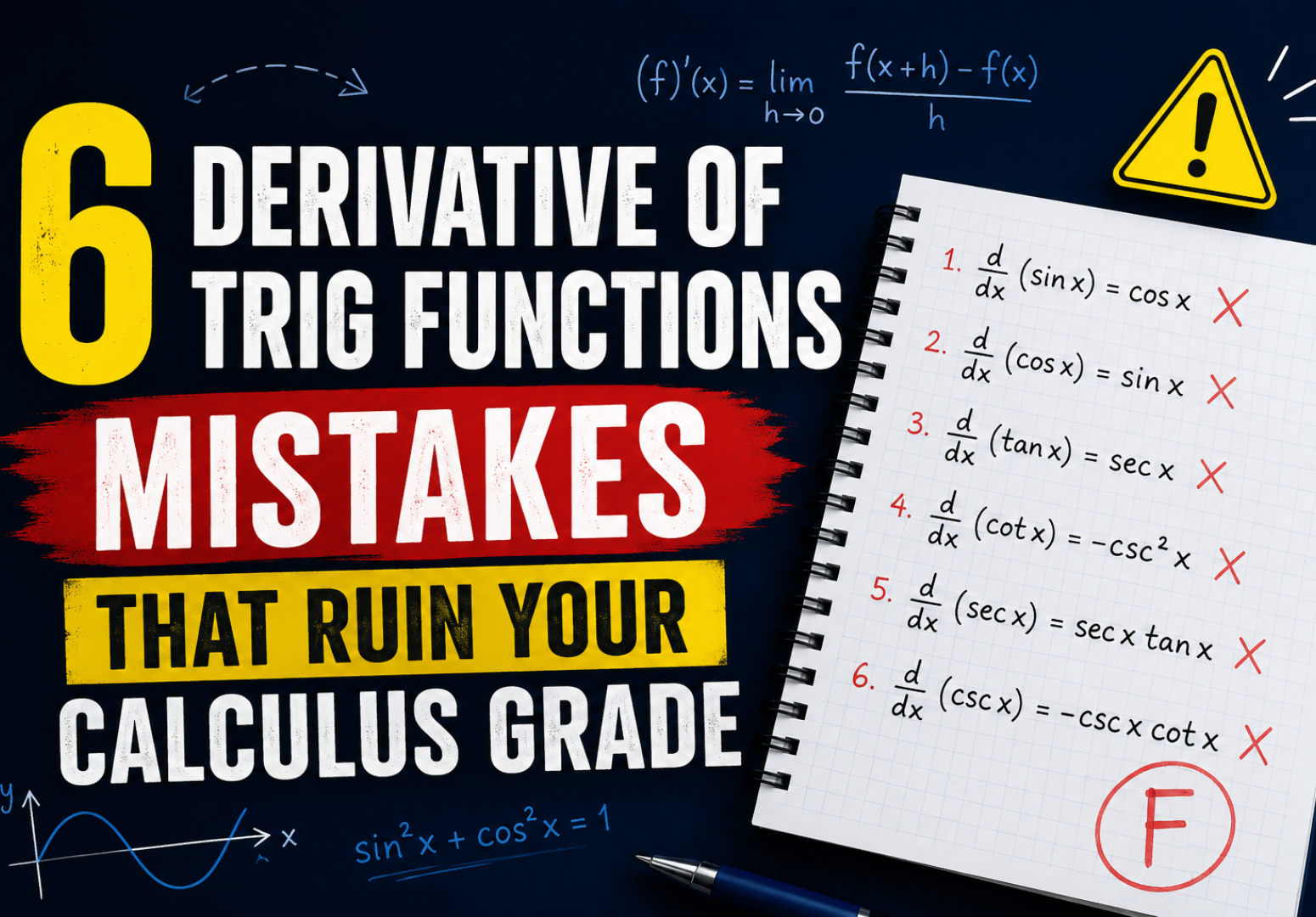
The six main trig derivatives are: sin(x) gives cos(x), cos(x) gives negative sin(x), tan(x) gives sec²(x), cot(x) gives negative csc²(x), sec(x) gives sec(x)tan(x), and csc(x) gives negative csc(x)cot(x). Memorizing these along with their signs is the starting point for all trig differentiation work.
Why does the derivative of trig functions only work in radians?
The derivative rules are derived using limits that only produce clean results when angles are expressed in radians. In degree mode, an extra conversion factor of π/180 appears, which complicates every formula. Radians are the natural unit for calculus because they make the relationship between a function and its rate of change mathematically precise and elegant.
How many times should I practice the derivative of trig functions before an exam?
There is no fixed number, but quality matters more than quantity. Practice until you can correctly differentiate all six trig functions in combination with the chain rule, product rule, and quotient rule without hesitation. If you can do that consistently across varied problem types, you are ready.
Is the derivative of trig functions used in real-world applications?
Absolutely. Trig derivatives appear in physics when analyzing wave motion and oscillations, in engineering when modeling alternating current, in signal processing, and in any field that deals with periodic phenomena. The rules you learn in calculus class are the same ones used in professional technical work every day.
Conclusion of derivative of trig functions
The derivative of trig functions is one of those calculus topics that rewards careful attention more than raw intelligence. The six derivative rules are not complicated — they are finite, learnable, and logical. The mistakes that trip students up are almost always rooted in rushed practice, incomplete understanding of supporting rules like the chain rule, or small sign errors that compound into larger problems.
Every mistake covered in this article is fixable. Confusing sine and cosine derivatives, dropping negative signs, skipping simplification, misapplying the product rule — none of these are signs of a student who cannot do calculus. They are signs of a student who needs more deliberate practice and a clearer mental framework for how the rules connect.
Start with the basics, build up to layered problems, review your errors honestly, and space your practice out over time. The derivative of trig functions will stop feeling like a source of lost marks and start feeling like one of the more satisfying parts of calculus — which, once you get there, it genuinely is. Keep at it, and the results will follow.