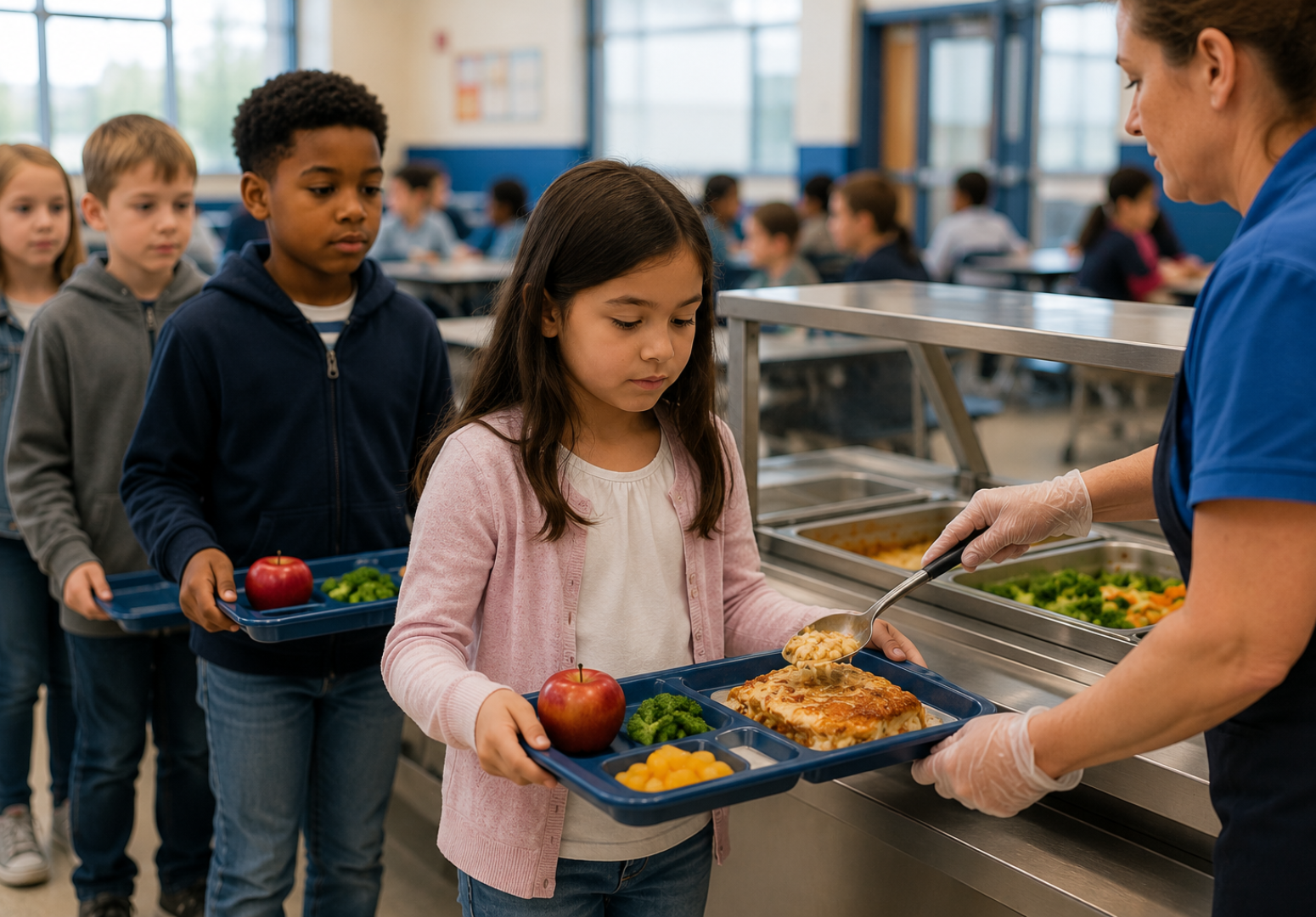
The lunch bell rings. Kids pour into the cafeteria. But for millions of students across America, what lands on their tray — or whether anything lands at all — is now in serious question. The USDA cuts school food programs funding decision has sent shockwaves through school districts from rural Mississippi to suburban Ohio. This isn’t a budget line on some federal spreadsheet. It’s a kid going home hungry. It’s a cafeteria worker unsure if she’ll have hours next month. It’s a parent who relied on free lunch to stretch a tight household budget — now scrambling.
This article breaks down what’s happening, why it matters, and what communities can actually do about it.
What the Cuts Actually Mean
When people hear “federal funding cuts,” they picture bureaucrats and conference rooms. But the USDA cuts school food programs funding translates directly into fewer meals served, reduced meal quality, and in some cases, full program closures at the school level. The National School Lunch Program alone serves roughly 30 million children every school day. That number doesn’t exist in a vacuum — it represents real children who depend on school meals as their most reliable source of nutrition.
The cuts affect multiple layers of the system. States receive less reimbursement per meal. Schools are then forced to either increase costs, reduce portions, or drop programs like after-school snacks and summer feeding initiatives entirely. The ripple effect hits hardest in low-income districts where families have the fewest backup options.
For many kids, school lunch isn’t a supplement — it’s the meal. Some students eat two out of three daily meals at school. When funding disappears, those children don’t suddenly have better options at home.
How School Lunch Programs Were Built
The National School Lunch Program was signed into law in 1946 by President Truman, partly as a national security measure. Malnourished children couldn’t serve in the military, so feeding kids was framed as patriotic duty. Since then, the program expanded dramatically — adding breakfast programs, fresh fruit and vegetable initiatives, and summer meal services. Check out how school health standards connect to these broader nutrition goals.
For decades, federal investment in school nutrition grew steadily. Eligibility criteria expanded. Reimbursement rates improved. The Healthy, Hunger-Free Kids Act of 2010 brought the most significant overhaul in decades — raising nutritional standards and extending free meals to millions more children.
The system was imperfect, but it worked. The USDA cuts school food programs funding now threatens to dismantle decades of bipartisan progress. That’s not political framing — it’s just the historical record.
Which Students Face the Biggest Risk
Not every school district feels these cuts equally. Rural schools, tribal schools, and urban districts serving high concentrations of low-income families are hit first and hardest. In many of these communities, the school cafeteria is the only consistent source of fresh food children encounter during the week.
Students who qualify for free or reduced-price meals — about 21 million children nationwide — are directly in the crosshairs. But the effects don’t stop there. When schools face funding shortfalls, they often consolidate programs. A school that loses funding for breakfast may quietly stop offering it, affecting all students regardless of income level.
Kids with dietary restrictions, food allergies, or special nutrition needs face added challenges. These programs often fund specialized menu options. When budgets shrink, those options disappear first.
The Nutritional Science Behind School Meals
There’s solid evidence that school meals improve academic performance, attendance, and long-term health outcomes. Children who eat breakfast at school show measurably better concentration and test scores compared to those who don’t. The connection between nutrition and cognitive function isn’t theoretical — it’s documented in hundreds of peer-reviewed studies.
The USDA cuts school food programs funding ignores this evidence in favor of short-term budget calculations. A child who can’t focus because they’re hungry costs the education system far more down the line — in remediation, grade repetition, and reduced graduation rates — than the cost of a nutritious school lunch.
According to research published by the USDA Economic Research Service, improvements in school meal quality have measurable effects on student health metrics, including lower rates of childhood obesity and better overall dietary intake during school hours.
States Scrambling to Fill the Gap
In the weeks since the USDA cuts school food programs funding announcement, state governments have been thrown into crisis mode. Some states have pledged to backfill lost federal dollars using state reserves. Others have convened emergency legislative sessions. A handful have already announced they simply cannot cover the shortfall.
California, New York, and Illinois — states with larger budgets and existing school nutrition infrastructure — are better positioned to absorb some of the hit. But smaller states with already-strained education budgets are facing impossible choices. Do you cut teachers or cut lunch?
The patchwork response means that a child’s access to school meals now depends heavily on their zip code. That’s not equity. That’s a system fracturing along existing fault lines.
School Districts Sound the Alarm
Superintendents across the country have been unusually vocal. Normally cautious administrators who avoid political statements have issued strong public condemnations of the USDA cuts school food programs funding. The reason is simple: they’re the ones who have to look parents in the eye.
In rural Kentucky, one district announced it would have to eliminate its breakfast program entirely. In New Mexico, a school board voted to reduce lunch portions starting next semester. These aren’t hypotheticals. These decisions are happening right now, in real school board meetings, with real consequences for real families.
Cafeteria workers, nutritionists, and food service directors are fielding questions they don’t have good answers to. The uncertainty alone has caused staffing challenges, as workers seek more stable employment.
What Parents Are Saying
The community response has been intense. Parent-teacher associations across the country have flooded congressional offices with calls and emails. Social media is full of parents sharing school meal schedules and asking how to navigate the changes. The frustration is palpable — and completely understandable.
Many parents, particularly those working multiple jobs, relied on school breakfast and lunch as a non-negotiable part of their family’s daily routine. The USDA cuts school food programs funding didn’t just change a policy — it disrupted a system families had built their schedules around.
Some parents are organizing food drives. Others are working with local restaurants and grocery stores to set up informal meal programs. The community resilience is real, but it shouldn’t be necessary. Voluntary charity was never meant to replace federal nutrition infrastructure.
The Political Fight Unfolding Now
This isn’t over. Advocacy groups, nutrition researchers, and several bipartisan coalitions in Congress are actively pushing back on the USDA cuts school food programs funding decision. Lawsuits have been filed in multiple states challenging the legality of the cuts under existing federal nutrition statutes.
The argument from critics is straightforward: Congress authorized these programs with specific funding levels. The executive branch cutting them unilaterally may exceed its authority. Courts will have to sort that out, but legal proceedings take time — and kids need to eat today.
On the other side, supporters of the cuts argue that federal spending must be reined in and that states should bear more responsibility for their own programs. The philosophical debate about federal versus state responsibility is real. But it’s being conducted while millions of children wait for their lunch tray.
Food Insecurity Numbers Don’t Lie
Food insecurity among children was already a serious problem before these cuts. Roughly 1 in 8 American children lived in food-insecure households last year. School meal programs were one of the primary structural responses to that reality. When you cut those programs, you’re not solving food insecurity — you’re making it significantly worse.
The USDA cuts school food programs funding arrives at a particularly difficult moment. Grocery prices remain elevated compared to pre-pandemic levels. Many families haven’t fully recovered financially. The safety net was already stretched thin. Now pieces of it are being cut away.
Researchers who track childhood food insecurity say we can expect measurable increases in the data following these cuts. That’s not an opinion — it’s a straightforward projection based on how these programs function and who they serve.
Summer Feeding Programs Under Threat
One of the less-discussed but critically important aspects of the USDA cuts school food programs funding involves summer meal initiatives. During the school year, kids have access to cafeteria meals. In summer, that disappears — and for low-income families, summer is often when children go hungriest.
Summer feeding programs operated through the USDA have served as a critical bridge. Community centers, libraries, parks, and churches hosted meal sites where any child could walk in and eat. These programs are now facing severe cuts or outright elimination in many states.
For a child in a low-income urban neighborhood or a rural community without reliable transportation, losing a summer meal site means losing lunch. Period. There’s no substitute waiting around the corner.
Teachers Absorbing the Burden
Here’s something that doesn’t get enough attention: when kids arrive at school hungry, teachers deal with the consequences directly. A child who hasn’t eaten breakfast cannot focus. They’re irritable, distracted, and struggling — through no fault of their own. Teachers know this. They’ve always known this.
The USDA cuts school food programs funding will put more pressure on an already-stretched teaching workforce. Many teachers already spend their own money on classroom supplies. Now some are stocking their classrooms with granola bars and crackers, trying to quietly make sure no kid is sitting through a lesson unable to think straight because their stomach is empty.
This is not a sustainable solution. It’s an individual workaround for a systemic failure. Teachers are not a backup nutrition program.
Long-Term Health Consequences
Childhood nutrition shapes long-term health in ways that compound over time. Children who experience chronic food insecurity have higher rates of developmental delays, anxiety, and chronic illnesses as adults. The USDA cuts school food programs funding aren’t just a short-term policy problem — they’re a long-term public health decision with consequences that will play out over decades.
Pediatricians and public health officials have been particularly alarmed. The American Academy of Pediatrics has issued statements warning that reduced access to school meals will lead to measurable declines in child health outcomes. These aren’t vague warnings — they’re informed projections from clinicians who see the effects of food insecurity in their practices every day.
Cutting school nutrition funding to balance a budget is a bit like skipping car maintenance to save money. You save something now, but you pay far more later — only in this case, children are paying the cost with their health.
Community Organizations Stepping Up
Nonprofits, faith communities, and local businesses are mobilizing. Food banks have seen a surge in requests for child-specific food programs. Churches that had wound down their community kitchen operations are reopening them. School PTA groups are launching fundraising campaigns specifically to cover meal costs for struggling families.
The generosity is genuinely moving. But it also highlights a fundamental problem: the informal charitable sector was never designed to replace federal nutrition infrastructure. A church food pantry can feed dozens of families. A federal school lunch program feeds tens of millions of children every single school day.
The USDA cuts school food programs funding has essentially asked voluntary community organizations to fill a gap they structurally cannot fill. The math simply doesn’t work.
What Advocates Are Demanding
The advocacy community has coalesced around several clear demands. First, an immediate reversal of the USDA cuts school food programs funding decision. Second, congressional action to protect school nutrition funding with statutory safeguards that make future cuts harder. Third, expanded universal free meal programs so that eligibility bureaucracy doesn’t become a barrier to children eating.
Organizations like the Food Research and Action Center and Share Our Strength have been particularly active, coordinating national campaigns and providing local chapters with materials to engage their congressional representatives. The effort is organized, focused, and growing.
What advocates are finding is that public opinion is strongly on their side. Across political lines, the idea of children going hungry at school polls very badly. That political reality may be the most powerful lever available.
How Funding Decisions Get Made
It’s worth pausing to explain how these funding decisions actually work, because the process matters. USDA cuts school food programs funding through a combination of regulatory changes and budget allocations. Some cuts can be made through executive action; others require congressional approval. The current situation involves a mix of both.
When the executive branch reduces reimbursement rates or tightens eligibility rules without full congressional action, it occupies a legally contested space. That’s partly why lawsuits have been filed. The courts may ultimately force a restoration of some funding, but the process takes months or years.
In the meantime, school districts are forced to plan around uncertainty. Some are cutting programs preemptively. Others are waiting to see how legal challenges play out. The uncertainty itself is damaging, because you can’t plan a cafeteria’s menu or staffing around a maybe.
What You Can Do Right Now
The situation feels overwhelming, but individual action genuinely matters here. Contacting your congressional representatives directly — by phone, not just email — remains one of the most effective forms of citizen advocacy. School nutrition funding has historically enjoyed bipartisan support, and lawmakers feel pressure when constituents call.
The USDA cuts school food programs funding affects every district in every state, which means every congressional office is hearing about this. That’s leverage. Local school board meetings are another venue where public comment can shape how districts respond and how loudly they advocate to state and federal officials.
If you’re in a position to donate, local food banks, summer meal programs, and school nutrition foundations are all accepting support. Many schools have quiet funds specifically used to cover meal debt for students — those funds need replenishment right now.
FAQ of USDA Cuts School Food Programs Funding
Does the USDA cuts school food programs funding affect all schools equally?
No. Districts serving higher percentages of low-income students feel the impact most severely, since they rely most heavily on federal reimbursements to keep meal costs manageable for families.
Can schools charge students more to cover the funding gap?
Technically yes, but this defeats the purpose for families who can’t afford increased costs. Schools in low-income areas often cannot raise prices because families will simply stop buying meals.
What programs are being cut specifically?
Cuts are affecting reimbursement rates for the National School Lunch Program, after-school meal programs, summer feeding initiatives, and in some cases, the Fresh Fruit and Vegetable Program that brought produce into classrooms.
What happens to kids who can’t pay for meals when funding runs dry?
Many schools have policies against outright denying meals, but some offer alternative “shame trays” — a single cold item like a cheese sandwich — when accounts are in debt. Advocates are fighting to eliminate these practices, but funding cuts make solutions harder to implement.
Conclusion
The USDA cuts school food programs funding isn’t an abstract policy debate. It’s happening in cafeterias right now, affecting the 30 million children who depend on school meals as a cornerstone of their daily nutrition. The evidence is clear: when kids eat, they learn better, feel better, and grow into healthier adults. Cutting the programs that make that possible is a decision with real human costs — costs that will compound for years.
States are scrambling, teachers are improvising, parents are organizing, and advocates are fighting back. The legal challenges may restore some funding. Congressional action could protect these programs long-term. Community generosity can fill some immediate gaps.
But none of that replaces a well-funded, stable, federally supported school nutrition system. The USDA cuts school food programs funding decision deserves sustained public attention, vocal community response, and direct pressure on elected officials at every level. Children can’t advocate for themselves in congressional hearings. That’s what the rest of us are for. The lunch bell is still ringing — the question is whether there’ll be something worth eating when kids get there.