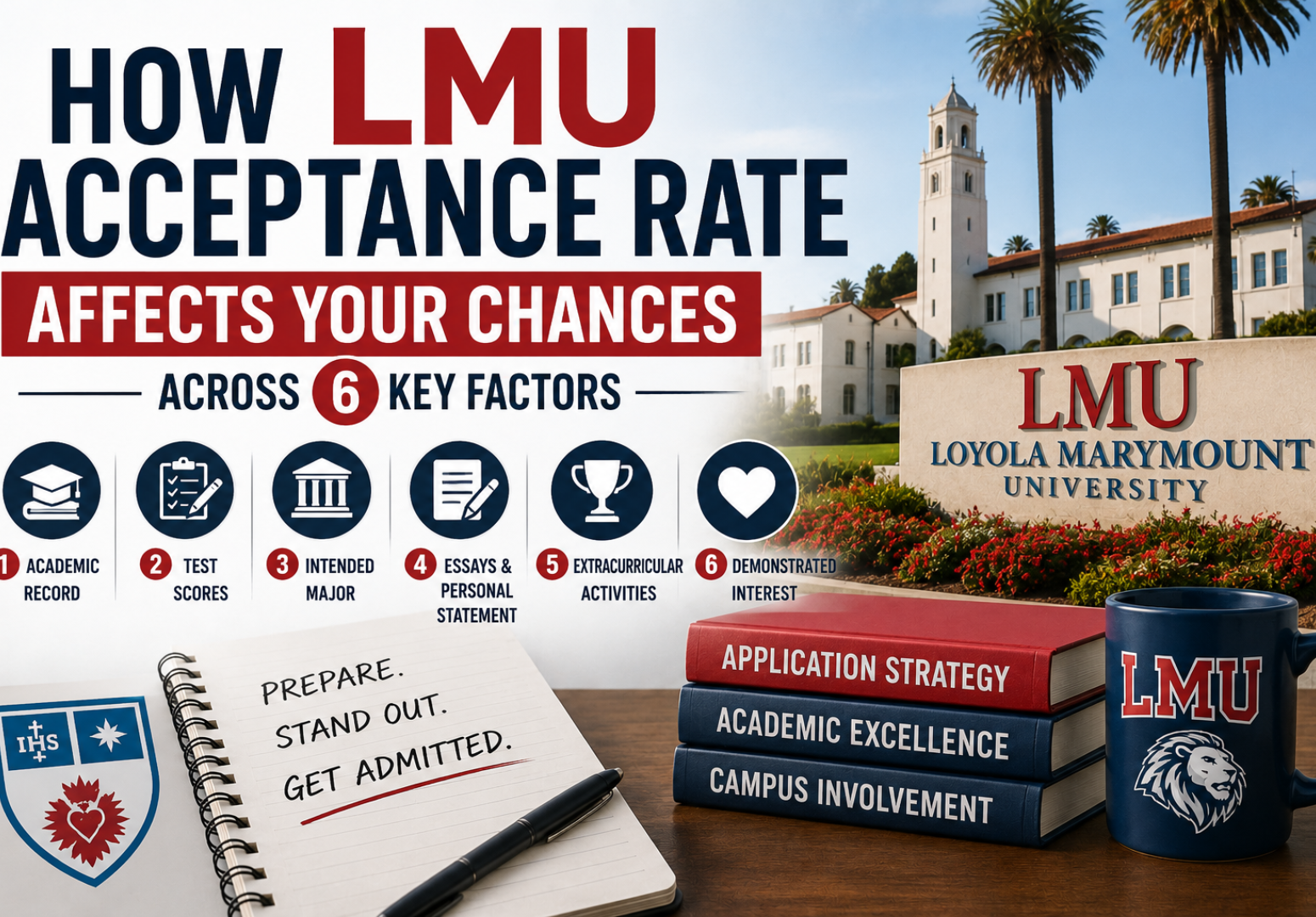
The LMU acceptance rate sits at roughly 44 to 46 percent in recent admission cycles, and at first glance that number looks pretty comfortable. Nearly half of applicants get in — that sounds reasonable. But the moment you start looking at what that percentage actually means for students with your GPA, your test scores, your intended major, and your background, the picture gets more complicated. Not scarier, necessarily. Just more nuanced.
Loyola Marymount University has seen its applicant pool grow steadily over the past several years. More students are applying, class sizes are not expanding at the same pace, and that gap is what slowly tightens the LMU acceptance rate cycle by cycle. Students who applied a decade ago would find today’s process noticeably more competitive. That does not mean getting in is out of reach — it means getting in requires a more deliberate approach than simply submitting and hoping for the best.
What LMU Actually Is
Loyola Marymount University sits in West Los Angeles with views of the Pacific Ocean and a campus that genuinely earns its reputation for beauty. It is a Jesuit Catholic university founded in 1911, and it holds onto that identity seriously — mission, service, and ethical leadership show up throughout the curriculum and campus culture in ways that feel genuine rather than decorative. Around 10,000 undergraduates attend LMU, which keeps the experience personal in a way that large public universities often cannot match.
The university offers strong programs across business, film, engineering, education, and the liberal arts. Its location in Los Angeles gives students access to entertainment industry connections, tech companies, nonprofits, and one of the most diverse urban environments in the country. That combination of Jesuit values, small-ish campus community, and LA access is exactly what drives more students to apply each year — which is exactly why the LMU acceptance rate has been trending in the direction it has.
LMU Acceptance Rate by the Numbers
The overall LMU acceptance rate for recent cycles has hovered between 44 and 46 percent, which places LMU in the moderately selective category among private universities. For context, that puts it more selective than many regional schools but less selective than the University of Southern California, which has an acceptance rate around 12 percent, or UCLA, which sits closer to 9 percent for undergraduates.
If you want to see how LMU’s numbers compare to other private university admission patterns, looking at university acceptance rate trends gives useful perspective on how private institutions across North America have been tightening their admissions over time. LMU received over 20,000 applications in a recent admissions year while admitting a class of roughly 1,800 to 2,000 students. The math on that is straightforward — a lot of qualified students do not get in, not because they aren’t capable but because the pool is strong and the seats are limited.
Factor One of LMU Acceptance Rate: Your GPA and Course Rigor
GPA is the most visible academic signal in any application, and the LMU acceptance rate data reflects that clearly. The middle 50 percent of admitted students typically show unweighted GPAs between 3.5 and 3.9. If your GPA falls below 3.5, you are not automatically out — but you are in a position where the rest of your application needs to work harder to compensate.
Course rigor matters as much as the number itself. An unweighted 3.7 earned through a schedule full of honors and AP courses reads differently than the same GPA earned through standard-level coursework. LMU’s admissions team reviews transcripts with that context in mind. If your school offers advanced courses and you took them, that signals intellectual engagement. If your school has limited options and you maxed out what was available, that context is noted too. The GPA matters, but it never exists in a vacuum.
Factor Two of LMU Acceptance Rate: Standardized Test Scores
LMU has maintained a test-optional policy in recent admissions cycles, a shift that became standard during the pandemic and has continued at many institutions. That means submitting SAT or ACT scores is not required, and students who choose not to submit scores are not penalized in the review process — at least officially. In practice, students who do submit scores and whose scores are strong give admissions officers one more piece of positive evidence to work with.
Among students who did submit scores in recent cycles, the middle 50 percent SAT range was approximately 1200 to 1380, and the ACT range was roughly 27 to 32. If your scores fall above those ranges, submitting them strengthens your file. If they fall below your GPA and your other academic indicators, leaving them off is a reasonable choice. The LMU acceptance rate does not shift dramatically based on test submission alone, but the scores you do submit need to be consistent with the rest of your profile to avoid sending mixed signals.
Factor Three of LMU Acceptance Rate : Your Intended Major
This is one factor that many applicants underestimate. The LMU acceptance rate is not uniform across all programs. Certain majors — film production, business administration, engineering, and nursing — attract significantly more applicants relative to available spots than other programs. If you are applying into one of those competitive programs, your effective acceptance rate is lower than the overall university figure suggests.
LMU’s School of Film and Television is one of the most respected programs of its kind in Los Angeles, and competition for spots there is intense. The Frank R. Seaver College of Science and Engineering draws strong applicants from across the country. If your intended major falls into one of these high-demand areas, you need to treat your application with the same seriousness you would give to a school with a much lower overall LMU acceptance rate. Choosing a less competitive major and planning to switch later is a strategy some students use, though LMU’s internal transfer process between schools has its own requirements and is not guaranteed.
Factor Four of LMU Acceptance Rate: Essays and Personal Statement
LMU uses the Common Application, which means your personal essay is the same one you submit to other schools. But LMU also includes supplemental essay prompts that ask students to engage specifically with the university’s Jesuit mission and values. These prompts are not busywork. They are one of the clearest ways the admissions team gets a sense of whether a student actually fits the community LMU is trying to build.
According to the Common App research data, students who engage thoughtfully with institution-specific essay prompts show meaningfully higher admit rates than those who submit generic responses. A student who can articulate why LMU’s commitment to service and ethical leadership connects to their own goals writes a different kind of essay than one who simply expresses enthusiasm for living in Los Angeles. The LMU acceptance rate reflects an admissions process that genuinely reads these essays — taking them seriously in your application preparation is not optional if you want a real shot.
Factor Five of LMU Acceptance Rate: Extracurricular Activities
LMU is looking for students who do things outside the classroom, and not just students who have padded their activity lists with clubs they attended twice. The admissions team is looking for depth over breadth — a student who has spent three years seriously committed to one or two activities, developed real skills, and taken on meaningful responsibility within those spaces reads more convincingly than a student who lists fifteen shallow involvements.
Service activities carry particular weight at LMU given the Jesuit tradition of cura personalis — care for the whole person — and its emphasis on service to others. A student who has volunteered consistently with a community organization, taken a leadership role, and can speak to what that experience taught them about themselves and their relationship to their community is speaking directly to what LMU values. That doesn’t mean only service-oriented students get in. Athletes, artists, researchers, and entrepreneurs all find a home at LMU. But whatever you do, showing that you did it with genuine investment makes a real difference in a process as competitive as the current LMU acceptance rate makes things.
Factor Six of LMU Acceptance Rate: Demonstrated Interest
Demonstrated interest is a factor that some universities weight heavily and others ignore entirely. LMU falls into the category of schools that do pay attention to it, which means the steps you take to show genuine engagement with the university can influence your application outcome. Campus visits, virtual information sessions, conversations with admissions representatives at college fairs, and thoughtful supplemental essays all signal that LMU is a real first choice rather than a safety school you barely thought about.
This matters more than it might seem. Admissions offices track yield rate — the percentage of admitted students who actually enroll — very carefully because it affects their planning and their rankings. A student who has demonstrated consistent interest in LMU is a lower yield risk than one who applied without any prior engagement. In a pool where many applicants are academically qualified, demonstrated interest can be what tips the decision for borderline files. It costs you nothing to attend a virtual session or reach out to an admissions counselor with a thoughtful question — and it might actually matter.
How Transfer Applicants Are Affected
Transfer students experience the LMU acceptance rate differently than first-year applicants. LMU accepts transfer students each year, primarily for the fall semester, and the process places more emphasis on college-level academic performance than on high school records. If your high school application did not go the way you hoped, community college followed by a strong transfer application to LMU is a legitimate and well-traveled path.
Transfer applicants typically need a minimum 2.8 GPA in college coursework to be considered, though competitive transfer admits usually show GPAs above 3.3. The major you are transferring into matters here as well — the same dynamics that affect first-year admissions by program apply to transfer students. Film, business, and engineering transfers face tighter competition than transfers into less oversubscribed programs. The transfer LMU acceptance rate is generally more favorable than the first-year rate for students who have built a strong college record, which makes it a worthwhile option for students who want a second shot at the school.
Financial Aid and Its Role in Decisions
LMU is a private university with a sticker price that can feel alarming at first glance — total cost of attendance runs close to $75,000 per year when you factor in tuition, housing, meals, and fees. That number stops a lot of families before they even finish reading the application requirements. But the sticker price is not what most students pay, and understanding that distinction matters a great deal.
LMU meets a significant portion of demonstrated financial need through a combination of grants, scholarships, and work-study packages. Merit scholarships are also available for students who meet academic thresholds, and these do not require separate applications in most cases. The net price for families with household incomes below $75,000 is substantially lower than the published cost. If cost is a genuine concern — and for most families it is — submitting the FAFSA and CSS Profile on time and accurately is as important as any other part of the application. The LMU acceptance rate means little if the financial package does not make attendance possible.
Early Action vs Regular Decision
LMU offers an Early Action option with a November deadline, and students who apply Early Action typically see slightly more favorable outcomes than those who apply Regular Decision. This is a common pattern across many selective universities and it is worth taking seriously. Early Action at LMU is non-binding, which means you can apply to other schools simultaneously and compare offers before committing.
Applying Early Action signals demonstrated interest and gives admissions officers the chance to review your file when the pool is smaller and decisions are less constrained by space. It also gets your financial aid package out earlier, which gives your family more time to compare offers. If LMU is genuinely a priority school for you, there is no good reason to wait for Regular Decision. The LMU acceptance rate advantage for Early Action applicants is not enormous, but in a competitive pool, every edge counts.
What Makes a Competitive LMU Applicant
Putting all six factors together, a competitive LMU applicant looks something like this: a student with a 3.6 or higher unweighted GPA, a challenging course load relative to what their school offers, essays that engage specifically and thoughtfully with LMU’s mission, two or three extracurricular commitments that show real depth, documented service or community engagement, and some form of demonstrated interest in the university. Test scores, if submitted, fall within or above the middle 50 percent range.
No single element of that profile is individually disqualifying or individually sufficient. Admissions decisions at LMU, like at most holistic review institutions, come from the full picture. A student with a 3.4 GPA and an extraordinary personal story, strong essays, and a compelling demonstrated fit with the university’s values can and does get admitted. A student with a 3.9 GPA and essays that feel generic and disconnected from LMU specifically can and does get waitlisted or denied. The LMU acceptance rate reflects a process that actually reads files rather than sorting them purely by numbers.
Common Application Mistakes to Avoid
Certain application mistakes show up repeatedly among students who do not get the outcome they hoped for at LMU. Writing generic supplemental essays is the most common. Submitting activity lists without context or without showing progression and impact is another. Applying without any prior engagement with the university when demonstrated interest is tracked is a missed opportunity. Missing the Early Action deadline when you had no good reason to is one more.
Beyond the content issues, practical mistakes matter too. Incomplete applications, missing recommendation letters, FAFSA submission delays, and transcript errors can all create problems that have nothing to do with your actual qualifications. The LMU acceptance rate applies to complete, on-time, well-executed applications. A strong applicant who submits sloppily is at a disadvantage compared to a slightly weaker applicant who submits carefully. Give your application the time and attention it deserves before you hit submit.
How LMU Compares to Similar Schools
Students applying to LMU are often also applying to schools like University of San Diego, Santa Clara University, Fordham, Gonzaga, and Chapman. These schools occupy a similar tier in terms of selectivity and campus culture, and comparing LMU’s profile against them helps calibrate where your application is most likely to succeed. LMU’s Los Angeles location is a genuine differentiator — no comparable Jesuit institution sits in a city with the same industry access and cultural diversity.
The LMU acceptance rate sits in the middle of this peer group. University of San Diego and Santa Clara are somewhat more selective. Chapman and Gonzaga are somewhat less so. If you are building a balanced college list, LMU probably belongs in your target or reach category depending on your specific profile, with one or two schools from this peer group serving as matches and one or two as safeties. A well-built list gives you options and reduces the pressure on any single decision.
LMU Acceptance Rate Future Trends
The LMU acceptance rate has been trending downward over time, slowly but consistently. As LMU’s national profile has grown — driven by its location, its programs, and its rankings performance — more students from outside California have added it to their lists. That broader geographic reach means more applications, and more applications with the same class size means a tighter rate year by year.
There is no reason to expect that trend to reverse dramatically. LMU is not about to become as selective as USC or the Ivies, but the difference between a 46 percent acceptance rate and a 38 percent acceptance rate over the next five years is meaningful for applicants. Students who apply in the next one to three years should treat LMU as meaningfully selective, not as a comfortable fallback. The students who will get in are the ones who approach the application with the same seriousness they bring to their most ambitious choices.
FAQ about LMU Acceptance Rate
What is the current LMU acceptance rate for first-year applicants?
The LMU acceptance rate for first-year applicants in recent cycles has been approximately 44 to 46 percent. That figure can shift slightly year to year based on application volume and class size targets. While it places LMU in the moderately selective category, the rate varies by program — competitive majors like film production and business administration see lower effective acceptance rates than the overall university figure suggests.
Does applying Early Action improve my chances at LMU?
Yes, applying Early Action generally produces slightly more favorable outcomes than Regular Decision at LMU. The pool is smaller when Early Action files are reviewed, and applying early signals genuine interest in the university. LMU’s Early Action is non-binding, so you can still compare offers from other schools before making a final decision. If LMU is a genuine priority, applying by the November Early Action deadline is a smart move.
How does the LMU acceptance rate compare to other California private universities?
LMU is considerably more accessible than USC, which admits around 12 percent of applicants, or Caltech and Claremont McKenna, which are far more selective. Among Jesuit and Catholic universities in the region, LMU sits in a competitive but not extreme range. Its peer group includes schools like University of San Diego and Santa Clara University, which have similar or slightly lower acceptance rates.
What GPA do I need to have a strong chance at LMU?
The middle 50 percent of admitted LMU students typically show unweighted GPAs between 3.5 and 3.9. A GPA of 3.5 or above with a rigorous course load puts you in a competitive range. Students below 3.5 are not automatically disqualified, but they need other elements of their application — essays, activities, recommendations — to be especially strong. Course rigor matters as much as the number itself.
Conclusion of LMU Acceptance Rate
The LMU acceptance rate of roughly 44 to 46 percent is a starting point for your research, not a final verdict on your chances. What actually determines whether you get in is how your specific profile lines up with the six factors this article has walked through — your GPA and course rigor, your test scores if you submit them, your intended major, the quality of your essays, the depth of your extracurricular involvement, and the degree to which you have shown genuine interest in LMU as a community.
None of those factors operate independently. Admissions at LMU is holistic, which means the full picture of who you are and what you bring matters more than any single data point. A student who understands that and builds their application accordingly — thoughtfully, specifically, and with real engagement with what LMU values — is in a much stronger position than one who treats the process as a numbers game.
The LMU acceptance rate will likely continue tightening in coming years as the university’s profile grows. Students applying now are doing so at a moment when the process is competitive but not extreme. That window is worth using well. Start your essays early, visit or engage virtually if you can, align your application with LMU’s Jesuit mission in a way that feels genuine, and submit on time. The students who get in are almost always the ones who gave it a real effort — and that is entirely within your control.