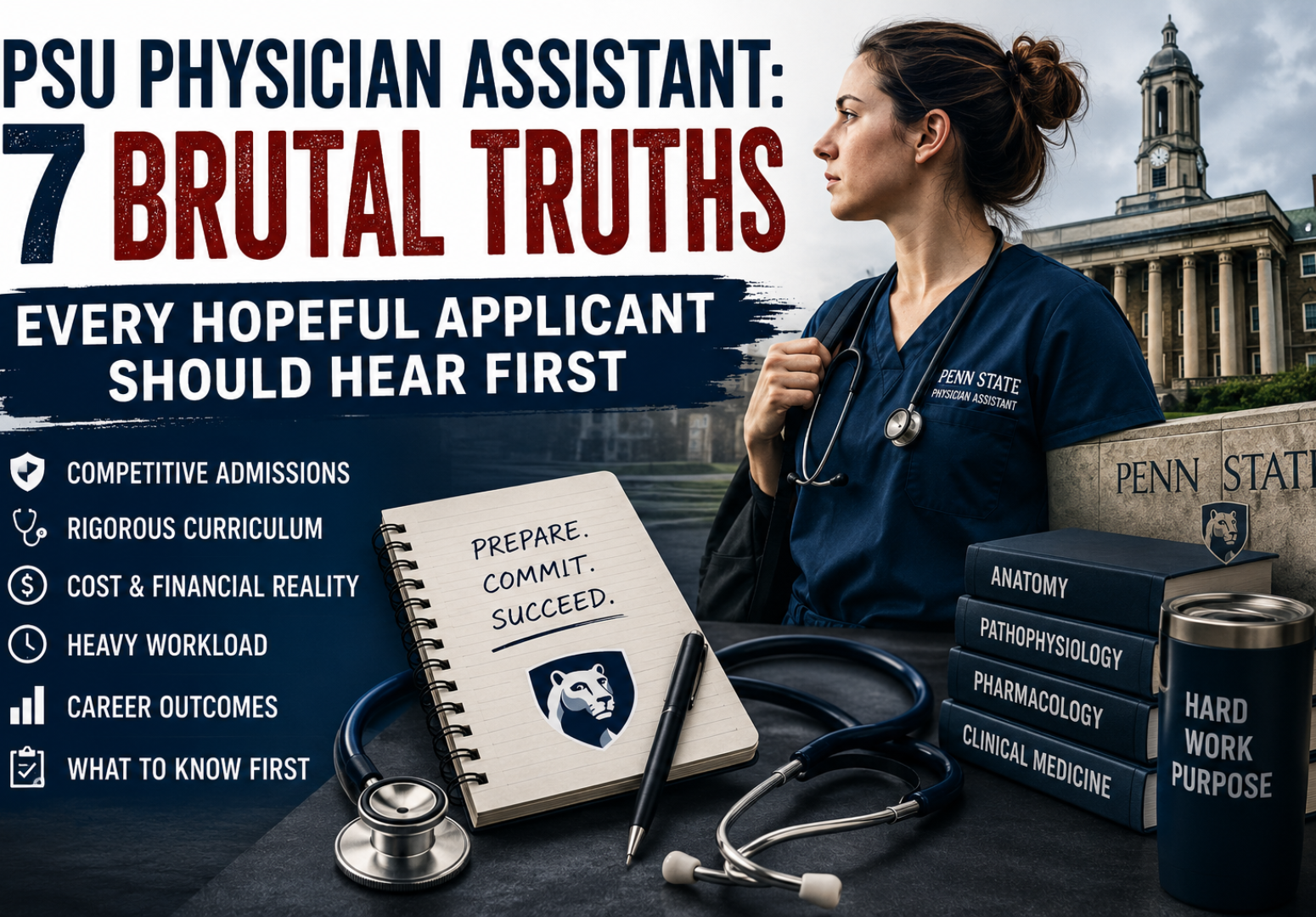
What Is PSU Physician Assistant
The PSU physician assistant program, offered through Penn State College of Medicine in Hershey, Pennsylvania, is one of the most recognized PA training programs in the northeastern United States. It trains students to become licensed medical providers capable of diagnosing illness, prescribing treatment, and working directly with patients across a wide range of clinical settings. The program is intensive by design — and that is exactly the point.
PA programs in general are not easy to get into, and Penn State’s is no exception. The PSU physician assistant track attracts hundreds of applicants every cycle competing for a limited number of seats. If you are serious about this path, you need to walk in with both eyes open. Knowing what you are signing up for before you apply is not pessimism — it is smart preparation.
Program History and Background
Penn State has a long history of producing healthcare professionals who go on to serve in hospitals, clinics, and underserved communities across the country. The physician assistant program fits naturally into that tradition. It sits within the College of Medicine, which means students benefit from access to Penn State Health facilities, a major academic medical center that handles complex and diverse patient cases.
If you want to understand how Penn State’s medical training compares to other institutions, a look at top medical schools in the US gives useful context about what competitive medical education actually looks like at the national level. Penn State consistently ranks among institutions known for clinical training quality, research infrastructure, and graduate outcomes in healthcare.
Brutal Truth About Acceptance Rates
Here is the first brutal truth about the PSU physician assistant program: getting in is genuinely hard. Penn State’s PA program receives thousands of applications annually for a class that typically accepts around 40 students. That means your odds, even with a strong application, are slim. Nationwide, PA program acceptance rates average between 15% and 20%, and competitive programs like PSU often sit well below that average.
Your GPA matters enormously. Most successful applicants to the PSU physician assistant program report undergraduate science GPAs above 3.4, with many admitted students holding overall GPAs closer to 3.6 or higher. But GPA alone does not get you in. Admissions committees look at the full picture — your healthcare experience hours, letters of recommendation, personal statement, and how clearly you understand what a PA actually does day to day.
Required Healthcare Experience Hours
The second brutal truth is about hours — specifically, the direct patient care hours you need before applying. Penn State’s PA program expects applicants to have meaningful hands-on clinical experience, not just shadowing from a distance. We are talking about roles where you are actively involved in patient care: EMT, medical assistant, phlebotomist, CNA, scribe with hands-on exposure, or similar positions.
Most competitive applicants to the PSU physician assistant program log anywhere from 1,000 to 3,000 or more direct patient care hours before they even submit an application. That is not a typo. One thousand hours is roughly six months of full-time clinical work. Many applicants spend a year or two after graduation building those hours before they feel genuinely competitive. If you are a sophomore thinking you will apply straight out of undergrad without clinical work, that plan needs revision.
GRE and Academic Requirements
Penn State’s PA program has specific academic prerequisites that applicants must complete before matriculation. These typically include courses in biology, chemistry, organic chemistry, biochemistry, microbiology, anatomy, physiology, statistics, and psychology. Each course needs to be completed with a competitive grade — a C in organic chemistry is not going to inspire confidence in an admissions committee reviewing your file.
The program has historically required or recommended the GRE, though requirements can shift from cycle to cycle. According to the Bureau of Labor Statistics, physician assistants are among the fastest-growing healthcare occupations in the country, with employment projected to grow 28% over the next decade. That demand makes PA programs more competitive than ever, which means your academic record needs to be as clean and consistent as possible from your very first semester of college.
PSU Physician Assistant Curriculum Overview
Once you actually get in — and that is a meaningful if — the PSU physician assistant curriculum is divided into two major phases. The first is the didactic phase, which runs roughly 12 to 15 months and covers everything from anatomy and pharmacology to clinical medicine and medical ethics. You will be in class, labs, and simulation centers for long hours every week. This is not a program where you coast through lectures and cram before exams.
The second phase is clinical rotations, where PSU physician assistant students rotate through different medical specialties: internal medicine, surgery, emergency medicine, pediatrics, obstetrics and gynecology, psychiatry, and primary care. These rotations place you in real clinical environments with real patients under physician and PA supervision. By the time you finish, you will have been exposed to a genuinely broad range of medical situations that few other educational experiences can replicate.
Cost and Financial Reality
Here is a brutal truth that does not get discussed enough: PA school is expensive. The PSU physician assistant program, like most graduate medical programs, carries a significant tuition price tag. Total program costs including tuition, fees, housing, and living expenses can easily exceed $100,000 for the full program duration. For students who are not Pennsylvania residents, tuition rates are typically higher.
Most PA students fund their education through a combination of federal student loans, scholarships, and in some cases employer tuition assistance if they worked in healthcare before enrolling. Loan repayment after graduation is manageable given PA salaries — the median annual salary for physician assistants in the US sits around $126,000 according to recent data — but you should go in with a clear financial plan rather than assuming it will all work out. Debt that feels abstract during school becomes very concrete when your first loan bill arrives six months after graduation.
PSU Physician Assistant Career Outcomes
Graduates of the PSU physician assistant program go on to work in a wide variety of clinical settings. Some enter hospital medicine, working in inpatient units alongside attending physicians managing complex cases. Others choose surgical specialties, assisting in the operating room and managing pre- and post-operative patient care. Primary care, urgent care, dermatology, orthopedics, and emergency medicine are all common landing spots for new PA graduates.
Penn State’s program benefits from strong clinical affiliate networks across Pennsylvania and the surrounding region, which means students build professional connections during rotations that sometimes lead directly to job offers. The PSU physician assistant credential carries real weight with healthcare employers who recognize Penn State’s reputation for producing clinically prepared graduates. Starting salaries for new PA graduates in the northeastern United States typically range from $95,000 to $115,000 depending on specialty and location.
PANCE Pass Rates Matter
One metric that every prospective PA student should research carefully is the PANCE pass rate — that is the Physician Assistant National Certifying Exam that every PA graduate must pass to practice. First-time PANCE pass rates vary meaningfully between programs, and a program’s pass rate tells you something real about how well it prepares students for the demands of actual clinical practice.
The PSU physician assistant program has maintained strong PANCE pass rates that consistently meet or exceed national averages. The national first-time PANCE pass rate typically hovers around 93% to 95%, and programs like Penn State that invest heavily in board preparation tend to perform at or above that benchmark. When you are evaluating any PA program, do not just look at rankings or reputation — look at the actual pass rate data, which is publicly reported and tells you whether graduates are walking out prepared or underprepared.
Brutal Truth About Workload
Nobody warns applicants enough about how demanding PA school actually is. The PSU physician assistant program compresses an enormous amount of medical knowledge into roughly 24 to 27 months. You are not easing into medicine — you are being dropped into the deep end of pharmacology, pathophysiology, clinical reasoning, and procedural skills all at once. Students who struggle are usually not struggling because they lack intelligence. They struggle because they underestimated the sheer volume of material and the pace at which it comes at you.
Sleep deprivation, high stress, and social sacrifices are part of the experience for most PA students. Relationships, hobbies, and side projects tend to go on pause during the program. That is a real cost worth acknowledging before you commit. The students who handle it best are usually those who built strong study habits during undergrad, have realistic expectations going in, and have a solid support system at home that understands what the next two years are going to look like.
How to Strengthen Your Application
If the PSU physician assistant program is your goal, start working backward from the admission requirements right now — even if you are still in undergrad. Build your clinical hours consistently, not in a frantic burst the semester before you apply. Seek out PA shadowing specifically, not just physician shadowing, so you can speak intelligently in your personal statement about what PAs actually do and why you want that specific role.
Your personal statement is more important than most applicants realize. Admissions committees read thousands of statements that say the same vague things about wanting to help people. The ones that stand out tell a specific story — a patient interaction that shifted your thinking, a clinical moment that confirmed your choice, a challenge that revealed something about how you handle pressure. Generic statements get generic results. Write something that only you could have written.
Alternatives If PSU Does Not Work Out
Getting rejected from the PSU physician assistant program does not mean your PA career is over. It might just mean your application needs another year of work. Many successful PA students apply two or even three cycles before they get in somewhere. Use the time productively — add more clinical hours, retake prerequisite courses where your grade was weak, get stronger letters of recommendation, and rewrite your personal statement from scratch.
There are also strong PA programs at other Pennsylvania institutions and throughout the country. Drexel, Jefferson, Arcadia, and Duquesne all have respected PA programs in the Philadelphia and Pittsburgh areas. Widening your geographic search significantly increases your chances of acceptance. Some applicants get into programs in other states, complete their training, and then return to Pennsylvania to practice. The goal is becoming a licensed PA, and there are multiple paths to that outcome.
Life After PSU Physician Assistant Training
Life as a practicing PA is genuinely good. The work is meaningful, the pay is competitive, the job security is strong, and the career offers a level of flexibility that few other healthcare roles can match. PAs can switch specialties without going back to school — something physicians cannot easily do. A PA who starts in emergency medicine can transition to dermatology, orthopedics, or urgent care with additional training and experience.
The PSU physician assistant degree opens doors across the full spectrum of American healthcare. Penn State graduates practice in academic medical centers, community hospitals, rural clinics, veterans’ facilities, and private practices. The credential is nationally recognized and reciprocally licensed across states, which means your career is not locked to Pennsylvania after graduation. That kind of portability matters in a healthcare job market that continues to evolve rapidly.
Frequently Asked Questions
What GPA do I need for the PSU physician assistant program?
Most admitted students have an overall GPA of 3.5 or higher, with science GPAs typically above 3.4. That said, GPA is one factor among many. Strong clinical hours, a compelling personal statement, and solid letters of recommendation can help an application with a slightly lower GPA stand out.
How many clinical hours are required for the PSU physician assistant application?
Penn State does not publish a hard minimum, but competitive applicants typically present 1,000 to 3,000 or more direct patient care hours. The quality and variety of your experience matters as much as the raw number.
Is the PSU physician assistant program worth the cost?
For most graduates, yes. With median PA salaries above $126,000 nationally and strong job security in a growing field, the return on investment is generally solid. The key is entering with a clear financial plan and realistic expectations about loan repayment timelines.
What makes PSU physician assistant graduates competitive in the job market?
Penn State’s clinical affiliate network, strong PANCE pass rates, and the reputation of Penn State College of Medicine all contribute to graduate competitiveness. Employers in the northeastern United States tend to recognize the program’s rigor and the preparation level of its graduates.
Conclusion
The PSU physician assistant program is not for everyone, and that is not an insult — it is a fact. It demands academic excellence, meaningful clinical experience, financial commitment, and the personal resilience to get through two of the most intellectually intense years of your life. The brutal truths in this guide are not meant to discourage you. They are meant to make sure that if you pursue this path, you do it with clear eyes and a real plan.
The PSU physician assistant credential is worth working toward. Graduates enter a profession that is growing fast, pays well, and offers the kind of daily work that genuinely matters — helping patients, solving clinical problems, and making a difference in people’s health outcomes. If you are willing to put in the preparation, build your application carefully, and approach the program with the seriousness it deserves, this could be exactly the right path for you. Start now, be honest about where your application stands, and keep improving until you get in.