If you’ve ever stopped to look at a rose, a mango tree, or even a patch of grass, you’ve already met a flowering plant angiosperm. This group of plants is the most dominant and diverse on Earth, accounting for around 90% of all plant species — roughly 300,000 known varieties and counting. They grow in deserts, rainforests, arctic tundra, and your kitchen windowsill. Yet most people know almost nothing about what makes them so extraordinary as a group.
The flowering plant angiosperm isn’t just pretty to look at. It’s the foundation of most terrestrial food webs, the source of the majority of human food crops, and one of evolution’s greatest success stories. This article gets into the real substance — what angiosperms are, how they work, why they evolved the way they did, and what makes them so remarkably dominant compared to every other plant group on the planet.
What Is Flowering Plant Angiosperm
The term angiosperm comes from two Greek words: angeion, meaning vessel or container, and sperma, meaning seed. A flowering plant angiosperm is, literally, a plant with enclosed seeds. That enclosure — the fruit — is what separates angiosperms from gymnosperms like pines and firs, whose seeds sit exposed on cone scales with no protective covering around them.
Angiosperms reproduce through flowers, produce seeds enclosed within fruits, and use a process called double fertilization that no other plant group on Earth uses. That last point is more important than it sounds. Double fertilization produces not just an embryo but also a nutrient-rich endosperm that feeds the developing seed. This extra nutritional investment gives angiosperm seeds a survival edge from the moment they form. You might find this kind of biological detail comes up naturally in science education discussions where teachers use real-world examples to spark curiosity in students.
Ancient Origins of Angiosperms
Angiosperms first appeared in the fossil record during the Early Cretaceous period, roughly 130 to 140 million years ago. That’s relatively recent in geological terms — conifers and ferns had been around for hundreds of millions of years before the first flowering plant angiosperm showed up. Charles Darwin famously called their rapid rise an “abominable mystery” because they spread so fast and diversified so explosively without an obvious explanation.
Modern research has offered some answers. Genetic studies suggest angiosperms may have originated even earlier than the fossil record shows, perhaps 200 million years ago during the Triassic. The explosion in diversity during the Cretaceous coincided with the rise of insect pollinators, particularly bees, which formed an evolutionary partnership with flowering plants that accelerated diversification on both sides. This co-evolutionary relationship between flowers and pollinators is one of the most documented examples of mutual adaptation in all of biology.
Monocots Versus Dicots Classification
Within the flowering plant angiosperm world, the two biggest divisions are monocots and dicots — though modern classification has shifted the term dicots to “eudicots” for precision. The distinction matters because these two groups differ in some fundamental ways that show up in plant structure, leaf venation, root systems, and flower petal counts.
Monocots have one seed leaf (cotyledon), parallel leaf veins, and flower parts typically in multiples of three. Grasses, lilies, palms, and orchids are all monocots. Eudicots have two cotyledons, branching leaf veins, and flower parts usually in multiples of four or five. Think roses, oaks, sunflowers, and beans. About 75% of all flowering plant angiosperm species are eudicots, making them the larger of the two groups. The classification isn’t just academic — it shapes how botanists study plant evolution and how agronomists approach crop breeding.
The Structure of Flowers
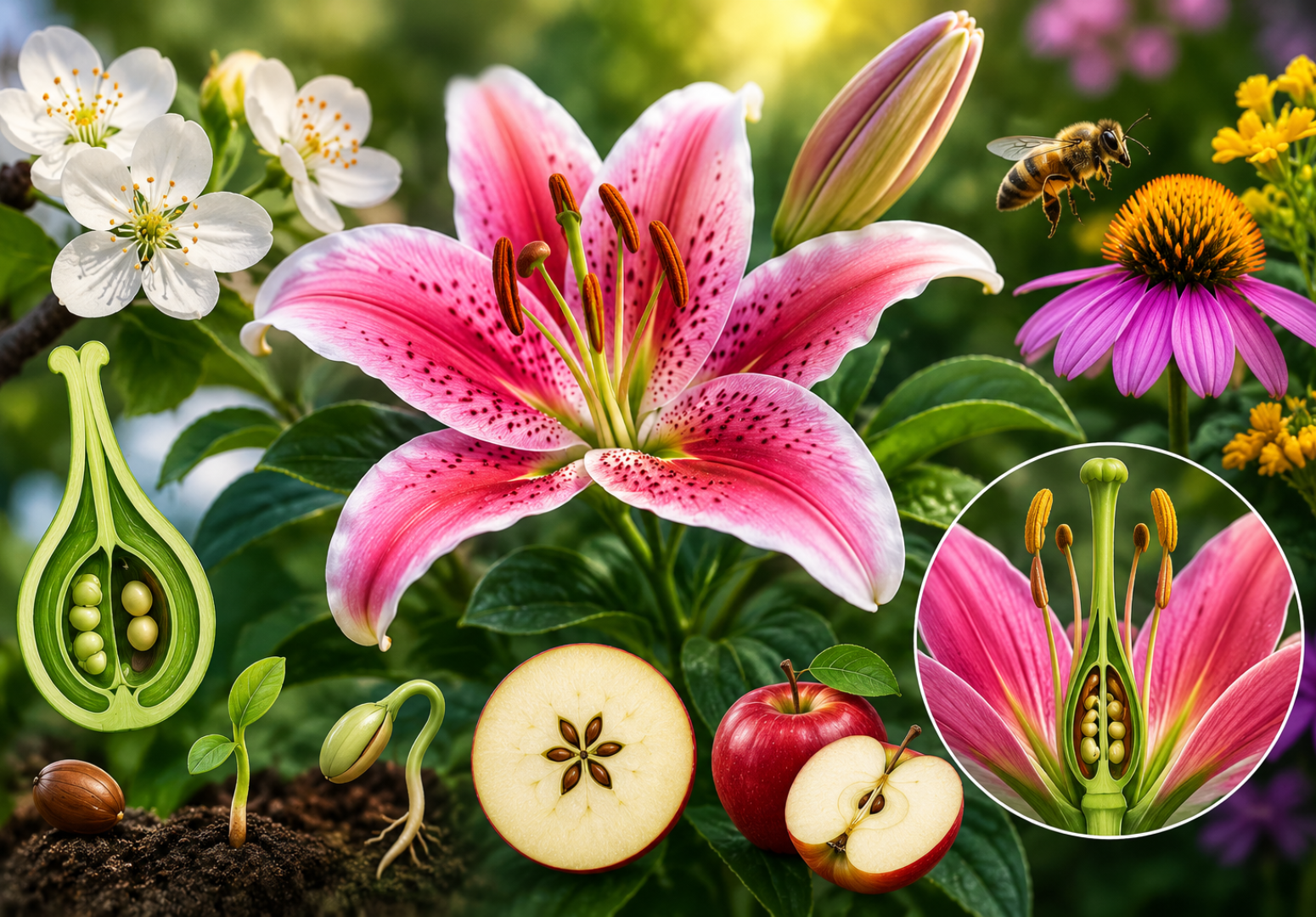
A flower is not just decoration. It’s the reproductive organ of a flowering plant angiosperm, and every part of it has a job. The outermost layer consists of sepals, the green leaf-like structures that protect the bud before it opens. Inside are the petals, which attract pollinators through color, shape, and scent. Within the petals sit the stamens (the male parts, producing pollen) and the carpel or pistil (the female part, containing the ovules).
The carpel deserves special attention. It has three components: the stigma at the top, which receives pollen; the style, a narrow stalk connecting to the ovary; and the ovary itself, which contains one or more ovules. After fertilization, the ovary wall develops into the fruit wall — the pericarp. Whether you’re eating a tomato, a peach, or a walnut, you’re eating the developed ovary of a flowering plant angiosperm. The elegance of that design is hard not to appreciate once you see it clearly.
Double Fertilization Unique Process
Double fertilization is the defining reproductive feature of every flowering plant angiosperm, and it’s genuinely unlike anything else in the plant kingdom. When a pollen grain lands on the stigma and germinates, it sends a pollen tube down through the style toward the ovary. The pollen tube carries two sperm nuclei, not one.
One sperm nucleus fuses with the egg cell to form the diploid zygote, which develops into the embryo. The second sperm nucleus fuses with two polar nuclei in the ovule to form a triploid cell (3n) that develops into the endosperm — the starchy, nutrient-rich tissue that surrounds the embryo in seeds like corn and wheat. This is why corn kernels are so nutritionally dense. The endosperm exists because of double fertilization. Gymnosperms don’t do this. Ferns don’t do this. Only the flowering plant angiosperm evolved this particular trick, and it’s been spectacularly successful.
Pollination Strategies and Adaptations
Pollination in angiosperms is where things get genuinely creative. Different species have evolved to attract wildly different pollinators — or to avoid pollinators entirely and self-pollinate or rely on wind instead. According to research published by the Smithsonian’s Department of Botany, over 80% of flowering plant angiosperm species depend on animal pollinators, with bees being the most important group globally.
Bee-pollinated flowers tend to be blue, violet, or yellow with ultraviolet patterns invisible to humans but highly visible to bees. Butterfly-pollinated flowers are often red or orange and tubular in shape. Moth-pollinated flowers bloom at night and tend to be white or pale with strong fragrance. Hummingbird-pollinated flowers are red, tubular, and odorless — birds have poor smell but excellent color vision. Each of these adaptations evolved because the flowering plant angiosperm species that attracted the right pollinators most effectively left more offspring. Natural selection is nothing if not thorough.
Fruit Types and Seed Dispersal
Once fertilization happens, the ovary develops into a fruit. The fruit’s job is simple but critical: get the seeds as far from the parent plant as possible to reduce competition. The diversity of fruit types across the flowering plant angiosperm lineage reflects the diversity of dispersal strategies that have evolved over millions of years.
Fleshy fruits like berries, drupes, and pomes are eaten by animals, which digest the fruit and deposit the seeds elsewhere in their droppings. Dry fruits like samaras (maple keys) use wings to catch wind and helicopter away. Burrs and hooks like those on burdock attach to fur or clothing. Explosive fruits like touch-me-nots (Impatiens) physically catapult their seeds outward. Coconuts use buoyancy to drift across oceans. The flowering plant angiosperm has essentially solved the seed dispersal problem 300,000 different ways, which goes a long way toward explaining how thoroughly they’ve colonized every terrestrial habitat on the planet.
Angiosperms and Human Agriculture
There would be no human civilization as we know it without the flowering plant angiosperm. Every major food crop humans depend on is an angiosperm: wheat, rice, maize, potatoes, soybeans, bananas, apples, tomatoes, coffee, sugar cane, cotton. The list is almost exhaustive. Even the plants that feed our livestock — hay, alfalfa, clover — are angiosperms.
Agriculture as a practice is really just humans learning to manipulate angiosperm reproduction to their advantage. Selective breeding over thousands of years has transformed wild plants beyond recognition. Modern maize bears almost no resemblance to its wild ancestor teosinte. Domestic wheat is a hybrid of three separate wild grass species, all angiosperms. The domestication of the flowering plant angiosperm is arguably the most consequential thing humans have ever done, and it happened independently in at least 11 different regions around the world starting about 12,000 years ago.
Adaptations to Diverse Environments
One of the most striking things about the flowering plant angiosperm as a group is its ecological flexibility. There are angiosperms adapted to survive in Death Valley’s summer heat, in the permafrost soils of Siberia, in saltwater mangrove swamps, and as aquatic plants floating on still ponds. No other plant group spans such a wide range of environments.
These adaptations often involve dramatic structural modifications. Cacti are flowering plant angiosperm species that have converted their leaves into spines to reduce water loss and developed thick, water-storing stems. Mangroves have evolved salt-excreting leaves and aerial roots that absorb oxygen from the air because the waterlogged soil is anaerobic. Carnivorous plants like sundews and pitcher plants have repurposed their leaves into insect traps to supplement nutrients in nitrogen-poor soils. Each of these is a flowering plant angiosperm that took a standard body plan and modified it radically to fit a challenging environment.
Role in Ecosystem Function
Flowering plant angiosperm species are ecological keystones in virtually every terrestrial biome. They form the base of food webs, provide habitat structure, regulate water cycles through transpiration, stabilize soil against erosion, and sequester enormous amounts of carbon. Tropical rainforests, which are dominated by angiosperms, account for roughly 50% of the world’s terrestrial biodiversity despite covering only about 6% of the land surface.
The relationship between angiosperms and animals runs deep and in both directions. Animals disperse seeds and pollinate flowers; plants provide food, shelter, and nesting material. Remove the flowering plant angiosperm community from any ecosystem and the entire structure collapses. The extinctions of angiosperm species ripple outward into losses of insects, birds, mammals, and fungi that depended on them. This is why plant conservation is increasingly recognized as foundational to broader biodiversity protection efforts.
Medicinal Plants and Angiosperm Chemistry
A remarkable proportion of human medicine traces back to the flowering plant angiosperm. Aspirin was derived from salicylic acid first found in willow bark. Morphine and codeine come from the opium poppy. Quinine, the first effective antimalarial drug, comes from the bark of Cinchona trees. Taxol, one of the most important chemotherapy drugs ever developed, was discovered in the Pacific yew tree.
This chemical richness isn’t accidental. Plants can’t run from herbivores or pathogens, so they’ve evolved extraordinarily complex secondary metabolite chemistry as defense. The same alkaloids, terpenes, and flavonoids that protect a flowering plant angiosperm from insects and fungi often have powerful effects on human biology. Of the roughly 25,000 plant-derived compounds that have been studied, only a fraction have been fully characterized pharmacologically. The angiosperm pharmacopeia is still largely unexplored, and new compounds with therapeutic potential are regularly being identified.
Threats Facing Angiosperm Species
Despite their success, flowering plant angiosperm species are under serious pressure. Habitat destruction, particularly deforestation and agricultural expansion, threatens an estimated 40% of plant species with extinction. Climate change is shifting flowering times, disrupting pollinator relationships that evolved over millions of years, and pushing species ranges poleward faster than many plants can migrate.
Invasive species add another layer of pressure. When a non-native flowering plant angiosperm enters a new ecosystem without its natural herbivores or pathogens, it can outcompete native species and reshape plant communities dramatically. Kudzu in the American Southeast, water hyacinth in African lakes, and lantana in Australian bushland are all examples of angiosperm species that have become serious ecological problems outside their native ranges. Conservation efforts increasingly focus on seed banking, habitat corridors, and assisted migration to give native angiosperms a fighting chance against these compounding pressures.
Angiosperm Diversity by Numbers
The scale of flowering plant angiosperm diversity is worth sitting with for a moment. There are approximately 416 plant families recognized in the angiosperm classification system, containing around 13,000 genera and upward of 300,000 species. The orchid family alone (Orchidaceae) contains roughly 28,000 species — more than all bird species combined. The daisy family (Asteraceae) contains around 24,000 species.
Some individual genera are extraordinarily species-rich. Astragalus (milk vetches) has over 3,000 species. Carex (sedges) has about 2,000. These numbers reflect millions of years of evolution in diverse environments with diverse pollinators driving divergence. Each flowering plant angiosperm species represents a unique solution to the problem of surviving and reproducing in a particular set of conditions. The numbers aren’t just impressive — they reflect the depth of evolutionary experimentation that the angiosperm body plan has enabled.
Comparing Angiosperms and Gymnosperms
It’s worth understanding what sets the flowering plant angiosperm apart from its closest relatives — the gymnosperms. Both groups produce seeds, but gymnosperms (which include conifers, cycads, and ginkgo) lack enclosed seeds and true flowers. Their seeds sit exposed on cone scales, and their “pollen transfer” is a much simpler and less targeted affair than the animal-mediated pollination common in angiosperms.
Gymnosperms dominated terrestrial vegetation for over 200 million years before angiosperms overtook them. Today, there are only about 1,000 gymnosperm species compared to 300,000 angiosperm species — a ratio that tells you something about the competitive advantage flowering plants evolved. The enclosed seed, the fruit, the flower, the double fertilization, and the diverse pollination strategies all combined to create a reproductive system more efficient and flexible than anything that existed before. The flowering plant angiosperm didn’t replace gymnosperms by chance; it outcompeted them on almost every front.
Angiosperm Conservation Efforts
Plant conservation efforts have accelerated significantly over the past two decades, driven partly by growing awareness of how many flowering plant angiosperm species face extinction. The Millennium Seed Bank at Kew Gardens in England now holds seed samples from over 2.4 billion seeds representing more than 40,000 species — the largest wild plant seed bank on Earth. The goal is to bank seeds from 25% of all plant species by 2030.
Botanical gardens worldwide maintain living collections of threatened angiosperm species that can no longer survive in the wild. Habitat restoration projects are reintroducing native flowering plant angiosperm communities to degraded landscapes, with encouraging results in many regions. Indigenous plant knowledge is increasingly incorporated into conservation planning, recognizing that local communities often hold detailed knowledge of plant uses and distributions accumulated over generations. None of this is sufficient on its own, but taken together, these efforts represent a serious global response to a serious threat.
FAQ
What exactly is a flowering plant angiosperm?
A flowering plant angiosperm is any plant that produces flowers for reproduction and bears seeds enclosed within a fruit. Angiosperms make up about 90% of all plant species on Earth, including nearly all food crops, most ornamental plants, and the majority of trees in deciduous forests. The defining features are flowers, double fertilization, and enclosed seeds.
How is a flowering plant angiosperm different from a gymnosperm?
The main difference lies in seed enclosure. A flowering plant angiosperm produces seeds enclosed within a fruit, while gymnosperms produce naked seeds on cone scales without a surrounding fruit. Angiosperms also reproduce through flowers and use double fertilization, neither of which applies to gymnosperms. There are roughly 300,000 angiosperm species compared to about 1,000 gymnosperm species alive today.
Why are angiosperms so ecologically important?
Angiosperms form the foundation of nearly every terrestrial ecosystem. They produce the oxygen, food, and habitat that most land-based animal life depends on. Their partnerships with pollinators and seed dispersers have shaped animal evolution for over 100 million years. The loss of angiosperm diversity directly threatens the stability of ecosystems and the services they provide to human societies.
What are examples of common flowering plant angiosperm species?
Wheat, rice, corn, roses, oak trees, sunflowers, orchids, grasses, tomatoes, mangoes, and water lilies are all flowering plant angiosperm species. If you eat it, wear it (cotton), drink it (coffee, tea), or use it as timber from a non-conifer tree, it almost certainly came from an angiosperm. The group’s reach into daily human life is nearly total.
Conclusion
The flowering plant angiosperm is, without exaggeration, the most consequential group of organisms in the history of terrestrial life. It transformed ecosystems, enabled the evolution of countless animal groups, and gave human civilization its agricultural foundation. From the double fertilization process that produces nutrient-rich endosperm to the extraordinary diversity of fruit types that scatter seeds across continents, every feature of the flowering plant angiosperm reflects millions of years of evolutionary refinement.
What’s easy to miss, standing in a garden or walking through a park, is just how much biological complexity underlies every flower in front of you. That rose or sunflower is the product of co-evolution with its pollinators, ecological competition with thousands of other plant species, and genetic innovation stretching back 130 million years. The flowering plant angiosperm isn’t just a pretty face in the landscape — it’s the architecture the landscape is built on. That’s worth knowing, and honestly, it’s worth stopping to appreciate next time you walk past a garden bed or reach for a piece of fruit.