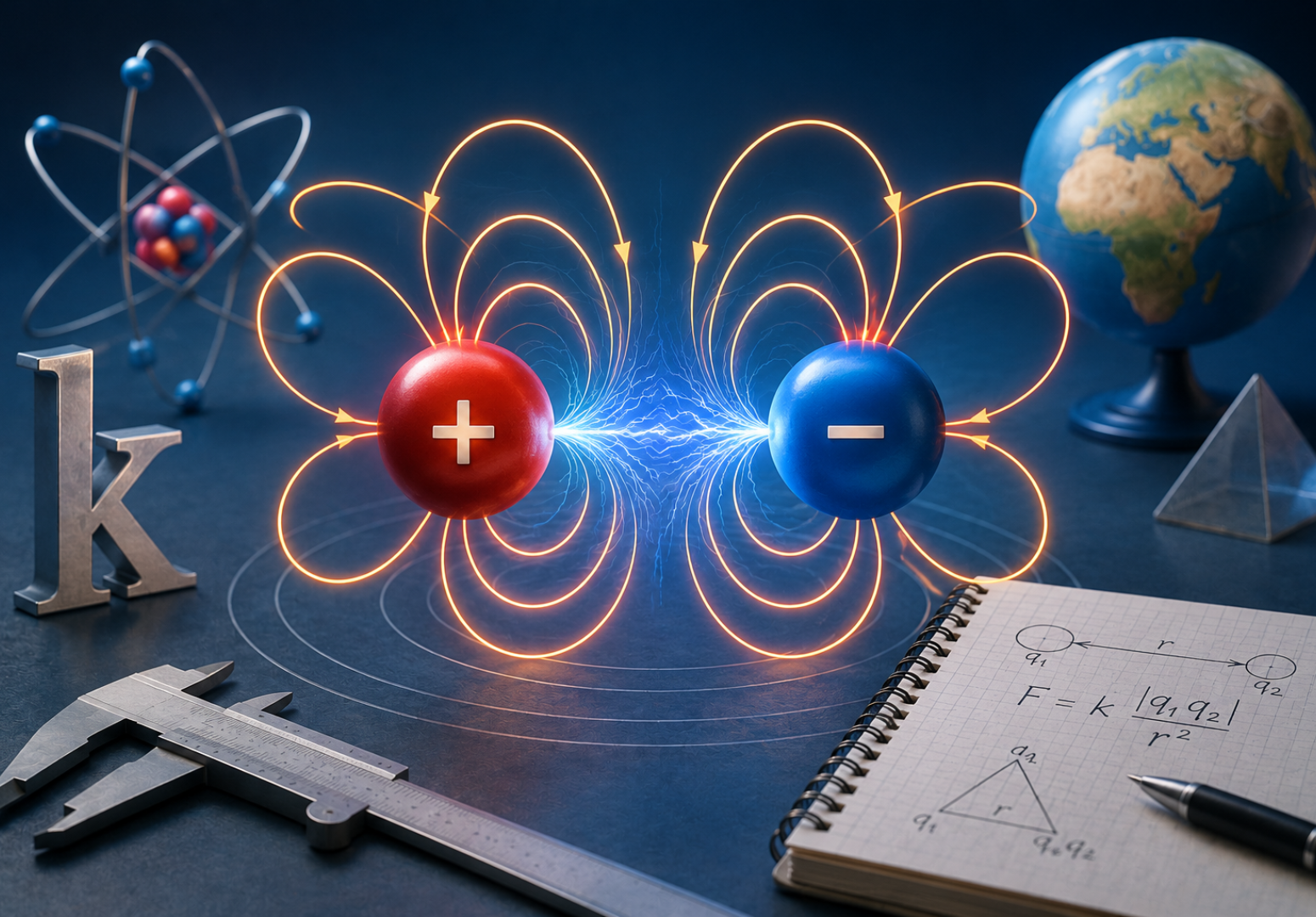
What Is the Coulomb Constant
Electrostatics is one of those physics topics that starts feeling real the moment you understand the numbers behind it. At the center of almost every electrostatic calculation sits one particular value — the coulomb constant. It appears in Coulomb’s law, which describes the force between two charged particles, and its numerical value determines just how strong that force actually is.
The coulomb constant is approximately 8.99 times 10 to the power of 9 Newton meters squared per Coulomb squared. That is usually written as 8.99 × 10⁹ N·m²/C². The number looks large, and it is — it tells you that even small electric charges can produce enormous forces over short distances. If you have ever felt a static shock or watched a bolt of lightning, you have experienced the coulomb constant at work in a very direct way.
Where This Constant Comes From
Physics constants rarely appear out of nowhere, and the coulomb constant is no exception. Its origin connects to both experimental measurement and the structure of the SI unit system. The constant is formally defined as 1 divided by 4 times pi times epsilon-naught, where epsilon-naught is the permittivity of free space — a measure of how much resistance the vacuum offers to the formation of an electric field.
If you enjoy reading about mathematics in science education, you will notice that constants like this one sit at the intersection of measurement and mathematical structure. Epsilon-naught has the value 8.854 × 10⁻¹² Farads per meter, and when you compute 1 divided by 4π times that value, you get 8.99 × 10⁹ N·m²/C² — the coulomb constant. The connection to permittivity means the coulomb constant is not just a historical artifact. It reflects something real about how electric fields propagate through empty space.
The relationship between the coulomb constant and permittivity also means the constant changes in different materials. In a vacuum or air, you use the standard value. In water, glass, or other dielectric materials, the effective constant decreases because permittivity increases. This is why electric forces between charges are weaker inside materials than in a vacuum, and it is a practical consideration in capacitor design and materials science.
Coulomb’s Law and the Constant
Coulomb’s law is the equation that gives the coulomb constant its primary role in physics. The law states that the electrostatic force between two point charges equals the coulomb constant times the product of the two charges, divided by the square of the distance between them. In symbols, F equals k times q1 times q2 divided by r squared.
Every variable in that equation matters. The force F is measured in Newtons. The charges q1 and q2 are measured in Coulombs. The distance r is in meters. And the coulomb constant k ties everything together with the right numerical weight to produce physically accurate results. Without the constant, the equation would give forces in the wrong units and the wrong magnitudes entirely.
What makes Coulomb’s law particularly powerful is the inverse square relationship. Doubling the distance between two charges reduces the force to one quarter of its original value. Tripling the distance reduces it to one ninth. The force drops off rapidly with distance, which explains why electrostatic effects are most noticeable at close range and become negligible at everyday macroscopic distances unless the charges involved are very large.
The Numerical Value Unpacked
The specific numerical value of the coulomb constant — 8.988 × 10⁹ N·m²/C² — is worth sitting with for a moment because it carries real physical meaning. Consider two charges of one Coulomb each, separated by one meter. The force between them would be approximately 9 billion Newtons. That is an almost incomprehensibly large force.
One Coulomb is actually an enormous amount of charge in practice. The charge of a single proton is about 1.6 × 10⁻¹⁹ Coulombs, which means one Coulomb represents roughly 6.24 × 10¹⁸ protons worth of charge. Static electricity experiments typically involve charges of microcoulombs or nanocoulombs — millionths or billionths of a Coulomb — and even at those tiny scales the coulomb constant ensures the resulting forces are detectable.
This is what makes electrostatic forces so significant at the atomic scale. Electrons and protons are separated by distances on the order of 10⁻¹⁰ meters, and their charges are small. But plug those numbers into Coulomb’s law with the coulomb constant in place and the resulting force is on the order of 10⁻⁸ Newtons. That sounds small until you compare it to gravity at the same scale, which is roughly 10⁻⁴⁷ Newtons. Electric force between subatomic particles is about 10³⁹ times stronger than gravitational force. The coulomb constant is part of what makes that staggering ratio possible.
Units and Dimensional Analysis
Getting the units right when working with the coulomb constant is non-negotiable in physics problem-solving. The units N·m²/C² are not arbitrary — they are precisely what is needed to make the product of the constant and the charges and the inverse distance squared come out in Newtons.
Walk through the dimensional analysis once and it becomes clear. The coulomb constant contributes N·m²/C². Multiplying by two charges in Coulombs contributes C², and dividing by distance squared in meters squared contributes 1/m². The C² terms cancel, the m² terms cancel, and you are left with Newtons. Everything balances, as it must in any physically consistent equation.
Students who skip dimensional analysis in electrostatics problems often end up with answers that are numerically plausible but dimensionally wrong, which is a silent error that can persist through multiple problem steps before revealing itself. Making it a habit to track units through every calculation that involves the coulomb constant prevents that category of mistake entirely and builds the kind of unit fluency that carries across all of physics.
Coulomb Constant in Electric Fields
The coulomb constant does not only appear in force calculations between pairs of charges. It also shows up in the formula for the electric field produced by a point charge. The electric field E at a distance r from a point charge q is given by k times q divided by r squared, where k is the coulomb constant. The field points radially outward from a positive charge and inward toward a negative charge.
According to NIST physical constants reference data, the precise value of the coulomb constant is 8.9875517923 × 10⁹ N·m²/C², with extremely high measurement certainty. This level of precision matters in advanced physics and engineering applications where small errors compound across large calculations. For most classroom and exam purposes, 9 × 10⁹ N·m²/C² is an acceptable approximation that keeps arithmetic manageable without sacrificing meaningful accuracy.
The electric field formula shows the same inverse square dependence as the force formula, which makes sense because the field represents the force per unit charge that a test charge would experience at that location. The coulomb constant gives the field its numerical scale, ensuring that the calculated field strengths correspond to what is actually measured in experiments. That agreement between theory and measurement is the real test of any physical constant’s validity.
Superposition and Multiple Charges
Real electrostatics problems rarely involve just two charges. When multiple charges are present, the principle of superposition applies: the total force on any one charge is the vector sum of the individual forces from every other charge. The coulomb constant appears in every one of those individual force terms.
This is where vector handling becomes important. Each pairwise force has a direction determined by the line connecting the two charges and whether the charges attract or repel. Summing those directional forces requires breaking each one into components, adding the components separately, and reconstructing the total force vector. The coulomb constant scales each component correctly, but the geometry of the situation determines the directions.
Three-charge and four-charge problems are standard in introductory physics courses precisely because they test both the application of Coulomb’s law with the coulomb constant and the vector arithmetic needed to combine results correctly. Students who are comfortable with both skills individually sometimes still struggle when they have to apply them simultaneously. Working through several complete examples — setting up the geometry, computing each pairwise force with the constant, resolving components, and summing — builds the fluency that multi-charge problems require.
Comparing Electric and Gravitational Forces
The coulomb constant enables one of the most striking comparisons in all of physics: the ratio of electric force to gravitational force between elementary particles. For two protons, the gravitational force is given by G times the proton mass squared divided by r squared, while the electric force is given by the coulomb constant times the proton charge squared divided by r squared. The distance r cancels when you take the ratio, leaving a pure number.
That ratio works out to approximately 1.24 × 10³⁶ — the electric force between two protons is more than a trillion trillion times stronger than the gravitational force between them. The coulomb constant is the reason the numerator in that ratio is so large. The value 8.99 × 10⁹ paired with the proton charge squared produces a force that dwarfs gravity by an almost unimaginable margin.
What makes this comparison philosophically interesting is that gravity dominates at cosmological scales despite being so much weaker at the particle level. The reason is that gravity has no negative counterpart — mass is always positive, so gravitational forces always attract and accumulate. Electric charges come in positive and negative varieties that cancel at large scales, leaving bulk matter electrically neutral. The coulomb constant governs a force that is far stronger than gravity but self-canceling in most macroscopic matter.
Applications in Circuit Analysis
The coulomb constant connects to circuit analysis in ways that are not always obvious in an introductory course. Capacitance — the ability of a system to store electric charge — is directly related to the geometry of a capacitor and the permittivity of the material between its plates. Since the coulomb constant equals 1 over 4π times permittivity, understanding the constant gives insight into why capacitance values depend on plate area, separation, and the dielectric material used.
A parallel plate capacitor with vacuum between its plates has capacitance equal to epsilon-naught times the plate area divided by the plate separation. That epsilon-naught is the same permittivity that defines the coulomb constant, so the two quantities are mathematically linked. Engineers designing capacitors for specific applications — filtering, timing circuits, energy storage — are working with the consequences of the coulomb constant whether they frame it that way or not.
Energy storage in a capacitor also involves the coulomb constant implicitly. The energy stored equals one half times the capacitance times the voltage squared, and the capacitance depends on permittivity. At the microscopic level, that stored energy is the potential energy of the charge distribution, calculated using Coulomb’s law and the coulomb constant. The macroscopic formula is a convenient summary of a microscopic reality governed by electrostatic principles.
Coulomb Constant in Atomic Structure
The stability and structure of atoms are fundamentally determined by the coulomb constant. The electron in a hydrogen atom is held in orbit by the attractive electric force between it and the proton nucleus. The Bohr model of the hydrogen atom — one of the first quantum mechanical models — uses Coulomb’s law with the coulomb constant to derive the allowed orbital radii and energy levels of the electron.
In the Bohr model, the electric force provides the centripetal force that keeps the electron in circular orbit. Setting k times e squared over r squared equal to the mass of the electron times v squared over r, where e is the electron charge and v is the orbital speed, gives a relationship between orbital radius and speed. Combining this with the quantum condition on angular momentum produces the discrete energy levels that explain the hydrogen emission spectrum.
The coulomb constant therefore sits at the foundation of atomic spectroscopy. The wavelengths of light emitted by hydrogen — the lines that appear in the visible spectrum as the Balmer series — are determined by energy level differences that depend directly on the coulomb constant, the electron charge, and the electron mass. When spectroscopists measure those wavelengths precisely, they are indirectly measuring the consequences of the coulomb constant with high accuracy.
Historical Context and Coulomb’s Experiment
Charles-Augustin de Coulomb established the law that bears his name in 1785 using a torsion balance — a delicate instrument that measured tiny forces by the degree of twist in a wire. His experiments showed that the force between charged spheres depended on the inverse square of their separation and on the product of their charges, precisely the form that appears in Coulomb’s law today.
What Coulomb could not do in 1785 was assign a precise numerical value to the constant in his law, because the Coulomb as a unit of charge did not yet exist. He could establish the form of the relationship — force proportional to charge product and inverse distance squared — but the numerical constant waited until the development of consistent electromagnetic units in the 19th century. The coulomb constant as a precisely defined numerical value is therefore a later refinement of an experimentally discovered relationship.
This historical arc is a good reminder that physical constants are not handed down from pure mathematics — they are measured, refined, and eventually defined with increasing precision as measurement technology improves. The modern value of the coulomb constant reflects centuries of experimental physics and the careful definition of SI units, all building on the foundational insight Coulomb established with a twisted wire in 18th century France.
Common Mistakes in Problem Solving
Students working with the coulomb constant make several recurring mistakes that are worth naming directly. The most common is forgetting to square the distance in the denominator of Coulomb’s law. The force depends on r squared, not r, and missing that square produces answers that are off by a factor of r — which for distances in the range of centimeters means errors of one to two orders of magnitude.
Sign handling is the second major source of errors. The coulomb constant itself is always positive, but the charges in the formula can be positive or negative. The sign of the product q1 times q2 determines whether the force is attractive or repulsive — positive product means repulsion, negative product means attraction. Students who drop signs or treat force magnitude and direction as separate afterthoughts end up with forces pointing the wrong way in vector problems.
Unit conversion errors round out the top three. Distances must be in meters, charges must be in Coulombs, and the resulting force will be in Newtons. Problems that give distances in centimeters or charges in microcoulombs require conversion before plugging into the formula with the coulomb constant. Missing a factor of 10⁻² or 10⁻⁶ produces answers that are off by several orders of magnitude, which is usually detectable but costs time and marks when it happens during an exam.
Practice Problems That Build Confidence
Building genuine fluency with the coulomb constant comes from working through a range of problem types, not just the basic two-charge force calculation. Start with straightforward problems — two charges at a known separation, find the force — to solidify the formula and the unit handling. Then move to electric field problems, where you find the field at a point rather than the force on a specific charge.
Progress to superposition problems with three or more charges arranged in geometric configurations — equilateral triangles, squares, straight lines. These require setting up a coordinate system, computing each pairwise force with the coulomb constant, resolving into components, and summing vectors. They are more involved but they build exactly the multi-step reasoning that physics exams test.
Finally, work through problems that connect the coulomb constant to energy — finding the electric potential energy of charge configurations, or the work required to assemble a set of charges from infinite separation. These problems use a slightly different formula — potential energy equals k times q1 times q2 divided by r, without the square on r — and distinguishing that from the force formula is an important detail that careful practice makes automatic.
FAQ Section
What is the exact value of the coulomb constant and what are its units?
The coulomb constant is 8.9875517923 × 10⁹ N·m²/C². For most physics problems, 8.99 × 10⁹ or simply 9 × 10⁹ N·m²/C² is used. The units are Newton meters squared per Coulomb squared, which are exactly what is needed to make Coulomb’s law produce a force in Newtons when charges are in Coulombs and distances are in meters.
How is the coulomb constant related to the permittivity of free space?
The coulomb constant k equals 1 divided by 4π times epsilon-naught, where epsilon-naught is the permittivity of free space with value 8.854 × 10⁻¹² F/m. This relationship means the coulomb constant reflects how strongly the vacuum permits the formation of electric fields. In materials with higher permittivity than the vacuum, the effective constant is smaller, which is why electric forces are weaker inside dielectric materials.
Does the coulomb constant change in different materials?
The fundamental coulomb constant is defined for a vacuum and does not change. What changes in different materials is the effective constant, sometimes written as k divided by the relative permittivity of the material. Water, for example, has a relative permittivity of about 80, so the effective electrostatic constant inside water is roughly 80 times smaller than in a vacuum. This reduced effective constant is why water is effective at dissolving ionic compounds — it weakens the electrostatic attraction between ions significantly.
Why is the coulomb constant so much larger than the gravitational constant?
The gravitational constant G is approximately 6.67 × 10⁻¹¹ N·m²/kg², while the coulomb constant is approximately 8.99 × 10⁹ N·m²/C². The difference in magnitude reflects the fundamental difference in strength between the electromagnetic and gravitational forces. At the particle scale, electric forces are roughly 10³⁶ to 10⁴² times stronger than gravitational forces depending on which particles you compare. The large numerical value of the coulomb constant is a direct expression of that enormous strength difference.
Conclusion
The coulomb constant is far more than a number to plug into a formula. It is a window into the fundamental strength of the electromagnetic force, the structure of atoms, the design of electronic components, and the history of experimental physics. Every time you calculate the force between two charges using Coulomb’s law, the constant is doing the work of connecting abstract mathematical relationships to physically real, measurable forces.
Getting comfortable with the coulomb constant means knowing its value, its units, its origin in permittivity, and its role in electric field and potential energy formulas alongside the basic force calculation. It means checking units every time, handling signs carefully, and remembering that the inverse square law makes distance the most sensitive variable in any electrostatic problem.
The coulomb constant appears in introductory physics and stays relevant through electromagnetism, quantum mechanics, atomic physics, and materials science. Students who treat it as a foundational concept rather than a memorized number find that it keeps paying off as their physics education deepens. It is one of those values that rewards careful attention early and continues giving back for a long time afterward.